Oz takes “confusion over clarity” to a new level – TIME

The Oz Diet. No more myths. No more fads. What you should eat — and why.

Leading off with a title like that, you’d expect to see some much-needed CLARITY on this crucial topic — but Dr. Oz’s cover article could not  have been more confusing. It was almost like the people at Time told him to write something good about all the bad foods, make the article as confusing as possible and do your part to support the magazine’s many toxic drug products advertised in the September 12 “Special Nutrition Issue.”

"Uncovering the myths about food" by Dr. Oz caught my eye immediatey

My score for the article: Confusion beats Clarity 35-0 on the first Saturday of the college football season. How so? 35 is the number of paragraphs adding to the “confusion” about this crucial topic — vs. none for adding to the “clarity.”

When my personal copy of TIME appeared in my mail slot yesterday, I was delighted to see all the food on the cover and knew that, one way or another, there would be some great fodder for blogging. And the cover story by Dr. Oz caught my eye immediately.

Before opening the magazine, I was foolishly thinking that Dr. Oz may have decided to jump on the Gupta-Clinton bandwagon and start getting real clear about what we should be doing to promote our health and prevent disease. Wrong.

After the CNN airing of the fabulous “Last Heart Attack” documentary for the past two weekends, I was thinking that Dr. Oz may have finally decided to get back in the ball game with distinguished men of integrity like Dr. Dean Ornish and Dr. Caldwell Esselstyn, the two MD’s that President Clinton turned to when his life was on the line — and the stars of the CNN special.
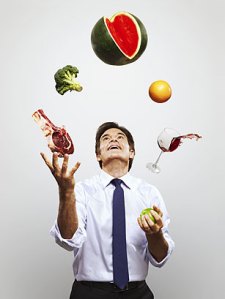
Dr. Oz juggles his food, which of course includes the all-important "protein" that is so important to him.

While Oz may actually think that he is helping promote health with his TV show and his various articles in TIME (his second cover story this summer); in my opinion he is more a part of the problem than a part of the solution. After watching my defending national champion Auburn Tigers snatch a miraculous victory from the jaws of defeat over Utah State, I read Oz’s entire article carefully.

Reading all thirty five paragraphs, I kept thinking that surely at least one would provide some clarity. Of course, if there had been just one, then it would’ve just added to the confusion, since the readers still wouldn’t know the difference and would just choose to follow the advice of whichever of those other 34 paragraphs best suited their collective bad eating habits.

So where did the phrase “confusion over clarity” originate? It was provided by Dr. T. Colin Campbell in a powerful paragraph in his book, The China Study. Here’s what we had to say about that paragraph in Chapter 8 of our book: This is a story of confusion that develops when an enormously complicated and interconnected group of organizations in a free market environment has zero financial incentive to promote the highest possible level of health. Here is Dr. Campbell’s powerful summary from his book:

Want clarity? Read this book. Published in January of 2005, it has consistently ranked in the top 100 books on Amazon -- proving that the world wants CLARITY over Confusion.

The entire system—government, science, medicine, industry and media—promotes profits over health, technology over food and confusion over clarity. Most, but not all, of the confusion about nutrition is created in legal, fully disclosed ways and is disseminated by unsuspecting, well-intentioned people, whether they are researchers, politicians or journalists. The most damaging aspect of the system is not sensational, nor is it likely to create much of a stir upon its discovery. It is a silent enemy that few people see and understand.

Back to the Oz article. TIME managing editor Richard Stengel leads off the “Special Nutrition Issue” with a few paragraphs entitled “Separating Fact from Fiction.” Praising Dr. Oz and his nutritional wisdom as if he were some kind of savior, he states that since he appeared on the Oz Show with him a few years ago that…

“Ever since then, I’ve been interested in not only how Oz eats (he’s always got a pocketful of almonds, and you can see his daily diet on page 55) but also in how he regards what the rest of us consume. For him, food is both fuel and medicine, and in his enlightening cover story, he separates fact from fiction when it comes to diet.”

Richard Stengel, Managing Editor of TIME

He mentions “what Oz eats,” a diet-style that is illustrated on page 55. Interestingly, there is a graphic on that page entitled “The Doctor Will Feed You Now. Oz’s Daily Menu.” Pictured are a total of fifteen foods, all of which appear to be whole plants — with the exception of salmon and yogurt.”

While the entire article is total confusion, it looks like Oz himself may be eating a very healthy diet — probably 3-Leaf or better in our 4-Leaf Program scoring system (over 60% of his calories from whole plants.) So why doesn’t he get REAL CLEAR in the article about exactly what he eats and why? Think how many lives would be saved if he told the world why over 60% of his own calories are derived from whole, plant-based foods. Instead he focuses on confusion in his article and comes up way short on clarity.

Sadly, that kind of clarity would not be good for the commercial success of the magazine or his own Oz Show. That’s because it wouldn’t help sell the products of its sponsors, like LOVAZA — with a two-page ad for another toxic drug from GlaxoSmithKline — appearing right in the middle of the Oz article on pages 53-54. In fact, the entire magazine is filled with drug ads, all of which devote about 75% of the printed space to the endless list of warnings and hazards of actually taking the drug.

Want to see one of his confusing paragraphs? Here it is; for your reading pleasure, appearing on page 50 of the article, under the heading Up Is Down,  where the good doctor explains “what you should eat and why:”

Want to get healthy? then forget about diet soda and low-fat foods. Instead, tuck into some eggs, whole milk, salt, fat, nuts, wine, chocolate and coffee. It’s true. Despite conventional wisdom, all of those foods and many more can be beneficial to your body. But overindulge in them, and they can be as problematic as you’ve always been led to believe.
J. Morris Hicks, working daily to promote health, hope and harmony on planet Earth.

In my opinion, his entire confusing cover story is not likely to help anyone become healthier. And, in the game of promoting health with food, one is either part of the problem or part of the solution; and sadly, Dr. Oz is with the former.

Meanwhile, Dr. Campbell and Dr. Esselstyn are both a powerful part of the solution, consistently delivering the ultimate clarity in four words — EAT MORE WHOLE PLANTS.

Those four simple words could transform the health of the entire Western world and shave two trillion dollars off the cost of health care in just the United States. But they won’t sell very many products and that’s why the “system” described above by Dr. Campbell, will never bring you the clarity that you deserve. Although Dr. Sanjay Gupta just might be emerging as the first exception to that rule. On that note, you will enjoy tomorrow’s blog:

Gupta over Oz — Proving that we want CLARITY over confusion
Leveraging the simple, yet powerful concept of maximizing the percent of your calories from whole plant foods -- still in nature's package

In closing, you may enjoy reading a few of my earlier posts related to the “confusion over clarity” topic:

The post that follows this one: Gupta over Oz — Proving that we want CLARITY over confusion

Lack of clarity from the likes of Dr. Andrew Weil…

Oz shares colon story; “cancer screening $$ business” gets bigger

Dr. Oz Show — focusing on plant-based, whole foods (4-29-11)

Dr. Oz – back to the same old fad diets… (one week later)

Want more clarity, click on our 4-Leaf image here. For the other 34 paragraphs of the Oz article in the current issue of Time, I have provided a link below my name for your convenience. Unfortunately, you will need to subscribe to the online TIME in order to view the entire article.

********************

If you like what you see here, you may wish to join our periodic mailing list. Also, for help in your own quest to take charge of your health, you might find some useful information at our 4-Leaf page. From the seaside village of Stonington, Connecticut – Be well and have a great day.

If you’d like to order our book on Amazon,  visit our BookStore now.

—J. Morris Hicks…blogging daily at HealthyEatingHealthyWorld.com

The Oz Diet – TIME.

PS: Occasionally an unauthorized ad may appear beneath a blog post. It is controlled by WordPress (a totally free hosting service). I do not approve or personally benefit whatsoever from any ad that might ever appear on this site. I apologize and urge you to please disregard. 

Posted in Celebrities, Medical Experts | Tagged , , , , , | 1 Comment

Keeping it simple with 4-Leaf…

The tale of the banana and the BK Whopper-No Cheese

A medium raw banana contains 105 calories and ALL of them are whole plant calories.

A reader told me recently that making the transition is difficult enough as it is. Adding in confusing calculations makes it almost impossible. With our 4-Leaf Program, we are striving to make things as simple as possible, trying to help you establish a routine for getting over 80% of your daily calories from whole plant-based foods.

So exactly how do you go about measuring that? In Chapter 10 of the book, we showed two simple examples for computing the percent of calories from whole plants: a banana and a BK Whopper, No Cheese. The banana was easy. Click on the image above and you will see all of the data (on nutritiondata.com) on this handy and healthy fruit. You will find that it has 105 calories (3 from fat), protein, fiber, calcium, and a few other nutrients — all natural and still in nature’s package.

It also has some “sugars” but we don’t worry about those “sugars” when Nature put them there. When humans put the sugar in the product, it’s called “added sugar;” and it’s never a good thing. So our banana is 100% whole plant, and it is definitely in the 4-Leaf range. The Whopper is a little more complicated.

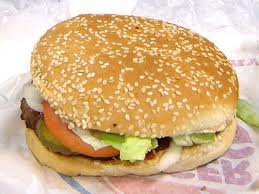
I chose the Whopper because I wanted to analyze a food that many people around the world think is pretty healthy. Without cheese and with five different plants — tomato, lettuce, onion, seeds and pickle; the average person might think this is a pretty good choice. Not. I did my analysis on nutritiondata.com and just copied the following from Chapter 10 of the book:

Click on Image for the NutritionData.com data on the BK Whopper (No Cheese)

Burger King Whopper, No Cheese

  • Total calories = 678; Calories from fat = 336
  • Percentage of calories from fat = 336 ÷ 678 = 50%
  • Calories from whole plants (tomato, lettuce, onion, seeds, pickles) = 14
  • Percentage of calories from whole plants = 14 ÷ 678 = 2%
  • These data put it at the No-leaf level in our system (0 to 19% whole plant calories).
  • It gets worse: The Whopper also contains 12 grams of saturated fat, 87 milligrams of cholesterol, 911 milligrams of sodium, and 12 grams of added sugars. 

Click on the Whopper image above to view all of the data for this product on nutritiondata.com. The calories from the whole plants were calculated one at a time on this same helpful site. A tedious process to be sure, but you only have to do it once. Pretty soon, you’ll be able to identify a 4-Leaf meal without doing any calculations.

You’ll also be able to identify the No-Leaf products and restaurant meals very easily. That’s because an estimated 90% or more of ALL commercial products/meals for sale in the Western world today are in the No-Leaf range. You don’t need nutritiondata.com or a calculator to tell you that a sausage biscuit is No-Leaf.

Leveraging the simple, yet powerful concept of maximizing the percent of your calories from whole plant foods -- still in nature's package

Establishing your 4-Leaf routine. The real key is developing a daily routine that features several meals that are high in the 4-Leaf zone. I did the same analysis as above for my Sailors Daily Oatmeal and came up with 90% whole plants. Definitely 4-Leaf. Only the soy or almond milk was not a whole plant.

We’re also creatures of habit when we go out to dinner. I sat next to a friend at a local pub earlier this week and he ordered the very same entree that he has ordered every single time in that restaurant for over 8 years — Duck and Scallops. You don’t need to calculate anything to know that it was in the NO Leaf range — below 20% of calories from whole plants — probably less than 5% (from the garnish).

So when you visit nutritiondata.com; use the Recipe function to add up the calories of all the whole plants in the meal. Divide that by the total calories of the meal. Most people are surprised to find how very little whole plant calories there are in a Pasta Primavera at a place like Olive Garden. So just cruise around on nutritiondata.com and sign up as a member for free. Then you can create your own list of foods that you use regularly. Soon, you will get into a routine of eating 4-Leaf meals and you will never need to count calories again — just eat all you want.

Rule of Thumb. In the interest of making this process even simpler, we recommend this handy rule of thumb. Most of use need to consume between 2000 and 2500 calories, and if you’re eating mostly 4-Leaf, it will actually be almost impossible to eat more than that — unless you load up on calorie-dense plant foods like avocado, olives and nuts. Nothing wrong with these healthy foods; but they are about 80% fat — and we’re also trying to keep our fat calories below 20% of our total calories.

So for 2000 calories a day, each meal (3 meals plus a few snacks) is going to average about 500 calories (give or take). And you want 80% of those calories to be from whole plants. So, for each meal, you’re looking for approximately 400 calories from whole plants. Simply said:

4-Leaf = 400 calories per meal from whole plant foods.

J. Morris Hicks, working daily to promote health, hope and harmony on planet Earth.

Bottom Line. If you’re getting 400 calories of whole plants from each meal, you don’t really need to worry that much about the other 20% — as you will be in the top one percent of the healthiest eaters in the Western world. So after about one month of making sure that your routine meals are in the 4-Leaf zone, you never have to worry about doing any calculations again.

**Note: There is a daily calorie needs generator in the bottom right corner of the home page of www.nutritiondata.com. It will tell you how many calories you “need” based on your height, weight, sex, age and activity level. I need around 2000, my son needs over 3000 (a cyclist who thinks nothing of taking a 50-mile bike ride after work). For more info on 4-Leaf eating, Click here for our 4-Leaf Page

If you like what you see here, you may wish to join our periodic mailing list. Also, for help in your own quest to take charge of your health, you might find some useful information at our 4-Leaf page. From the seaside village of Stonington, Connecticut – Be well and have a great day.

If you’d like to order our book on Amazon,  visit our BookStore now.

—J. Morris Hicks…blogging daily at HealthyEatingHealthyWorld.com

PS: Occasionally an unauthorized ad may appear beneath a blog post. It is controlled by WordPress (a totally free hosting service). I do not approve or personally benefit whatsoever from any ad that might ever appear on this site. I apologize and urge you to please disregard. 
Posted in 4Leaf for Life, Healthy Eating 101 | Leave a comment

American Hangnail “Association.” Do we need one?

No. And we may not need one for heart disease very much longer…

If you missed the CNN Special “The Last Heart Attack” this past Sunday, you will have several opportunities to see it — described later in this post. Among other things, that “special” got me to thinking about all of the huge organizations that have been created for the diseases driven by our toxic Western diet: the American Heart Association, the American Cancer Society, and the American Diabetes Association to name just a few. We’re talking about huge organizations with thousands of employees and billions of dollars.

American Heart Association

Ever wondered what would happen to all of those organizations if each of their specialty “diseases” simply disappeared. Dr. Esselstyn says that heart disease (our number 1 killer) is a “toothless paper tiger that need never exist.” And he knows how to get rid of it quickly if it does exist — without the use of stents, statins and bypass surgery. By simply returning to the natural diet for our species, we can eliminate an estimated 80% of all diseases and their trillions of dollars of cost.

Thanks to Dr. Gupta and CNN this past Sunday, now millions more people know how to make themselves “heart attack proof.” And with no heart disease, there would be no more reason to have an American Heart Association than it would be to have an American Hangnail Association. Sounds ludicrous, but it’s true. Clearly, there is no need for a “hangnail association,” nor would there be much need for any specialty organizations focusing on diseases that no longer existed.

As one insurance rep put it, "We get a piece of the pie -- the bigger the pie, the more we get. if everyone gets healthy, we're out of business."

Then there’s the medical insurance business. When we all start eating the right foods and 80% of our cost of health care disappears, what will happen to the insurance business? Once again, there would be no need for insurance to cover screening for heart disease and colon cancer for example — if they didn’t exist. As with any insurance, when risk approaches zero, there is no need for insurance. And if there were, it would be very cheap — reducing the giant medical insurance business to a mere fraction of its former size. The same goes for big pharma and all of the other pieces of that vast system — there is just not much money to be made by people getting healthy.

As with heart disease, Dr. Dean Ornish states on the cover of our book, type 2 diabetes is almost completely reversible with an optimal diet.

Don’t think it will ever happen? Well, think again. Just this past Sunday, Dr. Sanjay Gupta of CNN let the cat out of the bag with his powerful “Last Heart Attack” special, starring a former president of the United States. Now, he’s doing follow-up interviews, which will lead to more interviews, more specials, more networks picking up the story, and more people challenging the vast inter-connected “system” that brought us the toxic Western diet and is dedicated to maintaining the status quo.

It would appear that Dr. Sanjay Gupta is now a man on a mission to promote a plant-based diet as an effective cure and prevention of heart disease. In this 4-minute CNN promo video, Dr. Gupta re-affirms research showing that people who followed Dr. Esselstyn’s diet became heart attack proof, while people who dropped out of his program and went back to the standard American diet — died of or got sicker with heart disease. A plant-based diet works, says Dr. Gupta. Good food heals, bad food kills. It’s really that simple.

Now, there is another CNN video with Dr. Gupta talking specifically about Bill Clinton’s success with a plant-based diet to reverse his heart disease. He also responds to the question that we all hear about a hundred times a week, “Where do you get your protein?” Dr. Gupta calls that argument a “fallacy.” Want to see the full “special,” see end of next paragraph.

Click here to view the short CNN video featuring President Clinton – begins with short ad

Now that we have a mainstream news organization sharing this amazing story without reservations, our grassroots revolution has just picked up a huge ally. CNN also will be airing “The Last Heart Attack” special again this Saturday, Sept. 3 at 8 p.m. Or you can watch it on video now, near the bottom of my review of that show.

Not meaning to step on any toes, there is actually a federation of nail technicians -- but no GIANT organization searching for the "cure."

If you like what you see here, you may wish to join our periodic mailing list. Also, for help in your own quest to take charge of your health, you might find some useful information at our 4-Leaf page. From the seaside village of Stonington, Connecticut – Be well and have a great day.

If you’d like to order our book on Amazon,  visit our BookStore now.

—J. Morris Hicks…blogging daily at HealthyEatingHealthyWorld.com

PS: Occasionally an unauthorized ad may appear beneath a blog post. It is controlled by WordPress (a totally free hosting service). I do not approve or personally benefit whatsoever from any ad that might ever appear on this site. I apologize and urge you to please disregard. 
Posted in Cancer, Diabetes, Heart Disease, Insurance | Tagged , , , , , , | 1 Comment