A reader asks some very good questions about one of my daily staples.
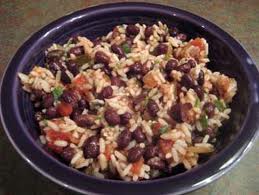
These rice and beans look a lot like the mixture that I consume almost every day—and I buy both of them dry.
Comparing canned beans to dry beans in a bag:
- Which are healthier?
- Which taste the best?
- What about sodium?
- What about cost?
- Which are most convenient?
- What about the environment?
As a man who consumes some kind of beans almost every day, I was delighted to receive this message from Kris last week.
Dear Mr. Hicks, I have been following your blog daily since the fall, and I’ve read your book, which brings together many good sources.
I’ve been meaning to write to suggest that you encourage people to buy dried beans (cheap) and soak and cook instead of relying on canned in all the recipes that you post. There is a big difference in flavor and texture between canned beans and dried ones cooked at home, even when pureed as in the recent recipe for the black bean soup.
Would you consider an entry devoted to cooking beans at home? When you get down to it, there is really no good reason, other than convenience to buy canned beans. Dried are cheaper and taste better and the need to search out low sodium vanishes.
Once cooked, they can be frozen. Kombu can be added to the pot for flavor and sea vegetable nutrition and tenderizing of the beans. I could go on, because I do cook my own beans and I want people to know that it is more frugal, tastier and in my opinion, better for the planet. Thanks for what you are doing, Mr. Hicks. It is much needed and I appreciate you. Best regards, Kris
Dear Kris,
Thank you very much for your note. Beans are a very key ingredient of my Sailors Super Lunch and I use a combination of red beans and black beans along with a combination of wild rice and brown rice. And, like you, I have been buying the dry beans myself for quite a few years—for all the reasons that you suggest. But for some people, the low sodium canned beans are more convenient. Maybe after some of them see my analysis, they may change their minds.

My analysis of beans included two products from the good people at Goya.
Now for the analysis. Over the weekend, I went online and analyzed two kinds of black beans:
- Goya brand low sodium canned black beans
- Goya brand dry black beans in a bag
For my analysis, I decided to follow the list of six questions above and make my comparison. I went to Peapod.com and quickly found the products that I was seeking. Not only did Peapod have price comparison, but also the complete nutrition information with calories, sodium, etc.
- Which are healthier? This one is hard to prove, but, given the choice, I always go with the one that is less-processed–and the one that has the least sodium per serving. The Hummus Blog says dried beans are superior (See link below). Advantage dry beans.
- Which taste the best? I will defer to Kris on this issue since I didn’t actually sample the canned beans pictured above. All I know is that my dry beans have a great taste and texture—with simple seasoning like Mrs. Dash and some basil flakes. Advantage dry beans.
- What about sodium? The canned beans had 125 mg. of sodium per 100 calories compared to only 30 mg. per 100 calories for the dry beans. So the canned beans have four times as much sodium—and I was comparing low sodium beans. The regular black beans have 16 times as much sodium. Advantage dry beans.
- What about cost? I can handle this one. The canned beans cost $.35 per 100 calories; the dry beans cost 45% less—only $.19 per 100 calories. If I eat 100 calories of beans every day, each year I save $58.40 by using dry beans. Advantage dry beans.
- Which are most convenient? Depends on who you ask. For my dry beans, I don’t have to use a can opener and I don’t have an empty can that I must wash and dispose. I put my beans in a pan with water before going to Starbucks at 6 a.m. and they’re ready to simmer for 75 minutes beginning anytime after about four hours. Advantage dry beans.
- What about the environment? Had to do a little research on this one, and the numbers are staggering. In the USA alone, we consume almost 37 billion tin/steel cans per year (112 cans for every person). The good news is that we recycle 63% of them. And, by so doing, we save enough energy to power 18 million homes. If we didn’t use cans at all, we could save enough energy to power another 18 million homes. We’d also save a lot of water and manufacturing costs. The only problem is that there are 35,000 American jobs depending on the can industry. Maybe those people could become organic farmers someday. Advantage dry beans.

By using less steel, energy and water, we move a step closer to living in harmony with our planet.
Final Score (the dry beans win by a couple of field goals)
- Dry beans–6
- Canned beans–0
Thanks again for your message Kris. This was a fun project and it may very well help many people save money, be healthier and be kinder to our environment. Best to you and your family, Jim Hicks.
- Hummus Blog says dried is superior. Nutritional comparison for hummus (canned vs. dry)
********************
Handy 4-piece take-charge-of-your-health kit—from Amazon.com
- The movie that’s changing the lives of millions: Forks Over Knives DVD
- Healthy Eating, Healthy World, The “big picture” about food (our book)
- An essential scientific resource: The China Study by Dr. T. Colin Campbell
- Dr. McDougall’s new book, The Starch Solution, with lots of great recipes.
Want to find out how healthy your family is eating? Take our free 4Leaf Diagnostic Survey. It takes less than five minutes and you can score it yourself. After taking the survey, please give me your feedback as it will be helpful in the development of our future 4Leaf app for smartphones. Send feedback to jmorrishicks@me.com

 International. We’re now reaching people in over 100 countries. Follow us on Facebook and Twitter or get daily blog notices by “following” us in the top of the right-hand column. For occasional updates, join our periodic mailing list.
To order more of my favorite books—visit our online BookStore now

J. Morris Hicks, working daily to promote health, hope and harmony on planet Earth.
For help in your own quest to take charge of your health, you might find some useful information at our 4Leaf page or some great recipes at Lisa’s 4Leaf Kitchen.
Got a question? Let me hear from you at jmorrishicks@me.com. Or give me a call on my cell at 917-399-9700.
SHARE and rate this post below.
Blogging daily at hpjmh.com…from the seaside village of Stonington, Connecticut – Be well and have a great day.
—J. Morris Hicks, board member, T. Colin Campbell Foundation

 Since Steve Jobs passed away in early October of 2011, people everywhere have been wondering why he died. Those of us who eat mostly plants have been wondering why a self-proclaimed, strict vegan like Jobs would succumb to pancreatic cancer. His biography led us to believe that he could have been cured of his cancer if he’d just agreed to have the surgery in 2003. But, that doesn’t appear to be the case.


 J. Morris Hicks, engineer. writer. big picture guy.