6th Grade Arithmetic and Food—Not Rocket Science

Upcoming speech to 6th graders in New London, CT

For my 707th consecutive daily blog, I salute one of the greatest aircraft ever built--the Boeing 707.

For my 707th consecutive daily blog, I salute one of the greatest aircraft ever built–the Boeing 707.

During 2012, I met Suellen Hampton, one of my blog readers from the local area. She has been a school teacher for 36 years (14 in New London; 22 in Orlando) and has invited me to speak to her 6th grade class of 48 students at the Bennie Dover Jackson Middle School on February 1. In addition, Suellen was kind enough to arrange for me to speak to all four of the other classes of 6th graders the following week—a total of about 240 students.

First of all, I am thrilled with the opportunity to visit with these 250 young people. Our book was written so that it could be read and comprehended by the average 8th grader in one day. Now, I will develop a presentation that can be easily understood by the average 6th grader. As the grandfather of a 6th grader in Massachusetts, I know that all I have to do is use a little simple 6th grade arithmetic.

Back in November, I published a blog entitled Graduation Day—An Essential “Top 10 List” for Life (See link below). It was basically an outline of a commencement address that I plan to use in the future for high school and college graduations. The title of that speech is Food Math 101—Why the numbers behind what we’re eating are not adding up—and how You can help fix it. Here’s the outline for that Top Ten List speech:

Who owns our planet? There are over a million species of creatures.

Who owns our planet? There are over a million species of creatures.

  1. The Big Picture
  2. Harmony
  3. Saving the planet
  4. People math
  5. Using the planet
  6. Finite amount of land
  7. Finite amount of water
  8. Our health & the “protein myth”
  9. The other million species
  10. Making every bite count

Today, I will focus on—The Big Picture, People Math and Using the Planet

Scientists agree that life first began on this planet about 4 billion years ago. And we humans have been around for just 200,000 of those years. In other words, we’re “johnny-come-latelies” when you think about the age of the planet. And to help those 6th graders get their arms around that number, I will ask them to imagine that the Earth has been supporting life for just one full year.

Now, if we humans have been around for 200,000 years, what part of our planet’s full 365 days would that represent? So I did a little 6th grade arithmetic to compute the answer; an astounding…

26 Minutes!

We have grown from one to seven billion people in just over 200 years.

We have grown from one to seven billion people in just over 200 years.

The next number is even more startling. Let’s take a look at how the human population has grown over the past 200,000 years. First of all, it took us 199,800 years to reach the one billion mark in 1804.

Since then, in just the past 200 years, we have added another six billion people. So here’s the startling number, what portion of our 26 minutes would those 200 years represent?

  • 200/200,000 = .001 (one thousandth of the time)
  • How many seconds in 26 minutes? 26 x 60 = 1560 seconds.
  • What is one thousandth of 1560 seconds?

Less than two seconds (1.56 to be exact)

If our planet has supported life for one full year, our human ancestors have been here for just 26 minutes and our population has increased from one billion to seven billion in just the last two seconds.

One football field is about 1.3 acres---enough land to feed 7 people a health-promoting plant-based diet.

One football field is about 1.3 acres—enough land to feed 7 people a health-promoting plant-based diet.

So why is that important? It’s important because of the amount of land it takes to feed just one human. Of course, it depends on what they eat. Let’s imagine that a small farm is the size of a football field.

If the people are eating mostly whole plants, you can feed about 7 of them on that little farm. But if they eat meat, dairy, and eggs everyday, you would need two of those farms to feed just one person.

So what’s the problem? Not enough land to go around. There are roughly 6 billion football fields of available farmland in the world. Let’s do a little arithmetic and find out how many people we can feed on that amount of land:

  • Plant eaters: 6 billion multiplied by 7 = 42 billion people
  • Omnivores, meat/dairy/egg eaters: 6 billion divided by 2 = 3 billion people

What’s wrong with this picture? We already have over 7 billion people. If everyone ate the way the average American eats, 4 billion people would starve to death. That, my young friends, is a good example of the phrase I used earlier:

Why the numbers behind what we’re eating are not adding up—and how You can help fix it

The typical western diet; a disaster for your health, your environment and the long-term sustainability of the human race.

The typical western diet; a disaster for your health, your environment and the long-term sustainability of the human race.

A wager today for my readers. I will bet you a hundred bucks that every single one of those 6th graders will quickly figure out what “they would need to do to help fix this problem.” And they will reach that conclusion before we even talk about how a mostly whole foods, plant-based diet could reverse their parents’ heart disease & diabetes and prevent their cancer.

They will quickly experience a blinding flash of the obvious solution and will probably:

  1. Go home and tell their parents what they have learned.
  2. They might show their parents this blog post and the other one listed below.
  3. They might ask their parents about eating more plant-based foods in their home.
  4. If their parents scoff at them, they could encourage them to read our book.
  5. After they read the book, the 6th grader might ask their parents if they are ready to get serious about changing their diet.
  6. And if the parents still aren’t ready to get serious, what kind of message is that sending to their children?

Gut Check Time. How about it parents? Can you see yourself telling your 6th grade child that you would be willing to let 4 billion starve to death so you could continue eating your meat, fish, cheese and/or eggs at every meal?

Handy 4-piece take-charge-of-your-health kit—from Amazon.com

Want to find out how healthy your family is eating? Take our free 4Leaf Diagnostic Survey. It takes less than five minutes and you can score it yourself. After taking the survey, please give me your feedback as it will be helpful in the development of our future 4Leaf app for smartphones. Send feedback to jmorrishicks@me.com

International. We’re now reaching people in over 100 countries. Follow us on Facebook and Twitter or get daily blog notices by “following” us in the top of the right-hand column. For occasional updates, join our periodic mailing list.

To order more of my favorite books—visit our online BookStore now

J. Morris Hicks, working daily to promote health, hope and harmony on planet Earth.

For help in your own quest to take charge of your health, you might find some useful information at our 4Leaf page or some great recipes at Lisa’s 4Leaf Kitchen.

Got a question? Let me hear from you at jmorrishicks@me.com. Or give me a call on my cell at 917-399-9700.

SHARE and rate this post below.

Blogging daily at hpjmh.com…from the seaside village of Stonington, Connecticut – Be well and have a great day.

—J. Morris Hicks, board member, T. Colin Campbell Foundation

Posted in Activism & Leadership, Big Picture, Children | 8 Comments

Colon Cancer—third disease in my new alphabetical listing

Welcome to the third PAGE of my new Diseases section of this site.

Colon CancerIt’s a sad situation when we have to spend $60 billion a year in this country to screen for a disease (colon cancer) that should never have to happen in the first place. But, as long as our “system” of treating symptoms instead of promoting health continues; don’t look for that to change anytime soon.

Screening for disease and treating symptoms is big business — promoting health; not so much. In the cancer industry, we hear an awful lot about genetics, screening, early detection and high-tech treatment with surgery, chemo and radiation. But we hear very little about the optimal diet that will prevent most cancers from ever occurring in the first place.

I have provided a total of nine blogs below. The first three deal primarily with colon issues—the last six mention colon cancer but deal primarily with cancer in general. Here is an excerpt from the 4th blog:

Like colonoscopies to screen for colon cancer, everything is based on the risk of developing the disease and dying from it. In an earlier post (see below) about Dr. Oz, I talked about the $50 billion business of screening, just for colon cancer—a disease that carries a 7% likelihood of causing your death.

But what if that risk was lowered to one half of one percent? Do you think we’d still have a $50 billion business to screen for it. Would you go repeatedly for screenings if the risk of dying from the disease was 1/2 of one percent, 1 person out of 200? I wouldn’t and I don’t.

While this procedure may be right for millions, I decided that it was not right for me.

While this procedure may be right for millions, I decided that it was not right for me.

The last three blogs listed below deal with the “big business” that cancer has become. And that business depends on people getting screened, getting diagnosed and getting treated. The business would essentially disappear if everyone were to start eating a near optimal, whole foods, plant-based diet.

If you or someone you love has been diagnosed with colon cancer or is trying to decide whether or not to schedule a colonoscopy, I recommend that you include the following nine articles in your research. In these well-reseached blogs, there is a wealth of information which may prompt some ideas that may help you plan your strategy.

  1. Oz shares colon story; “cancer screening $$ business” gets bigger (6-9-11)
  2. Are you a colonoscopy customer? My personal story on this topic (6-1-12)
  3. “High Fiber” diet saves lives…but not nearly enough (2-22-11)
  4. Early detection of prostate, colon & breast cancer…with McDougall video (2-11-12)
  5. Drugs for preventing cancer — now everyone can be a customer! (6-6-11)
  6. The “war on cancer” turns 41; now a major industry…(7-16-12)
  7. Searching for the cure—now has a life of its own. (5-18-12)
  8. Screening for cancer…a very big business (2-21-11)
  9. Riding the cancer train to fame and fortune (10-6-12)
J. Morris Hicks, working daily to promote health, hope and harmony on planet Earth

J. Morris Hicks, working daily to promote health, hope and harmony on planet Earth

My personal story in blog #2. When my 50th birthday rolled around, I forgot to go to the doctor to schedule my first colonoscopy—even though my wife would occasionally remind me. I also never got around to getting one when I turned 55.

For the rest of this story, take a look at the referenced blog #2 above. Need help in deciding your own strategy, you may want to consult with a physician who truly “gets it” about plant-based nutrition.

One-on-one MD Help. Sadly, 95% of our medical doctors are not aware of the power of plant-based nutrition to prevent or reverse many chronic diseases, including some cancers. Further, oncologists can only recommend the treatment regimens for which they have been trained. If you would like a second opinion (about cancer) from a medical doctor who truly “gets it” about food, you may wish to visit our MD Help page and schedule a telephone consultation with one of the MDs listed there.

**********************

Consecutive daily blogs

Consecutive daily blogs

This content of this blogpost also appears on this site as a page—and is the third one on the drop-down list under my new Diseases tab just under the banner. This new page was established to help my readers quickly find information on the most common diseases—that can be prevented or eliminated with a whole foods, plant-based diet. As I add more information, these pages will be updated.

Please forward this blog to anyone you know that may be interested in learning more about the causes and prevention of colon cancer. Click here to view the list of other “diseases” that will posted soon.

Handy 4-piece take-charge-of-your-health kit—from Amazon.com

Want to find out how healthy your family is eating? Take our free 4Leaf Diagnostic Survey. It takes less than five minutes and you can score it yourself. After taking the survey, please give me your feedback as it will be helpful in the development of our future 4Leaf app for smartphones. Send feedback to jmorrishicks@me.com

International. We’re now reaching people in over 100 countries. Follow us on Facebook and Twitter or get daily blog notices by “following” us in the top of the right-hand column. For occasional updates, join our periodic mailing list.

To order more of my favorite books—visit our online BookStore now

J. Morris Hicks, working daily to promote health, hope and harmony on planet Earth.

For help in your own quest to take charge of your health, you might find some useful information at our 4Leaf page or some great recipes at Lisa’s 4Leaf Kitchen.

Got a question? Let me hear from you at jmorrishicks@me.com. Or give me a call on my cell at 917-399-9700.

SHARE and rate this post below.

Blogging daily at hpjmh.com…from the seaside village of Stonington, Connecticut – Be well and have a great day.

—J. Morris Hicks, board member, T. Colin Campbell Foundation

Posted in Cancer, Colon Health | 3 Comments

Dollars & Sense of Healthcare, Defense & National Security

Strange bedfellows indeed—but then healthcare affects everything. 

Just a few days ago, my blog consisted of a letter to David Brooks (New York Times) about the cost of healthcare and the inability of Congress to make one single hard decision during the fiscal cliff episode. It turns out that the cost of healthcare was the primary reason why Congress has been unable to establish a sustainable budget for the past twenty years.

Chuck Hagel must fight the "health care monster" for money to run the DOD.

Chuck Hagel must fight the “health care monster” for money to run the DOD.

Now, Mr. Brooks has written another column wherein healthcare is once again center-stage. In his latest article, Why Hagel Was Picked (see link below), he essentially says that Hagel was picked because of his philosophies on running a leaner and meaner military—because we simply must save money somewhere. From the article:

Americans don’t particularly like government, but they do want government to subsidize their health care. They believe that health care spending improves their lives more than any other public good. In a Quinnipiac poll, typical of many others, Americans opposed any cuts to Medicare by a margin of 70 percent to 25 percent.

In a democracy, voters get what they want, so the line tracing federal health care spending looks like the slope of a jet taking off from LaGuardia. Medicare spending is set to nearly double over the next decade. This is the crucial element driving all federal spending over the next few decades and pushing federal debt to about 250 percent of G.D.P. in 30 years.

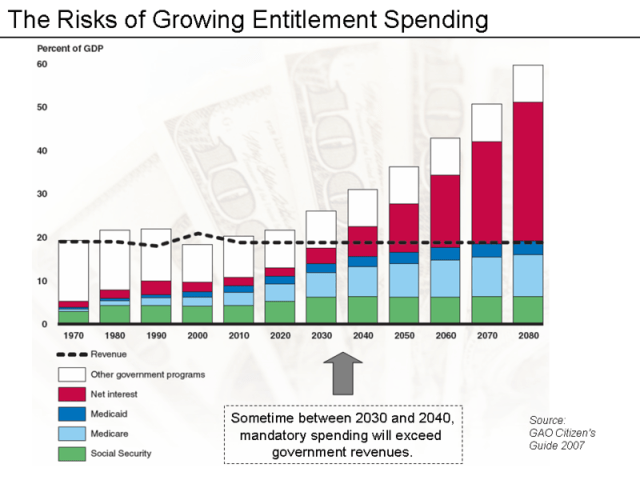
Take a real hard look at this chart (% of GDP)

I found it on Wikipedia; it shows that sometime between 2030 and 2040, mandatory government spending (Medicare, Medicaid & SS) will exceed government revenue. That means we would then have NO defense spending. Our only hope is to get real serious about reducing the cost of healthcare. If we don’t we will BANKRUPT our nation. Yet none of our prominent leaders, journalists, physicians or academics are even talking about it.

Entitlement spending

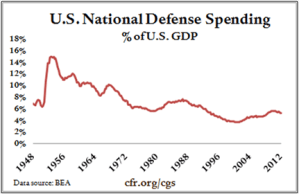
So, it turns out that healthcare is squeezing out all other spending, which Americans value far less. And the latest victim is the Department of Defense. During the past fifty years, while healthcare costs have been soaring as a percent of GDP, our military spending has been declining. As Brooks says:

As the federal government becomes a health care state, there will have to be a generation of defense cuts that overwhelm anything in recent history.

So President Obama has picked a Defense Secretary and a CIA director who agree with him about the need for a less-expensive military strategy. And as Brooks says, “Chuck Hagel has been nominated to supervise the beginning of this generation-long process of defense cutbacks. If a Democratic president is going to slash defense, he probably wants a Republican at the Pentagon to give him political cover, and he probably wants a decorated war hero to boot.”

Our defense spending has been trending downward for 30 years, but it's getting ready to go much lower.

Our defense spending (as % of GDP) has been trending downward for 50 years, but it’s getting ready to go much lower.

Currently our Defense spending is scheduled to go from 4.3 % of GDP to 3% according to the Congressional Budget office. As Brooks, says, we’re moving in the same direction as Europe and our military might will suffer as a result.

As late as the 1990s, Europeans were still spending 2.5 percent of G.D.P. on defense. Now that spending is closer to 1.5 percent, and, amid European malaise, it is bound to sink further,

How, in short, will Hagel supervise the beginning of America’s military decline? If members of Congress don’t want America to decline militarily, well, they have no one to blame but the voters and themselves.

The U.S. government spends close to one trillion a year on health care, far more than we spend on our armed forces.

The U.S. government spends close to one trillion a year on health care. This monster is the gorilla in the room when it comes to all federal spending.

The Bottom Line. We, the citizens of the United States, are being held hostage by our runaway cost of healthcare—something that almost everyone feels we must have have. And that “health care monster” is making it impossible for us to address many of our most urgent problems as a nation.

So does our decline as a military power qualify as an urgent problem? Yes, an urgent problem that could be solved if we executed the blinding flash of the obvious solution to saving money. Simply start eating the right food. To borrow a few paragraphs from my recent blog addressed to Mr. Brooks:

Mr. Brooks, you stated in your column that, “No coalition of leaders has successfully confronted the voters, and made them heedful of the ruin they are bringing upon the nation.”

I might say the same for a similar coalition of journalists. Why have the world’s most influential thinkers failed us when it comes to the blinding flash of the obvious solution to our most urgent problems?

Eat the right food (whole plants) and your weight will take care of itself.

The simple answer to our nation’s countless budget (and national security) problems.

What is that solution? All we need to do is to start eating the right food for our species. It’s as simple as two words: Whole Plants. The staggering global benefits of that simple step goes far beyond our cost of health care in the United States—and our military power as a nation. What we’re talking about here is the longterm sustainability of the human race. What could be more important than that?

Handy 4-piece take-charge-of-your-health kit—from Amazon.com

Consecutive daily blogs

Consecutive daily blogs

Want to find out how healthy your family is eating? Take our free 4Leaf Diagnostic Survey. It takes less than five minutes and you can score it yourself. After taking the survey, please give me your feedback as it will be helpful in the development of our future 4Leaf app for smartphones. Send feedback to jmorrishicks@me.com

International. We’re now reaching people in over 100 countries. Follow us on Facebook and Twitter or get daily blog notices by “following” us in the top of the right-hand column. For occasional updates, join our periodic mailing list.

To order more of my favorite books—visit our online BookStore now

J. Morris Hicks, working daily to promote health, hope and harmony on planet Earth.

For help in your own quest to take charge of your health, you might find some useful information at our 4Leaf page or some great recipes at Lisa’s 4Leaf Kitchen.

Got a question? Let me hear from you at jmorrishicks@me.com. Or give me a call on my cell at 917-399-9700.

SHARE and rate this post below.

Blogging daily at hpjmh.com…from the seaside village of Stonington, Connecticut – Be well and have a great day.

—J. Morris Hicks, board member, T. Colin Campbell Foundation

Posted in Activism & Leadership, Cost of Health Care | 4 Comments