
What is the future of food? — Take a look at the past.

J. Morris Hicks

During just the past few hundred years in the western world, we have gone from eating mostly whole plants to consuming almost none. Today, in the United States, we derive far less than ten percent of our calories from whole plant foods (in nature’s package) — the natural diet for our species.

This almost total shift away from our natural diet has taken its toll on our health and has inflicted enormous damage on the fragile harmony of our environment. I would like to think that we could learn how to eat healthy again and correct the mess that we have created. But, sadly, I don’t think that our species has the will to take on a mammoth change like that all by ourselves — we’re going to need some help. And that help is on its way — disguised as the end of cheap oil on planet Earth. (the title of Chapter 5 in our book).

More on that in a minute; first, let’s take a look at the way various cultures are eating on our planet today. Believe it or not, there are far less than 2 billion of the world’s 7 billion people that eat the way we do. But the other 5 billion are doing their best to adopt our rich, damaging, inefficient and extremely wasteful diet-style — and that is not a good thing.

Scroll down through the following three pictures slowly — from Ecuador — to Egypt — to the United States. (Pictures and data from Rusty Lime, link below) Then, let’s talk about your observations.

This family of nine in Ecuador spends $31.55 per week for their food.
This family of twelve in Egypt dines on $68.53 per week.

Now for the Americans, this family of four in North Carolina spends $341.98 per week on their food.

What do we see here?

  • The Ecuador food appears to be all plants with no packaging, no processing and no doubt locally grown.
  • The Egyptian diet, while still heavy on fruits and vegetables, does include some processed and packaged goods, like soda.
  • Then there’s the Americans — with their typical western diet — with meat and dairy three meals a day, almost no fresh fruits and vegetables and a plethora of highly refined — and unhealthy — food products.
  • The majority of the calories in the first two photos were probably grown close to home; whereas in the U.S. and other western countries, our food does a lot of traveling before it reaches our dinner table.

What we don’t see here is that the people eating the more “primitive” diet have almost none of the chronic diseases we suffer. They are also living much more harmoniously with nature — inflicting far less damage on the environment. Since the people in Ecuador are eating much more of the nutritious whole plants and causing much less damage to the environment, what’s it going to take for us to begin moving in the direction of that healthier diet?

The End of Cheap Oil! Take a look at the American photo again — from an energy consumption perspective:

  • Animal-based foods require, on average, 20 times more energy per calorie to produce than whole plant foods.
  • The refinement and processing of even the plant foods uses a lot of energy, costs a lot of money and makes the product much less healthy.
  • The packaging oftentimes costs more than the products inside and, of course, consume even more energy to manufacture them.
  • Transportation. We spend 20 calories of energy to transport one calorie of lettuce from California to New York.

As for the end of cheap oil, the world has consumed roughly one trillion barrels of oil in the past century. While no one knows for sure how much oil is left, many scientists have concluded that we will soon reach “Peak Oil” production — meaning that the global production of oil will begin a steady decline that will likely continue for another century. Some experts believe that we are at “peak oil” now.

There are some disagreements among the experts on this topic, but there are some facts on which they all agree:

  1. The world oil supply is finite.
  2. We have extracted the easiest trillion barrels first.
  3. The global demand continues to rise. (See related blog)
  4. Prices will rise in the future. (More on “peak oil”)
  5. Our current energy model is grossly unsustainable.
  6. We must develop renewable sources of energy.

Try to imagine what $10/gallon gasoline would do to our choices in food. Quite simply, it would mean less of the energy-wasting foods and more of the efficient foods. It would mean less animal products, more whole plants, less processing, less packaging, more locally grown food and much more fresher, healthier foods.

Healthier, more efficient foods sounds great, but there will also be a HUGE adjustment period as we learn to live permanently with expensive oil. As we pay more for our energy, we will begin to consume less of it. That means smaller homes, more dense communities, more trains, less cars, more sources of renewable energy and fewer sprawling subdivisions out in the boonies. The good news here: As people move away from those sprawling suburbs, they will be freeing up the local farmlands of our future. And there’s more good news…

There will no doubt be a lot of pain as we make our move back to a healthier diet and a more efficient lifestyle in general. But, in the end, there is a silver lining in this picture — a better quality of life. To understand what I mean, I will ask you one question? Where would you rather spend your vacation? Houston or Paris?

For the complete series of the family dining around the world, click on this link from Rusty Lime. Family food expenditures around the world – Rusty Lime.

If you like what you see here, you may wish to join our periodic mailing list. Also, for help in your own quest to take charge of your health, you might find some useful information at our 4-Leaf page. From the seaside village of Stonington, Connecticut – Be well and have a great day.

If you’d like to order our book on Amazon,  visit our BookStore now.

—J. Morris Hicks…blogging daily at HealthyEatingHealthyWorld.com

PS: Occasionally an unauthorized ad may appear beneath a blog post. It is controlled by WordPress (a totally free hosting service). I do not approve or personally benefit whatsoever from any ad that might ever appear on this site. I apologize and urge you to please disregard. 

Posted in Big Picture, Energy, Sustainability | 1 Comment

Erectile dysfunction can save your life. Who knew?

J. Morris Hicks

Everyone knows that heart disease is the number one killer in America, but who knew that E.D could save your life? For many victims of heart disease, the very first symptom they experience is a heart attack followed by the second symptom…death. Since the first attack doesn’t happen for most people until they are fifty or older, we naturally assume that the disease is associated with aging…and there’s nothing we can do about it, right? Wrong! On both counts.

What about the relationship between heart disease and erectile dysfunction? They are essentially the same disease; restricted blood flow due to the build-up of plaque in our arteries. Neither is the natural result of aging; both are the natural result of eating the rich western diet for many years. Autopsies of fallen U.S. soldiers in Korea revealed that 80% of these young men had advanced heart disease; whereas the arteries of the plant-eating Korean soldiers were largely clean, free of fatty deposits. USA Today reported (in the Tim Russert article) on June 16, 2008, these alarming statistics from a National Health and Nutrition Survey that took place from 1999 to 2004. These are the percentage of Americans, by age group, that has cardiovascular disease:

  • 11% for ages 20 to 39
  • 39% for ages 40 to 59
  • 73% for ages 60 to 79
  • 88% for ages 80+

According to these numbers, almost 90% of the people over 80 have some form of artery disease; not just because they’re old, but because they’ve been consuming a destructive diet for sixty years longer than the young adults.

Take charge of your health and lower the chances that you'll ever need to take the little blue pills for the rest of your life.

Studies show that men don’t usually worry a great deal about developing a chronic disease, but they do worry about E.D. Many physicians acknowledge that if a man has cardiovascular disease, then he is very likely to also suffer from E.D. Conversely, a diagnosis of E.D. is a pretty good indicator that you also have the other one. So, you cure one, you cure the other, right? That all depends on the treatment you choose. The standard treatments for heart disease are statin drugs and bypass surgery. Obviously, neither of those is going to do much for your love life.

But if you address the root cause of heart disease, you are likely to also address the root cause of E.D. The root cause for both is the consumption of the wrong food for our species. Animal foods that are high in fat and cholesterol contribute to the build-up of plaque in our arteries that lead to restricted blood flow, high blood pressure, and a host of other physical problems.

J. Morris Hicks turns the mike over to Dr. Caldwell Esselstyn at a yacht club in CT

My friend Dr. Caldwell Esselstyn, Jr., of the Cleveland Clinic, conducted a 20-year study (ongoing) of terminal heart patients. His treatment consisted only of diet modification. For the 17 patients who adhered to the guidelines, there were a total of 49 cardiac events in the 8 years leading up to the study. Over the next 11 years, there were a grand total of zero. That’s right, 49-0; sounds like a lopsided football score.

The study proved that heart disease can be arrested and reversed with a simple change of diet. Further, Dr. Esselstyn reports that the diet that reversed heart disease in those 18 patients, is the same diet that can solve most of our chronic disease problems in the world. As he said, we could easily save $2 trillion in health care costs in the U.S. simply by shifting to a totally plant-based diet. It’s that simple.

So if you’re lucky enough to get E.D. before your first heart attack, let it be your wake-up call to take action — NOW. Doing so will not only take care of your E.D. but will almost certainly take care of any heart problems that you may have. You are also likely to lose weight, eliminate most prescription medicines, sleep better, have more energy, live longer, enjoy vibrant health for more years and probably never have to suffer the indignity of a nursing home.

Got E.D.? Get rid of it by taking charge of your health, with saving your life as a convenient by-product — along with effortless weight-loss.

If you like what you see here, you may wish to join our periodic mailing list. Also, for help in your own quest to take charge of your health, you might find some useful information at our 4-Leaf page. From the seaside village of Stonington, Connecticut – Be well and have a great day.

If you’d like to order our book on Amazon,  visit our BookStore now.

—J. Morris Hicks…blogging daily at HealthyEatingHealthyWorld.com

PS: Occasionally an unauthorized ad may appear beneath a blog post. It is controlled by WordPress (a totally free hosting service). I do not approve or personally benefit whatsoever from any ad that might ever appear on this site. I apologize and urge you to please disregard. 

Posted in Erectile Dysfunction, Heart Disease | 1 Comment

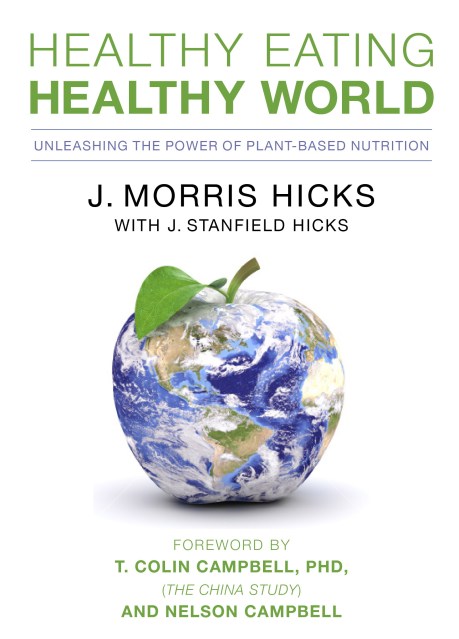
“Wow factor” on our book’s cover…

followed by world-changing information on the inside

Publisher -- BenBella Books -- October 2011 -- Now on pre-order at Amazon

Just finalized yesterday, we are simply thrilled with the cover of our book. If this book doesn’t sell, it won’t be because of the cover. Kudos to our publishing team at BenBella Books in Dallas. In addition to the new cover, I also updated the content of Book Preview page on this site. It now contains three excerpts from: the Foreword by Dr. Campbell, the Introduction, and the final chapter entitled A Return to Harmony.

Another new addition to the site is the Best Of page just to the right of the 4-Leaf page. It contains two lists of posts:

  • My own personal top-fifteen list in terms of importance relative to helping people grasp the “big picture.”
  • A ranked list of the top 15 most-viewed posts since Day 1 (2-10-11)

One more thing to share; just this morning, one of my readers sent me a link that contains a series of pictures from around the world — showing families surrounded by the food they eat in a week. The biggest spenders was a family of 4 in Germany — they spent $500.07; the low was $1.23 for a family of 6 in Chad. The irony here is that the Chad family is probably much healthier than the rich Germans…and guess what? They had zero packaged or animal food in Chad.

As for doing the best job of living in harmony with the planet; the good people in Chad get my vote.  Click here and scroll down from rich to poor— amazing.

If you like what you see here, you may wish to join our periodic mailing list. Also, for help in your own quest to take charge of your health, you might find some useful information at our 4-Leaf page. From the seaside village of Stonington, Connecticut – Be well and have a great day.

If you’d like to order our book on Amazon,  visit our BookStore now.

—J. Morris Hicks…blogging daily at HealthyEatingHealthyWorld.com

PS: Occasionally an unauthorized ad may appear beneath a blog post. It is controlled by WordPress (a totally free hosting service). I do not approve or personally benefit whatsoever from any ad that might ever appear on this site. I apologize and urge you to please disregard. 

Posted in Big Picture, Healthy Eating 101 | 2 Comments