
Big news re “weiner wars.” Which hot dog is best? Who cares?

We all know that all of them are bad for our health.
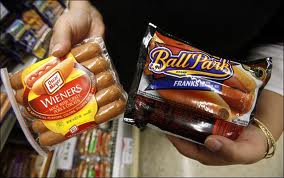
Which is best? Who cares?

Did you see the big news about the two major hot dog brands going to Federal court as the “weiner wars begin?” This was the lead paragraph in a USA Today article on 8-16-11.

CHICAGO — The nation’s two largest hot dog makers took their legal beefs to federal court Monday, where a judge will determine whether Oscar Mayer or Ball Park franks broke false-advertising laws in their efforts to become top dog…Thousands of pages of filings in three years of pretrial litigation by both food-industry giants demonstrate that the stakes are high…”There’s never been anything of this scope . . . in the entire history of hot dogs,” said Sara Lee’s attorney, Richard Leighton.

It is really sad to see how much time, money, and energy is being put into a battle where almost everyone knows that ALL of the products involved are among the least-healthy foods we can put in our mouth. Yet, while their lack of nutritional value is widely known, the almighty hot dog is one of the most ubiquitous items on our kids menus all across the nation. Like sausage, no one really wants to know what’s in it or how it is made. But the lawsuit is all about truth in advertising and whether or not the respective products are 100 percent beef or not — as if beef were some health food that we should be consuming in great quantities. From the article:

The lawsuit contends that while Oscar Mayer touted its Jumbo Beef Franks as “100 percent pure beef,” that claim is untrue, it cast aspersions on Ball Park franks and damaged their sales.

Kraft defends the “100 percent pure beef” tag, saying its intent was to state that the only meat used is beef. Some hot dogs include a mix of turkey, pork, chicken or other meats. Kraft further argues that the “pure beef” label is justified because surveys show a perception among some consumers that hot dogs contain “mystery meats.”

Unfortunately, the hot dog has become a cherished piece of Americana even though we know it’s not good for our health. I think it’s time for America to adopt a new national food — something very healthy from the plant kingdom. How about the apple, the potato or the watermelon? Anything but a hot dog.

How about the apple for America's new favorite food? It's already known for keeping the doctor away, it's the nickname for our most cosmopolitan city and it's the logo for the best computer company in the world. It also graces the cover of our book.

Out of curiosity, I went to NutritionData.com today and looked up the nutritional facts for both Oscar Mayer and Ball Park all beef franks. As expected, they are both bad, and are examples of the kinds of “food” that I would never feed to anyone I loved — especially my own children. Here’s the scorecard for our two weiner giants:

  • Calories from fat per serving: 123 and 150
  • Percent fat per serving: 84% and 79%
  • Saturated fat per serving: 6 gr. and 7 gr.
  • Cholesterol per serving: 25 mg. and 35 mg.
  • Sodium per serving: 461 mg. and 550 mg.
  • Added sugar per serving: 1 gr. and 2 gr.

So which one is which? Who cares? Do you think that the healthier one would kill your children more slowly or give them a slightly less chance of developing type 2 diabetes before they finish high school. When are we going to wake up and stop supporting industries that are poisoning our children? 

J. Morris Hicks, working daily to promote health, hope and harmony on planet Earth.

The entire article was ludicrous, so much so that I couldn’t even justify reading the entire piece. But just in case you’re interested, I have provided the USA Today link below.

If you like what you see here, you may wish to join our periodic mailing list. Also, for help in your own quest to take charge of your health, you might find some useful information at our 4-Leaf page. From the seaside village of Stonington, Connecticut – Be well and have a great day.

If you’d like to order our book on Amazon,  visit our BookStore now.

—J. Morris Hicks…blogging daily at HealthyEatingHealthyWorld.com

PS: Occasionally an unauthorized ad may appear beneath a blog post. It is controlled by WordPress (a totally free hosting service). I do not approve or personally benefit whatsoever from any ad that might ever appear on this site. I apologize and urge you to please disregard. 

Judge takes Ball Park-Oscar Mayer hot dog fight  relish – USATODAY.com.
Posted in Health in General | 1 Comment

Transforming a beautiful meal into a “4-Leaf” meal…

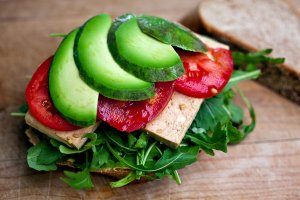
Beautiful sandwich…needs a little tweaking to be 4-Leaf

Almost 100% plant-based, this beautiful meal can easily be transformed into 4-Leaf.

This “marinated tofu sandwich with Asian greens” in the New York Times caught my eye last week. By eliminating or replacing things like the sesame oil, sugar, and mayonnaise; it’s pretty easy to make a 4-Leaf meal out of this beautiful sandwich. (See the link below for full article.)

While 99 percent of of the people looking at this meal would think that it is super-healthy already, there are a few reasons why it is not. If we analyzed the caloric content on nutritiondata.com; we’d find that 215 of the total 422 calories (51%) come from the fat of just the tofu, avocado and the mayonnaise. Remember that our target is to stay below 20% of our calories from fat. Here is what the article had to say about the nutrition of the original meal shown above:

Nutritional information per serving: 422 calories; 3 grams saturated fat; 4 grams polyunsaturated fat; 6 grams monounsaturated fat; 5 milligrams cholesterol; 36 grams carbohydrates; 9 grams dietary fiber; 854 milligrams sodium (does not include salt to taste); 18 grams protein

A simple approach to leveraging the power of whole, plant-based foods.

So, exactly how would I make this sandwich a 4-Leaf meal? I would start by eliminating all of the mayo, half the bread and half of the tofu. As for the tofu and the bread, we’re not saying they’re harmful, we’re just trying to help you maximize your percent of calories from whole plants.

Then I would double up on the tomato and greens. That would take care of getting near the 80% of the calories from whole plants but it still might have a little over 20% of the calories from fat. So I might just request a side order of legumes and/or grains — adding more calories and fiber without adding much fat or sodium. Note that we are not trying to cut calories, we’re just trying to “manage” where those calories are coming from.

Routine vs. an occasional meal. If the above meal were offered in a restaurant while I was on vacation, I would likely order it without suggesting any changes. I would know without doing calculations that it was over 50 percent fat, but I would also know that it was nearly 100 percent plant-based (exception being the mayo). Here is our main point:

We want to help you consume nothing but 3-Leaf or 4-Leaf meals for all of your daily routine (repeatable) breakfasts, lunches and dinners. Then, when you’re out with friends or on vacation, you can seek out entrees like this one and know that it would be a whole lot healthier than what everyone else is ordering. Or you and a friend could order one of these sandwiches along with some low fat sides of grains and legumes — then share everything.

J. Morris Hicks, working daily to promote health, hope and harmony on planet Earth.

Click here to visit our 4-Leaf Page where you’ll find lots of information on this creative approach to eating more health-promoting foods.

If you like what you see here, you may wish to join our periodic mailing list. Also, for help in your own quest to take charge of your health, you might find some useful information at our 4-Leaf page. From the seaside village of Stonington, Connecticut – Be well and have a great day.

If you’d like to order our book on Amazon,  visit our BookStore now.

—J. Morris Hicks…blogging daily at HealthyEatingHealthyWorld.com

PS: Occasionally an unauthorized ad may appear beneath a blog post. It is controlled by WordPress (a totally free hosting service). I do not approve or personally benefit whatsoever from any ad that might ever appear on this site. I apologize and urge you to please disregard. 

Marinated Tofu Sandwich With Asian Greens – Recipes for Health – NYTimes.com.

Posted in 4Leaf for Life, Healthy Eating 101, Recipes & meals | Leave a comment

Finite Fossil Fuels…3 ways to make them last longer

We know they’re finite…but we’re using them as if they will last forever.

Shopping for fresh vegetables at Union Square in New York City

The residents of New York City are among the most energy efficient of all citizens of the United States. They achieve that distinction by being exceptionally efficient in two out of three of our primary energy usage categories: our homes and our transportation.

But, for the other category, they are no better than the rest of the United States. That third category is the energy that is going into the production of our food supply. And that’s the category that offers the single best opportunity to prolong the finite supply of our fossil fuels (oil, coal and natural gas) – until renewable alternatives can be developed.

So how much could we save on that food supply category? While researching for our book, we found that approximately one third of our fossil fuel consumption (in the USA) goes to the production of livestock for our dinner tables. We also found that on a per calorie basis, it takes twenty times more energy for animal-based foods as compared to the highly efficient whole plant foods. That means that if we all shifted to eating mostly plants, we could lower our nation’s total fossil fuel consumption by 30 percent.

Subway travel in New York, the ultimate in transportation efficiency

So how can we get the ball rolling such that the average citizens are aware of our impending energy crisis and understands what they each can do to minimize the disruption to our lives when the era of cheap oil comes to a screeching halt? Until oil prices go through the roof, what can we do to influence them to change their behavior now?

We can help them understand the “big picture” about our energy supply and why they might be real smart to start living more efficiently — sooner rather than later. We can make an effort to install more home solar panel systems to cut down on our energy consumption and save money. For example, companies like California’s Verengo Solar, offering custom home solar installation, are making it easier for homeowners and ordinary citizens to join in the fight for cleaner, sustainable energy.

Chapter 5 in our book is entitled “The End of Cheap Oil” and reports on a phenomenon called “peak oil” that experts project will happen between within the next ten to thirty years. Some of the more notable experts believe that it has already happened. “Peak oil” is when the entire world’s production level hits a peak and then gradually declines indefinitely. And without abundant renewable fuels to replace that oil, prices are expected to rise sharply as the world markets realize that we have hit that peak. So what can we do to prepare for that peak? The short answer is that we can get real serious about reducing our consumption now – and thereby give our scientists more time to develop those renewable sources of energy.

My three tips for saving our finite fossil fuels.

  • Eat mostly whole plants. This is the single most powerful move that we can make to save the most energy in the least amount of time.
  • Change the way we live. We can look to our friends in NYC that I mentioned earlier. In a nutshell, we need to live in smaller homes with better insulation and in denser neighborhoods. Need a visualization? Think Paris vs. Houston. This change in lifestyle sets the stage for the third tip for saving energy.
  • Change the way we transport ourselves. For as we live in denser neighborhoods, our needs for daily travel change considerably and mass transit becomes much more feasible. Like the good folks in NYC (and Paris), they make extensive use of their subway for both work and play. Most of them don’t even own automobiles as they commute to work via subway or bus and travel by train to other nearby cities during their leisure time.

One thing that might help the average citizen make better choices in the above three categories would be a projection of prices for the next fifteen years — for a key energy indicator, such as the price per gallon of gasoline. If you knew that the price of gasoline would go up an average of fifty cents a gallon, every year, for the next fifteen years; how would that information affect your lifestyle choices? That means that gasoline would cost $6/gallon in 2016, $8 in 2020 and $11 in 2026. My personal feeling is that those numbers are realistically possible and maybe even a bit conservative.

  • Food choices. If a McDonald’s hamburger was headed to $10 and all other animal-based foods were escalating at similar rates, do you think you might be choosing more of the much cheaper plant-based calories?
  • Home choices. With gasoline and heating prices expected to triple in the next fifteen years, what kind/size of home would you like to have and, more importantly, where would you like for it to be located? Do you think it might be smart to go ahead and sell that McMansion out in the boonies while it’s still worth more than you owe? And, just think how that new location might affect your transportation needs.
  • Transportation choices. With gasoline headed to $11 a gallon, do you think it might be nice to reduce your family fleet from three cars to one, start using mass transit, live close enough to work to ride your bike or walk?

"It turns out that if we eat the way that promotes the best health for ourselves, we will also promote the best health for the planet." Dr. T. Colin Campbell

The problem is that no government officials are likely to announce what’s likely to happen with the cost of energy – even if they knew. Because they’d be afraid of losing votes with anyone involved with any of the industries that might be adversely affected by projections of sharply higher energy costs: automobile, meat & dairy, travel and real estate to name just a few.

As unpopular as it is to say, I truly believe that rising cost of energy today will turn out to be our best friend in the years ahead. For it will force us to consume less energy, ensure that our finite supply of fossil fuels last a few years longer and give us time to gradually adjust to a world after the era of cheap oil. It will also force us back to a much kinder and gentler treatment of our precious planet.

Click here for a blog post that addresses this entire “peak oil” phenomenon. Includes three videos. If you like what you see here, you may wish to join our periodic mailing list. Also, for help in your own quest to take charge of your health, you might find some useful information at our 4-Leaf page. From the seaside village of Stonington, Connecticut – Be well and have a great day.

If you’d like to order our book on Amazon,  visit our BookStore now.

—J. Morris Hicks…blogging daily at HealthyEatingHealthyWorld.com

PS: Occasionally an unauthorized ad may appear beneath a blog post. It is controlled by WordPress (a totally free hosting service). I do not approve or personally benefit whatsoever from any ad that might ever appear on this site. I apologize and urge you to please disregard. 

Posted in Energy | 1 Comment