Cancer. Too much hoopla. Not much help.

Reminds me of the old Texas slogan, “Big Hat, No Cattle.”

War on breast cancer

Recently, I noticed one of the NY Times “most emailed” articles of the week—one written by a breast cancer survivor. So, while resting next to Stonington Harbor during the middle of my daily walk, I read it on my iPhone. So, how’s our war on cancer going in the USA? Here’s a factoid of interest that was mentioned in the article entitled: Our Feel-Good War on Breast Cancer:

One hundred and eight American women die of breast cancer each day. Some can live for a decade or more with metastatic disease, but the median life span is 26 months.

NY Times LogoNot knowing what I was in for at the beginning of the article, I kept thinking that this somewhat skeptical “survivor” was going to reveal some important information. After all, the New York Times devoted quite a bit of space to her 6,000-word article. On top of that, there are now 577 comments, which probably adds another 30,000 words—in case you’ve got an extra day or two to devote to reading about our nation’s totally dysfunctional cancer situation.

I didn’t read any of the 577 comments but I did read the entire article. I was searching for a glimmer of hope from the author—some life-saving information about how to avoid this horrible disease in the first place.
Run for the cureAs I plodded through the article which must’ve been more than 200 pages on my iPhone 5, I only found one paragraph that even hinted at the crux of the problem—the fact that we’re spending practically nothing on prevention. That paragraph was about 3/4 of the way through the 6,000 words. As you can see, they mentioned the word “prevent” but the word diet did not appear—anywhere in the 6,000 words. Here’s the prevention paragraph:

Women are now well aware of breast cancer. So what’s next? Eradicating the disease (or at least substantially reducing its incidence and devastation) may be less a matter of raising more money than allocating it more wisely. When I asked scientists and advocates how at least some of that awareness money could be spent differently, their answers were broad and varied. Many brought up the meager funding for work on prevention. In February, for instance, a Congressional panel made up of advocates, scientists and government officials called for increasing the share of resources spent studying environmental links to breast cancer. They defined the term liberally to include behaviors like alcohol consumption, exposure to chemicals, radiation and socioeconomic disparities.
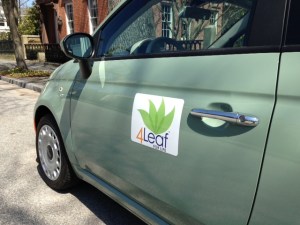
My new car is also a 4Leaf-er. A "green" Fiat 500 that gets over 40 mpg.

My new car is also a 4Leaf-er. A “green” Fiat 500 that gets over 40 mpg on regular gasoline.

While reading this article, I kept thinking about the blog I wrote about how the 42-year-old search for the cure now “has a life of its own.” (See link below) In that blog, I drew the analogy between taking care of one’s automobile and taking care of one’s body.

But unlike our automobiles, we only get one body per customer. Even so, most Americans devote much more attention to the type of fuel they put in their cars than the fuel they put into their own bodies. Searching for the cure—now has a life of its own.

The Bottom Line. Since the 6,000-word article in the NY Times provided no useful information when it comes to preventing cancer, I have decided to share seven points from The China Study. This is an excerpt from my special page on Cancer in general (See link below).

This should be required reading for all members of Congress.

Guess the author of the 6,000 word article never read this great book.

So why aren’t we being told about the ability of a whole foods, plant-based diet to prevent most cancers? I will let Dr. T. Colin Campbell (of Cornell) answer that question—with a few lines from The China Study (Chapters 1, 3 & 8)

1. Despite thirty years of the massively funded War on Cancer, we have made little progress. Contrary to what many believe, cancer is not a natural event.

2. Adopting a healthy diet and lifestyle can prevent the majority of cancers in the United States. Old age can and should be graceful and peaceful.

3. [C]asein (the protein in cow’s milk) and very likely all animal proteins, may be the most relevant cancer-causing substances that we consume.

4. There is enough evidence now that the U.S. government should be discussing the idea that the toxicity of our diet is the single biggest cause of cancer.

5. There is enough evidence now that doctors should be discussing the option of pursuing dietary change as a potential path to cancer prevention and treatment.

6. Our institutions and information providers are failing us. Even cancer organizations, at both the national and local level, are reluctant to discuss or even believe this evidence.

7. Food as a key to health represents a powerful challenge to conventional medicine, which is fundamentally built on drugs and surgery.

Counting this one, I have now posted a total of fifty blogs on cancer in the past two years. One of them ended up with a “survivor” firing me as a friend. Maybe someday, she and the millions of other cancer victims out there will understand that our nation’s “search for the cure” has done practically nothing to prevent the occurrence in the first place.

My goal here is to help the masses who remain completely uninformed about the simplicity of cancer prevention—providing them with the simple message that they will never get from the nation’s prominent cancer organizations. (See #6 in the above list.) Want to learn more about our nation’s HUGE cancer business? Check out the last blog listed below.

Handy 4-piece take-charge-of-your-health kit—from Amazon.com

Want to find out how healthy your family is eating? Take our free 4Leaf Survey. It takes less than five minutes and you can score it yourself. After taking the survey, please give me your feedback as it will be helpful in the development of our future 4Leaf app for smartphones. Send feedback to jmorrishicks@me.com

International. We’re now reaching people in over 100 countries. Follow us on Facebook and Twitter or get daily blog notices by “following” us in the top of the right-hand column. For occasional updates, join our periodic mailing list.

To order more of my favorite books—visit our online BookStore now

J. Morris Hicks, working daily to promote health, hope and harmony on planet Earth.

For help in your own quest to take charge of your health, you might find some useful information at our 4Leaf page or some great recipes at Lisa’s 4Leaf Kitchen.

Got a question? Let me hear from you at jmorrishicks@me.com. Or give me a call on my cell at 917-399-9700.

SHARE and rate this post below.

—J. Morris Hicks, board member, T. Colin Campbell Foundation
Posted in Cancer | 3 Comments

Reflecting on the ancient past; contemplating the future

A visit to the Metropolitan Museum inspires some “big picture” thinking.

Met MuseumScientists report that the human species is about 200,000 years old. And that estimate squares with the oldest exhibit at the Metropolitan Museum of Art in New York City. While visiting the museum on April 27th, I was struck by the fact that the vast majority of the exhibits were less than 3,000 years old (1,000 BC until today)

The next day, I found myself wondering what the oldest exhibit at the Met might be. I was guessing maybe 2,000 BC—and I was not even close. According to Wikipedia, “The oldest items at the Met, a set of Archeulian flints from Deir el-Bahri which date from the Lower Paleolithic period (between 300,000 – 75,000 BC), are part of the Egyptian collection.”

So those items might be as old as the scientists’ estimate for our species—200,000 years. But suffice it to say, there weren’t many humans around 200,000 years ago and those who were weren’t inflicting much if any damage on the planet.

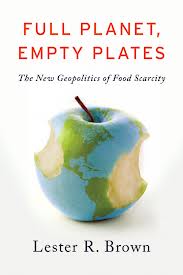
Like ours, Mr. Brown's book features a single apple on the cover. And like our apple, his tells a story.

Like ours, Mr. Brown’s book features a single apple on the cover. And like our apple, his tells a story.

That didn’t really begin until just over 200 years ago when our species hit the one billion population mark. It took us 199,800 years to reach one billion—and only 200 more years to reach 7 billion. Author and global environmental analyst described it best in his new book, “Full Planet, Empty Plates.”

Throughout most of human existence, population growth has been so slow as to be imperceptible within a single generation. Reaching a global population of 1 billion in 1804 required the entire time since modern humans appeared on the scene. To add the second billion, it took until 1927, just over a century. Thirty-three years later, in 1960, world population reached 3 billion. Then the pace sped up, as we added another billion every 13 years or so until we hit 7 billion in late 2011.

One of the consequences of this explosive growth in human numbers is that human demands have outrun the carrying capacity of the economy’s natural support systems— its forests, fisheries, grasslands, aquifers, and soils. Once demand exceeds the sustainable yield of these natural systems, additional demand can only be satisfied by consuming the resource base itself. We call this overcutting, overfishing, overgrazing, overpumping, and overplowing.

It is these overages that are undermining our global civilization. The exponential growth that has led to this explosive increase in our numbers is not always an easy concept to grasp. As a result, not many of us— including political leaders— realize that a 3 percent annual rate of growth will actually lead to a 20-fold growth in a century.

The French use a riddle to teach exponential growth to schoolchildren. A lily pond, so the riddle goes, contains a single leaf. Each day the number of leaves doubles— two leaves the second day, four the third, eight the fourth, and so on. Question: “If the pond is full on the thirtieth day, at what point is it half full?” Answer: “On the twenty-ninth day.” Our global lily pond may already be in the thirtieth day.  Click here to purchase Mr. Brown’s new book on Amazon.

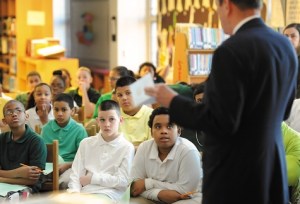
J. Morris Hicks speaking to the sixth graders in New London, CT

J. Morris Hicks speaking to the sixth graders in New London, CT

Humans, relative newcomers to planet Earth. In my recent speech to the entire sixth grade class at the middle school in New London, I told them about the fact that our home (planet Earth) had been supporting life for roughly four billion years.

In order to help them visualize what a small part of the planet’s history has included humans, I asked them to imagine that all 4 Billion years of the Earth’s history was crammed into one single year.

If all of history was one single year, humans reached the 200 million population mark around the time of Christ—about twenty seconds ago. And after finally reaching the one billion population mark in 1804, we’ve added another six billion people in just the last two seconds. And during the last fifty years (one half of one second of that single year), We humans have inflicted more damage on the fragile harmony of nature than all previous generation of humans for the past 200,000 years combined.

Former Amazon forest; now being used to grow soybeans to feed to pigs in China

Former Amazon forest; now being used to grow soybeans to feed to pigs in China

Land Grabs, robbing from the poor to feed the rich. In Chapter 10 of Mr. Brown’s book, he describes the latest tragedy that is taking place all over the world. With seven billion humans and adding another billion every 13 years, we’re simply running out of land.

What is new now is the scramble to secure land abroad for more basic food and feed crops— including wheat, rice, corn, and soybeans— and for biofuels. These land acquisitions of the last several years, or “land grabs” as they are sometimes called, represent a new stage in the emerging geopolitics of food scarcity. They are occurring on a scale and at a pace not seen before.

Among the countries that are leading the charge to buy or lease land abroad, either directly through government entities or through domestically based agribusiness firms, are Saudi Arabia, South Korea, China, and India. Saudi Arabia’s population has simply outrun its land and water resources. The country is fast losing its irrigation water and will soon be totally dependent on imports from the world market or overseas farming projects for its grain. Click here to purchase Mr. Brown’s new book on Amazon.

The Bottom Line. We humans have three very serious problems: our population, the way we live and the way we eat. Eventually, all of them will be corrected, but for now—the most powerful move that we humans can make is to move aggressively in the direction of a whole foods, plant-based diet for all humans.

If all of the people that are now eating the typical Western diet did that today, we’d free up a massive land area roughly twice the size of the United States. And we shouldn’t use that “freed up” land to grow our population and feed more people, we should return that land to Mother Nature, from whom we stole it in the first place.

Handy 4-piece take-charge-of-your-health kit—from Amazon.com

Want to find out how healthy your family is eating? Take our free 4Leaf Survey. It takes less than five minutes and you can score it yourself. After taking the survey, please give me your feedback as it will be helpful in the development of our future 4Leaf app for smartphones. Send feedback to jmorrishicks@me.com

International. We’re now reaching people in over 100 countries. Follow us on Facebook and Twitter or get daily blog notices by “following” us in the top of the right-hand column. For occasional updates, join our periodic mailing list.

To order more of my favorite books—visit our online BookStore now

J. Morris Hicks, working daily to promote health, hope and harmony on planet Earth.

For help in your own quest to take charge of your health, you might find some useful information at our 4Leaf page or some great recipes at Lisa’s 4Leaf Kitchen.

Got a question? Let me hear from you at jmorrishicks@me.com. Or give me a call on my cell at 917-399-9700.

SHARE and rate this post below.

—J. Morris Hicks, board member, T. Colin Campbell Foundation
Posted in Big Picture, Sustainability, World Hunger | 5 Comments

How many people do you know that have heart disease?

Probably a great many more than you think.

Think of how many people you know over thirty; then multiply that number by 90%. You see, most people in the United States over the age of thirty already have heart disease, although most of them have never experienced the first symptom. And far too often that first symptom is a deadly heart attack.

That’s what happened to Mike—a good friend of mine in Stonington, CT, a few weeks ago. He was 71, an avid skier, sailor, exercised regularly and was apparently in very good health. While expecting to enjoy many more years of travel, leisure, volunteer work and great times with friends and family—his life was snatched away in an instant. It is the memory of Mike that inspired me to write this post today. Maybe his story will help to save others; he would like that.

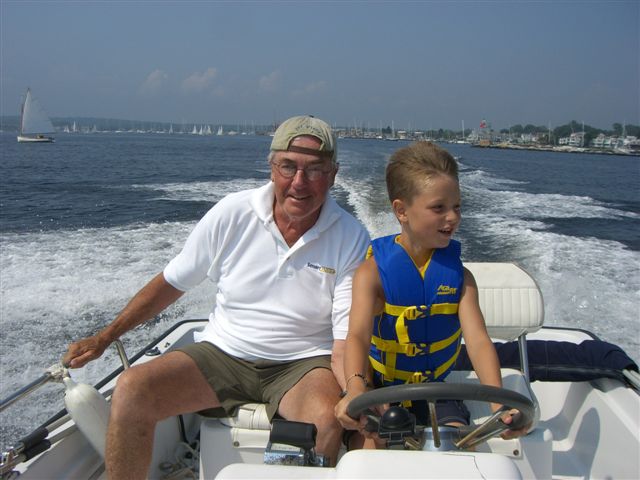
This photo illustrates the way I will remember my good friend—enjoying time on the water with me and my oldest grandson, Collin. Unfortunately for Mike’s grandchildren, they will not be able to sail with their grandfather ever again. Because Mike died of heart disease on April 5, 2013.

In the summer of 2009, my oldest grandson, Collin (7), stayed with me for a week while he was here for “sailing camp” at the SHYC foundation. In his thoughtful and generous manner (as always), Mike asked Collin (at breakfast) if he’d like to take a motorboat ride that afternoon. Naturally, he responded in a gleeful affirmative. A few hours later, as the fog lifted, the three of us enjoyed a spirited tour of Stonington Harbor---with young Collin at the helm.

My friend Mike in 2009. That summer, my oldest grandson, Collin (7), stayed with me for a week while he was in town for “sailing camp.” In his thoughtful and generous manner (as always), Mike asked Collin (at breakfast) if he’d like to take a motorboat ride that afternoon. Naturally, he responded in a gleeful affirmative. A few hours later, as the fog lifted, the three of us enjoyed a spirited tour of Stonington Harbor—with young Collin at the helm.

So did Mike know that he had heart disease? I doubt it, although I know that he visited a number of physicians regularly and he may have been taking cholesterol lowering drugs. But no one dies from high cholesterol. Cholesterol is just a bio-marker.

People die from heart disease—a build-up of plaque in the arteries. Even if Lipitor may keep total cholesterol below 200, it does nothing to address the causation of the disease and it does nothing to remove the deadly plaque that has built up from a lifetime of eating the artery-clogging Standard American Diet (The S.A.D.).

Caldwell Esselstyn, MD. Director of Cardiovascular Disease Prevention and Reversal at the Wellness Institute of the Cleveland Clinic.

Caldwell Esselstyn, MD. Director of Cardiovascular Disease Prevention and Reversal at the Wellness Institute of the Cleveland Clinic.

Heart disease at age 30? What’s up with that? I first learned about it from Dr. Caldwell Esselstyn, Jr., when he told the story of American soldiers who died fighting in Korea back in the early fifties. Autopsies at the time revealed that 80% of those young men had advanced coronary artery disease.

But guess what? Their Asian counterparts (who ate a mostly whole foods, plant-based diet) had perfectly healthy arteries—not a trace of heart disease. We’re talking sixty years ago. We’re talking about the #1 killer in the United States and most of the Western world. So why is this news not being shared with the public?

The Story of Dr. Sprouts. When Dr. Esselstyn began reversing heart disease in ALL of his patients at the Cleveland Clinic back in the early eighties, guess what the cardiologists there started calling him? Dr. Sprouts. They ridiculed him because he had figured out a way to completely cure heart disease—by simply prescribing whole, plant-based foods like broccoli, oatmeal and Brussels sprouts.

So why are the cardiologists and other mainstream medical doctors not telling us this wonderful news today—over thirty years later? The short answer is MONEY. The longer answer includes a few more words: power, ego and control. If you want to learn the entire gory story about our dysfunctional health “care” system, order yourself a copy of Dr. Campbell’s new book, WHOLE. It starts shipping on May 7.

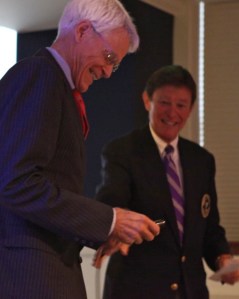
J. Morris Hicks turns the mike over to Dr. Caldwell Esselstyn

J. Morris Hicks turns the mike over to Dr. Caldwell Esselstyn

You might be wondering right now why J. Morris Hicks didn’t tell his friend Mike about preventing and reversing most chronic disease with nothing more than a whole foods, plant-based diet? Actually, in August of 2008, I arranged for Dr. Esselstyn to speak at our yacht club in Stonington. He spoke to a packed house and then we all enjoyed a health-promoting meal that had been designed by his wife Ann for the event.

But how many people took heed? Not many. Oh, some may have thought about what they were eating for a few days, but would soon forget about it when they next visited their own doctor. That’s because there’s about a 95% chance that their own doctor would be eating some version of the S.A.D. him/herself—meat, dairy, eggs and processed foods three meals a day, 365 days a year.

A truly sad situation. How many more unnecessary deaths will occur before our health care professionals start telling us the truth about the primary cause of chronic disease? How can you help accelerate the process?

The Bottom Line. Even though the news is out there quite a bit these days, people are not likely to “radically” change their diet-style until they get crystal clear advice from their own medical doctor. Even though President Clinton went public with his heart-healthy vegan diet in 2010 and even though CNN aired the powerful “Last Heart Attack” special with Dr. Sanjay Gupta in 2011—most people are not going to change their eating habits until they start hearing it from their doctors.

Mike would probably still be alive today if he’d been getting “Dr. Esselstyn” type of advice from the five or six doctors who comprised his health “care” team. What can you do to help spread the word? What can you do to help your doctor discover the powerful disease-reversing truths that were discovered over a half-century ago? Here’s what you can do: Prevent Reverse

  1. Ask your doctor to watch “The Last Heart Attack.” If he/she hasn’t seen it when you go for your next visit, get a new doctor until you find one that will listen. You want a doctor who will learn to promote health—even though it doesn’t pay as well as “managing disease.” “The Last Heart Attack” CNN
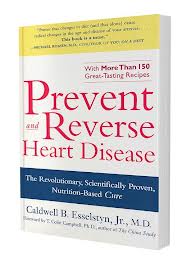
  2. Give a copy of Dr. Esselstyn’s book to your doctorClick here to purchase Prevent/Reverse on Amazon. Again, if he/she doesn’t read it and discuss it with you, get a new doctor.
  3. Send this blogpost to all of your friends and ask them to see if they can get their doctors to watch “The Last Heart Attack” and read Dr. Esselstyn’s book.

Aside from the millions of unnecessary deaths in the United States each year, the cost of “managing disease” is bankrupting our nation. It’s also beginning to impact our defense spending and jeopardizing our national security. Not only that, the way we eat is the leading cause of global warming, it is grossly unsustainable and would require over two planet Earths to feed all seven billion of us if everyone ate the way we do in America. 

Finally, do all of the above for the future “Mikes” out there who are totally unaware of the disease that is quietly going about putting their heart out of business.

Handy 4-piece take-charge-of-your-health kit—from Amazon.com

Want to find out how healthy your family is eating? Take our free 4Leaf Survey. It takes less than five minutes and you can score it yourself. After taking the survey, please give me your feedback as it will be helpful in the development of our future 4Leaf app for smartphones. Send feedback to jmorrishicks@me.com

International. We’re now reaching people in over 100 countries. Follow us on Facebook and Twitter or get daily blog notices by “following” us in the top of the right-hand column. For occasional updates, join our periodic mailing list.

To order more of my favorite books—visit our online BookStore now

J. Morris Hicks, working daily to promote health, hope and harmony on planet Earth.

For help in your own quest to take charge of your health, you might find some useful information at our 4Leaf page or some great recipes at Lisa’s 4Leaf Kitchen.

Got a question? Let me hear from you at jmorrishicks@me.com. Or give me a call on my cell at 917-399-9700.

SHARE and rate this post below.

—J. Morris Hicks, board member, T. Colin Campbell Foundation

Posted in Bill Clinton, Heart Disease | 7 Comments