What I choose to to eat is my own business. Well, not entirely.

The “second-hand smoke” of our meat-laden diet

Back in the 40′s and 50′s, smoking was almost as common among adults as the consumption of the rich western diet is today.  It seemed that everyone was smoking back then — movie stars, doctors, soldiers, executives, teachers, etc.

Just like smoking; we now know that what you eat is everyone's business.

Then, along came a surgeon-general’s warning on the pack about cigarette smoking being hazardous to your health.  That stopped some of the people, but millions of people kept right on puffing; claiming that if I want to smoke, I’m not hurting anyone but myself.  This is where we are right now with the rich western diet, consisting of meat and dairy three meals a day by most people in the western world.

Fast-forward another few decades and it became common knowledge that one could be injured by second-hand smoke; meaning that you might get lung cancer just by working in an office with a bunch of smokers.  This gradually led to the outlawing of cigarettes in the workplace, sections reserved for smokers on planes, trains and restaurants; then the complete elimination of ALL smoking in public places in many states.  This trend has resulted in less smoking — many people stopped smoking and far fewer people are starting in the first place.  That’s because the majority of the people now agree that smoking is a dirty, nasty, harmful and expensive habit — and that it is simply not cool anymore.

Clean air, free of second-hand smoke, is everyone's right. So is a healthy environment, enough arable land to feed the world's hungry and conservation of our finite supply of fossil fuels.

The transition away from smoking has taken 50 years; yet there are still millions who continue to smoke; but they’re legally forbidden to smoke around others except in their own homes.  That means that the only citizens we’ve not protected from smoking are the children of the smokers. Sad, for sure, but this story gets much worse.

In today’s modern western world, over 95% of the population (adults and children) are eating the typical western diet — a diet that has been proven to be unhealthy, unsafe, extremely damaging, incredibly wasteful, horribly inhumane, and completely unsustainable.  In a February 1 article in the New York Times, Mark Bittman said this about our good old American diet of meat and dairy at every meal,  ”It would be hard to devise a more wasteful, damaging, unsustainable system.”

Although our rich western diet of choice is causing far more damage throughout the world than any second-hand smoke could possibly cause, that fact simply hasn’t been shared and/or accepted enough people to make much of a difference. And, unlike smoking, the tiny children are suffering from this diet-style as they become obese at record levels and start out their lives on a highly destructive diet that will lead to record levels of heart disease, cancer, diabetes, osteoporosis, etc.  But, like smoking, the adults of today, for the most part, still think that what they eat is their own business and that there choice of food will not harm anyone but themselves. Wrong.

We all must eventually accept the fact that we are all connected in this world.  As Dr. T. Colin Campbell and his son, Nelson, wrote in the foreword of our book,

Most of us live apart from Nature, within artificially constructed environments that bear little resemblance to the mountains, meadows, forests and streams experienced by our ancestors. And living apart from Nature, we too often forget that we are part of an interconnected whole. No matter how hard we try, however, we cannot escape this fact forever. We can construct our material world and engage in individualistic pursuits, but eventually must face the fact that we do not live on islands.

We are connected to one another and to the larger natural world of which we are still a part.There may be no better illustration of this fact than the way we eat. The decision of what to put at the end of our fork is a private decision and one that seems to have no relevance beyond the edges of our dinner plate. But the truth is this: the effects of what we eat ripple round and round the world … and this is the story of “Healthy Eating — Healthy World” by J. Morris Hicks.

In 2006, the U.N. published a 407-page report entitled “Livestock’s Long Shadow” that summarized the extreme damage that our raising of livestock is inflicting on our environment in four major areas:  Land & forests, Water, Climate and Biodiversity. The report was full of powerful bits of information, such as, our meat laden diet causes 30% more global warming than all of transportation in the world…combined. Yet, Al Gore failed to even mention it in his 2006 movie, An Inconvenient Truth.

Our health and our environment is being sacrificed for one reason only — we like the taste of cooked animal flesh.  Sure, second-hand smoke is harmful and inexcusable; but it doesn’t hold a candle to the destruction and unsustainability of our meat-based diet. We’re seriously talking about the survival of the planet itself.  So how did we get into this mess and what can be done about it? First, a little history.

There are over one million named species on the planet.  Roughly 50,000 are vertebrates and about 15,000 of those are mammals.  In the millions of years of history, the human being has distinguished himself as the only species that has not lived in harmony with nature.

Many have referred to the human race as the “infestation of planet-earth” as he has selfishly ridden roughshod over the entire world, selfishly satisfying his own cravings. In a Times Magazine article in November of 2010, the late Mark Twain described mankind thusly:

Mankind “was not made for any useful purpose, for the reason that he hasn’t served any; that he was most likely not even made intentionally; and that his working his way up out of the oyster bed to his present position was probably a matter of surprise and regret to the creator.

Eventually, we must take responsibility for our actions and correct the errors of our past. The problem is that most people are simply unaware of the information in this post. The first step in solving our dilemma is getting the word out to as many people as possible. That’s what we have done in our book and will continue to do so in other mediums until this inevitable grassroots movement of change eventually takes hold for good.

If you like what you see here, you may wish to join our periodic mailing list. Also, for help in your own quest to take charge of your health, you might find some useful information at our 4-Leaf page. From the seaside village of Stonington, Connecticut – Be well and have a great day.

If you’d like to order our book on Amazon,  visit our BookStore now.

—J. Morris Hicks…blogging daily at HealthyEatingHealthyWorld.com

PS: Occasionally an unauthorized ad may appear beneath a blog post. It is controlled by WordPress (a totally free hosting service). I do not approve or personally benefit whatsoever from any ad that might ever appear on this site. I apologize and urge you to please disregard. 
Posted in Big Picture, Environment, Health in General, Suffering of Animals, Sustainability | Leave a comment

4Leaf eating, Part 5 — Dining outside the home

Challenging for some – great fun for the well-prepared

When dining outside the home; look for restaurants that are likely to have fresh produce in the kitchen.

Since most Americans consume more than half of their calories outside the home, it’s very important that you learn how to practice your 4Leaf eating experience in restaurants, in friend’s homes and while traveling.

Let’s begin with the restaurants. The most important thing is to frequent eateries that actually have fresh grains, vegetables, fruits and legumes in their kitchen at any given time. As we know, many restaurants primarily rely on frozen goods, meat and dairy for the vast majority of their calories served. Not even Houdini could order a 4-Leaf meal in one of those places. Here are my six simple steps to ordering great meals in almost any restaurant except for Fast Food.

If you want to order a 4-Leaf meal in a restaurant, they need to the kind of place that has lots of fresh produce in the kitchen.

“Hicks Six” Creative Ordering

  1. First, look for some healthy side dishes on the menu.
  2. Then, scan the menu looking for clues to what other kinds of healthy veggies they have in the kitchen.
  3. Look at entrees carefully and make a mental note of the healthy items they are serving with them..also ask your server for ideas, maybe saying that your doctor has you on a special diet (Dr. Campbell, Dr. Esseslstyn, Dr. Fuhrman, Dr. McDougall, etc.).
  4. Once you find out what they have, you can talk to your server about portion size and meal preparation details — like cooking with no oil or butter and no added salt.
  5. When ordering pasta, make sure that at least 2/3 of the dish is veggies, not pasta…and always ask for whole grain bread, pasta or rice.*
  6. As for the “token” vegetarian entree; forget it. It is typically loaded with oil, white flour and cheese; derives very few calories from whole plants and is rarely even close to being a health-promoting 4Leaf meal.

After a little practice, this creative ordering can be a lot of fun. Not only will you be enjoying healthy and delicious meals that you create yourself, you’ll be saving roughly $10 every time you dine. As a single man, I save enough going out every night to pay for ALL of the groceries that I purchase at the supermarket.

Most people think that this would be a fairly healthy meal but with the cheese on top, the oil, the white flour pasta and precious few vegetables -- this would be a 1-Leaf meal at best.

* If you order a pasta primavera off almost any menu, it will typically be a huge bowl of white pasta, a few tiny vegetables here and there and covered with some combination of oil and/or cream sauce. Bottom line — less than 10% of your calories will be from whole plants — scoring in the “No Leaf” level on our “4Leaf” scale. In your own 4Leaf pasta dish, you will want to make sure that most of the calories come from the veggies.

Social Situations

So what about parties and eating at friends’ homes? This can be more difficult but not impossible. If it’s a cocktail party like the one shown here, simply dig into the carrots, broccoli, celery and hummus and avoid the cheese, shrimp and deviled eggs. And, to play it safe, have a snack before you go and just enjoy your cocktail sans the solid food.

Yes, you can eat 4-Leaf at most cocktail parties - not counting the beverages.

If it’s a sit-down dinner, you can tell your hostess in advance that your doctor has you on a restricted diet and you’ll just be enjoying her salad, vegetables and bread this evening. Depending on how well you know the hostess, the less said the better.

Healthy Eating on the Road

Finally, for traveling, I like to carry easy-to-eat items like bananas, apples, oranges, and nuts for the plane or train. Then, at the airports, I always look for the Mexican or Asian places, where you can usually get at least a 3-Leaf meal, perhaps with a little more oil and salt that you’d be able to order at a fine restaurant — like the Water Street Cafe in Stonington, CT….pictured above.

That’s about it — it only takes about a month to form a new habit. Once you have an established 4Leaf routine in your life, there is no need to count calories or log every meal in order to consistently eat at the 4Leaf level. Just use the simple guidelines in this 5-part series. Need a refresher, just return to the 4Leaf Program page.

Tips on Eating Out by Dr. John McDougall

If you like what you see here, you may wish to join our periodic mailing list. Also, for help in your own quest to take charge of your health, you might find some useful information at our 4Leaf page. From the seaside village of Stonington, Connecticut – Be well and have a great day.

If you’d like to order our book on Amazon,  visit our BookStore now.

—J. Morris Hicks…blogging daily at HealthyEatingHealthyWorld.com

PS: Remember, this program is all about Celebration, not deprivation. Forget the fake meats, tofu and the like — and get serious about enjoying the health promoting and world-changing power of 4-Leaf meals that derive over 80% of their calories from whole plants — in nature’s package.

PPS: Occasionally an unauthorized ad may appear beneath a blog post. It is controlled by WordPress (a totally free hosting service). I do not approve or personally benefit whatsoever from any ad that might ever appear on this site. I apologize and urge you to please disregard. 
Posted in 4Leaf for Life, Healthy Eating 101, Social Challenges | Leave a comment

“4-Leaf” eating, Part 4 — shopping for groceries

If it goes in your cart, it is almost certain to end up in your stomach.

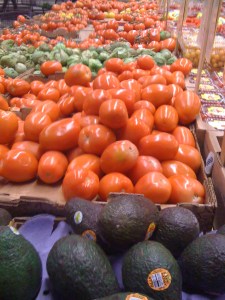
Spend most of your time in the produce aisle shopping for healthy items with no labels.

Since most of us eat so many of our calories outside the home, we must take special care to make sure that our home meals are simply the healthiest that they can possibly be. How do we do that?

If you are really committed to the 4-Leaf Program, then you need to start by physically removing ALL of the bad stuff from your kitchen. See rule above. Here are the things that must go:

  • salt
  • sugar
  • all meat & dairy (this includes all cheese and milk)
  • oil
  • salad dressings with oil
  • cereals with sugar
  • frozen dinners
  • all processed foods
  • white flour, white pasta

You get the picture, if it’s a product that will make it difficult for you to make it to the 4-Leaf level, then get rid of it. You will have plenty of temptations when you’re eating outside the house; so just get rid of the ones that you have at home. My recommendation is to give them to charity.

Now you’re ready to go shopping for groceries. Three simple rules.

Rule #1. Buy over 80% of your calories in the fresh produce aisle – with one exception — the whole grains, oatmeal and legumes that are packaged in plastic bags or cartons.

Rule #2. Follow the advice of nutrition guru Jeff Novick, “Don’t believe anything on the front of the package.” That information is there for the sole purpose of selling the product. An example of the trickery you will find in this game — an analysis of 2% Milk ingredients reveals that 37.5% of the calories are derived from fat. Do the math yourself the next time you’re in the store…just check out the numbers on the Nutrition Facts label.

Rule #3. When buying packaged goods like cereal, look at the Nutrition Facts label and check out the following:

The BK Whopper — Like most foods in the typical western diet — a recipe for disaster

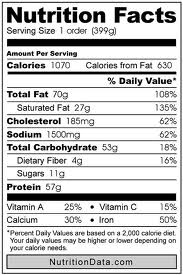
  • Percent of calories from fat. If you want to eat 4-Leaf and average less than 20% of your total calories from fat, then try not to ever purchase anything with over 25 or 30% fat. (See example below)
  • Sodium. Make sure that the milligrams of sodium is less than the calories per serving. The Whopper at right fails by a score of 1500 to 1070.
  • Avoid any cholesterol, saturated fat and added sugars. The example here fails miserably on all of these deadly items.
  • List of ingredients. These will be listed in ranked order of quantity, so if fructose is listed first, don’t buy it. You’re looking for the word “whole” near the top of this list. And, as a general rule, don’t buy anything that’s got more than five ingredients — usually a long list of items you can’t pronounce.

More on the above “Nutrition Facts” Example

We chose the BK Whopper to illustrate how to use the Nutrition Facts label found on all packaged foods in your grocery store. No, you can’t buy the Whopper in your grocery store, but you need to know what’s in it — so you won’t ever buy fast foods ever again for yourself or your family.

Buying only “4-Leaf” foods ensures that you’ll be eating mostly “4-Leaf” meals, like this one — my favorite Sailors Daily Oatmeal

Percent of fat. You can easily see that the 630 calories from fat is well over half the 1070 total calories…in fact it’s 59%. It also fails the sodium rule with a “whopping” 1500 milligrams — 430 more than the # of caloires. It’s also loaded with saturated fat, cholesterol and added sugar. But it does have tomato, lettuce, pickle, onion and seeds — a total of 14 calories…less than 2% of the meal. It also has a measly 4 grams of fiber — from a half-day’s worth of calories.

What about the good things like fiber and protein? Not a problem. If you’re buying over 80% of your calories in the fresh produce aisle, you will soon be consuming over 60 grams of fiber per day and you will always get just the right amount of protein, carbohydrates and fat — without even trying. Still worried about protein, click here for a recent post on that topic. For more background on our 4-Leaf Program, click here.

For amusement, I like to casually observe the contents of the carts of other shoppers. Not surprisingly, there is a definite correlation between those contents and the body types of the shopper. More importantly, there is also the crucial matter of vibrant health to consider.

Click here to visit the final “eating outside the home” segment of this 5-part series on 4-Leaf eating.

If you like what you see here, you may wish to join our periodic mailing list. Also, for help in your own quest to take charge of your health, you might find some useful information at our 4-Leaf page. From the seaside village of Stonington, Connecticut – Be well and have a great day.

If you’d like to order our book on Amazon,  visit our BookStore now.

—J. Morris Hicks…blogging daily at HealthyEatingHealthyWorld.com

Posted in 4Leaf for Life, Healthy Eating 101 | 2 Comments