What “can” you eat at your next dinner party?

And what, if anything, do you tell the hostess in advance?

Lots of dietary restrictions these days; what’s a hostess to do? From a recent New York Times article: (See link below)

It’s becoming harder for Americans to break bread together. Our appetites are stratified by an ever-widening array of restrictions: gluten free, vegan, sugar free, low fat, low sodium, no carb, no dairy, soyless, meatless, wheatless, macrobiotic, probiotic, antioxidant, sustainable, local and raw.

Though medical conditions like celiac disease and severe allergies have long relegated a small percentage of diners to rigid diets, more and more eaters outside this group appear to be experimenting with self-imposed limits, taking a do-it-yourself, pick-and-choose approach to restricting what they consume.

In the above list, there are 16 different kinds of dietary restrictions—and I’m sure there are many more. So I can certainly appreciate how the hostess of a large dinner party might have a difficult time pleasing everyone. But, as the article pointed out, you don’t have to delight every guest—with every single dish. That’s why potluck dinner parties work best for larger groups—15 or more. It just raises the odds that EVERYONE will find at least a few dishes that they “can” and “will” eat.

A formula for enrichment in your life

Maybe our 4Leaf Potluck Supper Club concept is a formula for what lies ahead in the world of social dining. Maybe in the future, in addition to clubs that are formed around the common interest in a sport (golf, tennis, sailing, cricket, skiing) the social dining clubs of the future may include people with a common interest in a particular way of eating.

Here’s how our monthly 4Leaf Potluck Supper Club works in Stonington, CT; the emailed invitation contains the following information:

  • When: Date and time— It’s basically a BYOB cocktail party with lots of healthy food.
  • Location: 103 Main Street in Stonington Borough
  • What: Bring a 4Leaf* “tapas” dish to share; we’ll advise you of attendance in a few days. You’re basically planning enough food for everyone to have a small side dish of whatever you bring. There is no MAIN course so to speak. Questions: visit 4leafprogram.com (mostly whole plants; no dairy, meat or eggs)
  • Salad: The hosts will provide the salad, the ice, the dishes, etc.
  • Dress: Mid Summer Snappy Casual
  • Drinks: BYOB
  • Dessert: Who wants to bring the dessert for all?
  • RSVP: By return email to the party organizer

* (4Leaf means mostly whole, plant-based foods; no meat, dairy, eggs and easy on the oil or salt.)
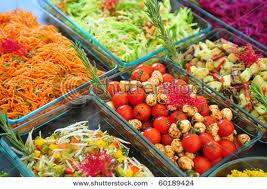
This is the kind of vegetable buffet that you’ll see at our monthly 4Leaf Supper Club gatherings.

That’s it. We don’t worry about the occasional person who might not eat soy, gluten, cooked food or whatever. With enough people, there are usually enough choices—so that everyone will have plenty to eat. Plus, we 4Leaf-ers have an advantage over the carnivores’ eating clubs; almost no one is allergic to vegetables.

As a 4Leaf eater (mostly whole plants) for the past ten years, I never worry about not getting enough to eat; that’s because there are almost always several choices of whole plants at every party I attend. While I may not load up on the main course of grilled steak, I can usually find all that I need from the side dishes, salads and the starch of the day.

And since I usually do a little snacking before I leave for the party, it really doesn’t take many whole plants to make me happy. So, unless it’s a formal sit-down kind of dinner, I rarely bother the hostess in advance with my self-imposed dietary restrictions.

A final comment. I happen to believe that a great many of our so-called dietary restrictions and food allergies would simply disappear if we all made a major shift in the direction of what nature intended for us to eat in the first place—whole, plant-based foods.

Handy 4-piece take-charge-of-your-health kit—from Amazon.com

Want to find out how healthy your family is eating? Take our free 4Leaf Diagnostic Survey. It takes less than five minutes and you can score it yourself. After taking the survey, please give me your feedback as it will be helpful in the development of our future 4Leaf app for smartphones. Send feedback to jmorrishicks@me.com

International. We’re now reaching people in over 100 countries. Follow us on Facebook and Twitter or get daily blog notices by “following” us in the top of the right-hand column. For occasional updates, join our periodic mailing list.

To order more of my favorite books—visit our online BookStore now

J. Morris Hicks, working daily to promote health, hope and harmony on planet Earth.

For help in your own quest to take charge of your health, you might find some useful information at our 4Leaf page or some great recipes at Lisa’s 4Leaf Kitchen.

Got a question? Let me hear from you at jmorrishicks@me.com. Or give me a call on my cell at 917-399-9700.

SHARE and rate this post below.

Blogging daily at hpjmh.com…from the seaside village of Stonington, Connecticut – Be well and have a great day.

—J. Morris Hicks, board member, T. Colin Campbell Foundation
Posted in 4Leaf for Life, Social Challenges | 1 Comment

A message from John Robbins, compassionate human

With the help of John Robbins—back in the spring of 2003, I experienced my blinding flash of the obvious when it comes to what we should be eating. After beginning my quest for knowledge about food in late 2002, I read about fifty books before devouring John’s Diet for a New America over Memorial Day weekend.

I had already learned all about the health benefits of a whole foods, plant-based diet but had not connected the dots regarding the environment, our energy supply, world hunger or the suffering of animals.

Diet for a New America helped me connect those dots and suddenly conclude:

Oh my God, we’re eating the wrong food!

In addition to Diet for a New America, I have also learned a great deal from some of John’s other books, particularly The Food Revolution and Healthy at 100. Along with Dr. T. Colin Campbell and a few medical doctors, John has been one of my primary mentors when it comes to grasping the big picture about the food choices of the human race.

Promoting health, hope and harmony on planet Earth

What’s good for our health, is also good for the planet — and all of her creatures.

Not only did John help me see the big picture, but he also wrote an endorsement blurb for our own Healthy Eating, Healthy World:

 “J. Morris Hicks has done us all a tremendous service.  He has put together a simple, clear, and profoundly helpful guide to the extraordinarily powerful benefits of plant-strong nutrition.  If you want to be healthy, read this amazing book.  In a world hungry for hope, this book arrives at precisely the right time.”

Although I have not met him in person, I remain a huge fan of John Robbins and just recently came across the following video in which he talks about his latest book, No Happy Cows. Take a couple of minutes and get to know this great American writer and activist.

In my opinion, John Robbins has probably done more than any single human to help steer us all back to the natural diet for our species. He’s been talking about GMO longer than anyone and he has tirelessly gone about helping to make the world a better place–passing up the opportunity to be wealthy. Here’s what Wikipedia has to say about him:

Robbins is the son of Irma Robbins and Baskin-Robbins co-founder Irv Robbins. He graduated from the University of California, Berkeley, in 1969, and received a Master’s Degree from Antioch College, in 1976. Rather than following the ice-cream parlor legacy of his father, he left the company to seek a life he found more rewarding.

He and his wife Deo were married on March 10, 1967. Robbins advocates a plant-based diet for personal and environmental health. He updated these ideas in his 2001 book The Food Revolution, which includes information onorganic food, genetically modified food, and factory farming. His 2006 book Healthy at 100, published by Random House, was printed on 100% post-consumer non-chlorine bleached paper, a first for a book from a major U.S. publisher.

A victim of the Bernie Madoff scam, you can help this great American by buying his books and spreading the word about his wonderful work.

February 2, 2014 update. I first published this blogpost in July of 2012, over a year before meeting John in person for the first time. That took place at a plant-based summit of 24 people at James and Suzy Cameron’s Santa Barbara Ranch in November of 2013. We have since become good friends and fellow environmentalists as we work together to help preserve Mother Nature’s ability to sustain humankind as a species. 

Handy 5-piece take-charge-of-your-health kit—from Amazon.com

Why should we be eating mostly plants? The “big picture” in 4 minutes.

Want to find out how healthy your family is eating? Take our free 4Leaf Survey. It takes 2 or 3 minutes and you can score it yourself. After taking the survey, please give me your feedback as it will be helpful in the development of our future 4Leaf app for smartphones. Send feedback to jmorrishicks@me.com

International. We’re now reaching people in over 100 countries. Follow us on Facebook and Twitter or get daily blog notices by “following” us in the top of the right-hand column. For occasional updates, join our periodic mailing list.

J. Morris Hicks, working daily to promote health, hope and harmony on planet Earth.

To order more of my favorite books—visit our online BookStore now

For help in your own quest to take charge of your health, visit our 4Leaf page and also enjoy some great recipes from Lisa’s 4Leaf Kitchen.

Got a question? Let me hear from you at jmorrishicks@me.com. Or give me a call on my cell at 917-399-9700.

SHARE and rate this post below.

—J. Morris Hicks, board member since 2012; click banner for more info:

Nutrition Certificate

Posted in Activism & Leadership, Big Picture | 4 Comments

Omega-3; more bad news than good these days

Sure, we need omega-3; but we don’t need it from fish.

Let’s face it, the meat, eggs and dairy people don’t have many weapons in their arsenal when it comes to the health benefits of eating their food. Oh, you’ll hear them talk about protein, calcium, Vitamin B-12, and Vitamin D. But those are simple to explain—as we did in Chapter 3 of our book. But make no mistake, the human’s need for omega-3 fatty acids is their single best argument for eating any kind of flesh or animal products whatsoever—especially fish.

Bad news about animal foods. As Howard Lyman stated in his book, No More Bull, (See link below)

“The bad news about animal foods never ends. With a single exception. This exception naturally has been widely reported because it remains the only good news out there about any animal-based products. Mainstream publications hype this lonely positive item concerning animal food because they wouldn’t want to appear to be advocating a vegetarian diet.

Surely you’ve heard that fish, particularly fatty fish, is good for your heart. In fact, you’ve probably heard it about a million times. Is it true? Yes and no. (Howard goes on to explain and also to suggest healthy sources of plant-based omega-3.)

What about the bad news? Just recently there was an article in the New York Times entitled, Omega-3s Don’t Cut Diabetics’ Heart Risks (See link below). A large trial found that supplements of omega-3 did nothing to prevent cardiovascular problems in people with Type 2 diabetes. Now, with ten percent of the U.S. population afflicted with diabetes and moving rapidly toward one in three—this is not great news for the omega-3 supplement pushers. The article stated:

After an average follow-up of more than six years, they found that the omega-3 and placebo groups showed no difference in rates of heart attack or stroke, or in number of deaths from cardiovascular disease or arrhythmia. Rates of hospitalization for heart failure or other cardiovascular problems were nearly identical.

What does Dr. Campbell say about omega-3? He says it’s mainly about the ratio of omega-6 to omega-3 in our diet. And most Americans get too much of the omega-6 from their meat and dairy diet—making the ratio of omega-6 to omega-3 too high. When they replace all that meat and dairy with whole plants (including things like flaxseeds, walnuts and chia), that ratio gets quickly into balance—without the fish or fish oils.

The Harvard School of Public Health

It gets worse. He also reports an alarming statistic from a Harvard Study regarding omega-3. From page 58 in our book:

Dr. Campbell also brings up a possible concern about consuming fish to get omega-3s. “If you’ve heard anything about omega-3 fatty acids, it’s that you need more of them to be healthy,” he says. Noting that you can’t always believe what you hear on the evening news, he offers the following from a 1999 Harvard study: “[C]ontrary to the predominant hypothesis, we found an increased risk of breast cancer associated with omega-3 fats from fish.”

The Bottom Line. We need omega-3, omega-6 and all the other essential vitamins. But we don’t need to get ANY of them from animals. And it’s a darn good thing, because our love affair with the meat, dairy, egg and fish diet-style is grossly unsustainable for much longer—for a host of reasons. 

Handy 4-piece take-charge-of-your-health kit—from Amazon.com

Want to find out how healthy your family is eating? Take our free 4Leaf Diagnostic Survey. It takes less than five minutes and you can score it yourself. After taking the survey, please give me your feedback as it will be helpful in the development of our future 4Leaf app for smartphones. Send feedback to jmorrishicks@me.com

International. We’re now reaching people in over 100 countries. Follow us on Facebook and Twitter or get daily blog notices by “following” us in the top of the right-hand column. For occasional updates, join our periodic mailing list.

To order more of my favorite books—visit our online BookStore now

J. Morris Hicks, working daily to promote health, hope and harmony on planet Earth.

For help in your own quest to take charge of your health, you might find some useful information at our 4Leaf page or some great recipes at Lisa’s 4Leaf Kitchen.

Got a question? Let me hear from you at jmorrishicks@me.com. Or give me a call on my cell at 917-399-9700.

SHARE and rate this post below.

Blogging daily at hpjmh.com…from the seaside village of Stonington, Connecticut – Be well and have a great day.

—J. Morris Hicks, board member, T. Colin Campbell Foundation

Posted in Omega 3 | 4 Comments