The solution to enabling Mother Nature to sustain our species longterm
 In a recent blog entitled “Do you breathe air, drink water and have sex?” (see link below) I was making the case for the above solution.
Why are we the only species who can’t figure out what we should be eating on our own? Why do we need thousands of scientists, doctors and dietitians who seem to disagree on everything? And what’s going to happen if we don’t get it right pretty soon? I decided to try to explain as simply as I could in just four minutes.
After watching this video, I urge you to take a look at the series of six blogs listed at the end of this piece.
VIDEO: The 4Leaf Story in 4 minutes
This video was produced by Giles Morgan, a young man I met through his mother, Kyrena Robinson, one of my blog readers who works at nearby Pfizer. For your convenience, I have provided the entire script below—along with a dozen PowerPoint slides.
The Script for My Video
Hello, I’m J. Morris Hicks and I want to talk about the simple solution to the food problem that is wrecking our health, our environment and even threatening our very existence.
My study on this topic began in 2002, when I became curious about the optimal diet for humans. After reading 30 or 40 books on the subject, I concluded that a whole foods, plant-based diet was probably best for our health. Then, over the same weekend in 2003, I read two more books that focused more on the environmental and social consequences of our food choices. That’s when I experienced my “blinding flash of the obvious,” saying: “Oh my God, we’re eating the wrong food!”
 So what is the “right” food? We begin to answer that by observing Nature, which has a diet-plan for all species. Some animals eat other animals; some animals eat plants and so forth. Animals whose DNA is almost identical to ours, gorillas, eat nothing but raw plants.
 Then, there are people like the Tarahumara of Mexico.
They eat mostly corn, squash, and beans. And guess what? They rarely experience ANY of our chronic diseases.
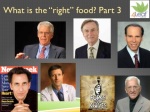 The clincher for me was disease reversal. Our book features five MDs who have enjoyed great success in reversing many chronic diseases—with whole, plant-based foods. Pictured along with Dr. T. Colin Campbell are images of those five pioneering medical doctors. Clockwise from Campbell are Barnard, Ornish, Esselstyn, McDougall and Fuhrman.
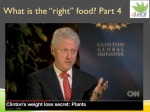 Smart people (like this man) are “getting it” regarding my blinding flash of the obvious. Three of the above experts (Esselstyn, Ornish and Campbell) influenced President Clinton to adopt a whole foods, plant-based diet in 2010. He reversed his heart disease, lost weight and has never looked better.
 Protein Myth is alive and well.
Yet, the strongest animals in the world like elephants and horses—eat nothing but raw plants.
Sustainability–Part I. Even if animal foods were the  healthiest diet for humans, eating them is simply not sustainable for much longer. On a per calorie basis, they require over ten times as much land, water and energy as a plant-based diet. If everyone ate the way we do in the USA, we’d need two planet Earths to feed us all and we only have one.
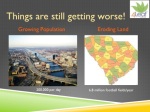 Sustainability—Part II. In a seriously overpopulated world that is running out of enough land to grow our food, we continue to add 200,000 people every day (a city the size of Grand Rapids, MI) and we lose an area of land the size of South Carolina to erosion every year.
 Need more evidence? Also endorsing the plant-based diet are the United Nations, Albert Einstein and, most recently, our nation’s largest healthcare company, Kaiser Permanente. From their Spring 2013 Journal. “Physicians should consider recommending a plant-based diet to all their patients…encouraging whole, plant-based foods and discouraging meats, dairy products, and eggs as well as all refined and processed foods.”
 A positive description. We felt that it was time for a more positive and descriptive way to define a near optimal diet than words like vegetarian or vegan. Those words say more about what you’re avoiding than what you should be eating. So we based our 4Leaf approach on the common ground wisdom of the five medical doctors mentioned earlier.They all agree with this simple statement by Dr. Campbell, “The closer we get to eating a diet of whole, plant-based foods, the better off we will be.”
The closest that we could possibly get would be 100% so we set the top bar at 80. That means that when you’re eating at the 4Leaf level, you’re deriving over 80% of your daily calories from whole plants. Even the 1Leaf level beginning at 20% delivers four times as many whole plant calories as the Standard American Diet.
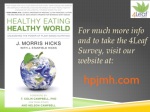 Based on overwhelming evidence, there is no doubt in my mind that the right food for humans is whole plants. The question is, how do we get enough people to change soon enough to make much of a difference? To help speed up the process, we’re working on a number of initiatives here at 4Leaf Global —more education, healthy (great tasting) foods and a brand new approach to corporate wellness.
 The global consequences of our food choices are incredibly complex—yet the solution is refreshingly simple. Eat more whole plants! Our book goes into great detail on all of the above topics and is written so that it can be easily understood by the average 8th grader.
Our 4Leaf Pledge to you. We’ll gradually help people everywhere understand the “big picture” consequences of their food choices. As a result, many of them will begin to improve their diet, take charge of their own health and do some very GREEN things for the environment—No less than our future as a species hangs in the balance. Now, I’m going sailing!

What’s next? Near the end of the above presentation, I posed the following question, “How do we get enough people to change soon enough to make much of a difference? That got me to thinking about other ways to make that happen—ways that might work better than trying to use just logic.
My thought process began with the following series of blogs posted in the past few weeks. I got the idea for this series after watching two videos of Dr. Campbell contained near the end of the first blog, A:
- A. Do you breathe air, drink water and have sex? (7-1-13)
- B. “Air, Water, Sex and FOOD” revisited — Blog # 777 (7-7-13)
- C. Are humans the “infestation” of planet Earth? (7-8-13)
- D. My letter to Chelsea Clinton — as promised (7-12-13)
- E. Are you ready for a $35 burger? (7-13-13)
- F. “You’re Screwed” or “We’re F – – – – D?” Take your pick. (7-14-13)
- G. James Cameron—on “Walking the Walk” (7-24-13)
Want to help spread the word? Call me at 917-399-9700 if you’d like me to speak at your venue. That’s one thing that you can do to help ensure the longterm sustainability of our species.
Handy 5-piece take-charge-of-your-health kit—from Amazon.com
- The movie that’s changing the lives of millions: Forks Over Knives DVD
- Healthy Eating, Healthy World, The “big picture” about food (our book)
- An essential scientific resource: The China Study by Dr. T. Colin Campbell
- Dr. McDougall’s latest book, The Starch Solution, with lots of great recipes
- Dr. Campbell’s new book: WHOLE, Rethinking the Science of Nutrition
Want to find out how healthy your family is eating? Take our free 4Leaf Survey. It takes 2 or 3 minutes and you can score it yourself. After taking the survey, please give me your feedback as it will be helpful in the development of our future 4Leaf app for smartphones. Send feedback to jmorrishicks@me.com

 International. We’re now reaching people in over 100 countries. Follow us on Facebook and Twitter or get daily blog notices by “following” us in the top of the right-hand column. For occasional updates, join our periodic mailing list.

J. Morris Hicks, working daily to promote health, hope and harmony on planet Earth.
To order more of my favorite books—visit our online BookStore now
For help in your own quest to take charge of your health, visit our 4Leaf page and also enjoy some great recipes from Lisa’s 4Leaf Kitchen.
Got a question? Let me hear from you at jmorrishicks@me.com. Or give me a call on my cell at 917-399-9700.
—J. Morris Hicks, board member since 2012; click banner for more info:




 J. Morris Hicks, engineer. writer. big picture guy.