Texas “4-Leaf” Meal…not an oxymoron

Even during Rodeo Week, it is possible to order a healthy meal in almost any restaurant in Texas.
Positive, simple, flexible and powerful! -- even in Texas

I didn’t say the healthy meal would be listed on the menu, I said that you could order one. And that’s what we did yesterday in Galveston…at a beach restaurant that features 90% of its calories on the menu from fried seafood, big juicy burgers and French fries.

My friend Carl, who has recently joined our 4-Leaf program, was a bit leery when he first saw the menu. Now that he is striving to get over 80% of his calories each day from whole plants, he was even more doubtful when he smelled the grease from the kitchen. But when the menus arrived, I quickly scanned the extensive offerings looking for some side dishes…and there they were.

A very healthy 4-Leaf meal at the Fish Tales Restaurant facing the Gulf of Mexico in Galveston, Texas

We each ordered a combination of mixed vegetables, new potatoes, and brown rice — along with a saucer of lemons to squeeze on our veggies. Being in Texas, we had  Lone Star beers and proceeded to enjoy a delicious, healthy and filling meal — for a mere $10 each; about half the price of the other entrees. Check out this great looking meal on the right, with the lemons right behind the Lone Star.

For the uninformed, here are six simple steps to ordering great meals in almost any restaurant except for Fast Food.

“Hicks Six” Creative Ordering

  1. First, look for some healthy side dishes on the menu.
  2. Then, scan the menu looking for clues to what other kinds of healthy veggies they have in the kitchen.
  3. Look at entrees carefully and make a mental note of the healthy items they are serving with them..also ask your server for ideas, maybe saying that your doctor has you on a special diet (Dr. Campbell, Dr. Esseslstyn, Dr. Fuhrman, etc.).
  4. Once you find out what they have, you can talk to your server about portion size and meal preparation details — like cooking with no oil or butter.
  5. When ordering pasta, make sure that at least 2/3 of the dish is veggies, not pasta…and always ask for whole grain bread, pasta or rice.*
  6. As for the “token” vegetarian entree; forget it. It is typically loaded with oil, white flour and cheese; derives very few calories from whole plants and is rarely even close to being a health-promoting 4-Leaf meal.

After a little practice, this creative ordering can be a lot of fun. Not only will you be enjoying healthy and delicious meals that you create yourself, you’ll be saving roughly $10 every time you dine. As a single man, I save enough going out every night to pay for ALL of the groceries that I purchase at the supermarket.

*If you order a pasta primavera off almost any menu, it will typically be a huge bowl of white pasta, a few tiny vegetables here and there and covered with some combination of oil and/or cream sauce. Bottom line — less than 10% of your calories will be from whole plants — scoring in the “No Leaf” level on our “4-Leaf” scale.

J. Morris Hicks

If you like what you see here, you may wish to join our periodic mailing list. Also, for help in your own quest to take charge of your health, you might find some useful information at our 4-Leaf page. From the seaside village of Stonington, Connecticut – Be well and have a great day.

If you’d like to order our book on Amazon,  visit our BookStore now.

—J. Morris Hicks…blogging daily at HealthyEatingHealthyWorld.com

PS: Occasionally an unauthorized ad may appear beneath a blog post. It is controlled by WordPress (a totally free hosting service). I do not approve or personally benefit whatsoever from any ad that might ever appear on this site. I apologize and urge you to please disregard. 

Posted in Healthy Eating 101, Recipes & meals | 2 Comments

Eating a near optimal “4-Leaf” diet…in a toxic world

It all goes back to the natural diet for our species…whole plants.

J. Morris Hicks, eating 4-Leaf for health, hope and harmony on planet Earth

As Dr. T. Colin Campbell has often said, “the closer we get to a diet of whole plant foods, the better off we will be.” So, let’s assume that you have accepted that premise and are going to strive to greatly increase your consumption of those whole plant foods.

  • How will you keep up with your progress?
  • How will you know how close you’re coming to the optimal diet of eating nothing but whole plants, like our nearest relatives in the wild?

First of all, we’re not necessarily talking about a strict vegetarian or vegan diet. Many people who use those labels to describe their diet-style are eating very unhealthy diets. That’s because they are not getting the majority of their calories from whole plants; in fact, many vegans don’t even get 20% of their calories from whole plants.

  • We must remember that it’s not just the avoiding of animal foods that makes us healthy, it is the maximization of the percentage of our calories from whole plants — in nature’s package.
  • With that thought in mind, we came up with a simple concept that we call the 4-Leaf Program in our book.

Starches like potatoes, legumes, and grains are good choices for maximizing calories from whole plants while minimizing calories from fat.

Here’s how that program works. The 1-Leaf level begins at over 20% of one’s calories from whole plants. With the average American getting far less than 10% of their calories from those nutritious foods, just moving to that first level is a big improvement.

As the percentage of calories from whole plant goes up, so do the “leaves.” From 20% to 40% to 60% to 80%…1, 2, 3 and 4 leaves. And what does that do for your health? Unlike those who consume the typical western diet, we have observed that people eating at the 4-Leaf level…

tend to have trim bodies, vibrant health, lots of energy, take no medications, almost never have ANY disease and will very likely live a long & healthy life.

Why not shoot for 100%? That would be great, but for practical reasons, we chose 80% as our threshold of excellence in terms of the percentage of calories from whole plants…and that doesn’t mean counting calories for every meal for the rest of your life. It starts with learning what a single “4-Leaf” meal looks like. We are all creatures of habit and tend to eat the same kinds of things every day. So, all we need to do is analyze what we typically eat for breakfast, lunch, dinner and snacks.

Just take each meal that you eat regularly and look at it carefully. By using nutritiondata.com, you can determine the percentage of calories from the whole plants and the percentage of calories from fat.  You may be surprised to discover that those “healthy looking” salads you’ve been having for lunch every day derive 80% of their calories from oil, cheese, egg and bread. After a few adjustments, you will quickly learn how to turn that greasy salad into a “4-Leaf” meal…maybe adding some legumes, rice, squash, and avocado to replace those other non whole plant items.

Ordering a 4-Leaf meal on the River Walk in San Antonio. While avocados are healthy whole plants, just remember that they are over 70% fat.

The key to achieving a consistent 4-Leaf level day in and day out, is gaining a feel for what it’s like to eat at that level and enjoying the many healthy benefits that it delivers. A 4-Leaf weekly score is comprised of lots of 4-Leaf meals.

************

If you like what you see here, you may wish to join our periodic mailing list. Also, for help in your own quest to take charge of your health, you might find some useful information at our 4-Leaf page. From the seaside village of Stonington, Connecticut – Be well and have a great day.

If you’d like to order our book on Amazon,  visit our BookStore now.

—J. Morris Hicks…blogging daily at HealthyEatingHealthyWorld.com

PS: Occasionally an unauthorized ad may appear beneath a blog post. It is controlled by WordPress (a totally free hosting service). I do not approve or personally benefit whatsoever from any ad that might ever appear on this site. I apologize and urge you to please disregard. 

Posted in 4Leaf for Life, Healthy Eating 101, Recipes & meals, Vegan or vegetarian? | Leave a comment

The Price of Oil…and the food we eat

Our best near term solution to conserving fossil fuels is right under our nose — it’s what we put in our mouths every day.

J. Morris Hicks, "the big picture guy" for promoting health, hope & harmony on planet Earth.

Blogging from Houston today, I thought this would be a good day to cover this critical topic. With the world’s biggest rodeo in town this week, I am probably putting my life in danger as I blog about the global issues associated with our consumption of beef. Oh well, here goes….

Chapter 5 of our book is devoted to a look at our energy resources and our potential for making our finite supply of fossil fuels last long enough for us to develop enough sources of renewable energy to replace them.

It turns out that the single biggest opportunity available to us to conserve our fossil fuels is a deliberate shift in the direction of a plant-based diet for all of humankind.

While doing research for the book, we studied the works of Jeff Rubin, prominent energy economist, and many others. In the video linked at the end of this post, one particular point caught my attention right away. During the era of cheap oil, we have been expending 10 calories of fossil fuel to produce a single calorie of food. After “peak oil,” that simply means that food is going to become a lot more expensive — to grow, to process and to distribute.

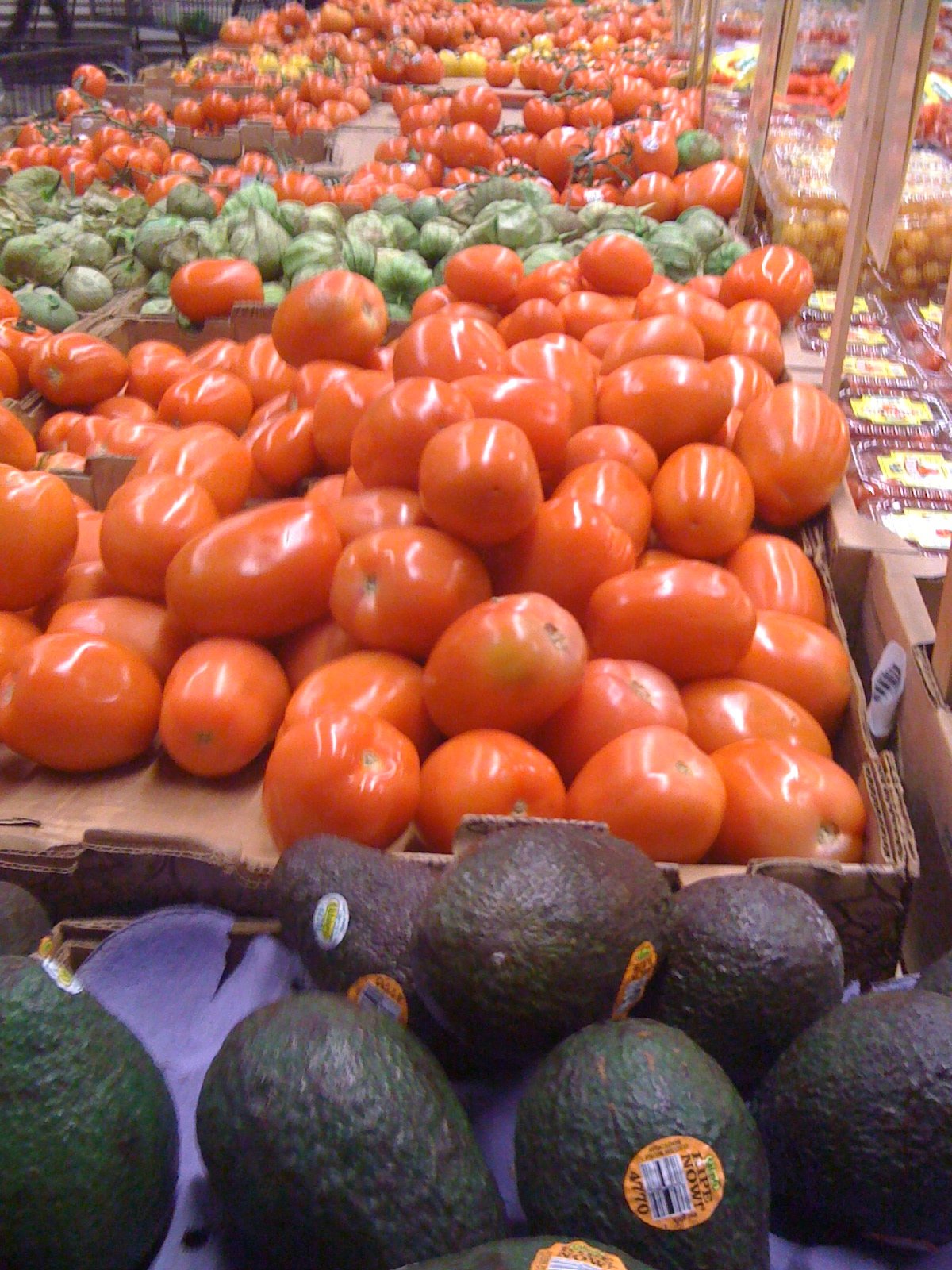
Shopping for energy saving and health promoting whole plants at the Central Market in Houston - Life is good!

The video below describes the impending crisis — the picture at left illustrates our best near term solution. The video, produced in the U.K. around 2005, is a good overview of the “peak oil” phenomenon and the likely repercussions that will be felt around the world once we realize that we are past peak.

Many experts feel that we very well may have reached the peak in 2010. The U.S. hit its peak in 1971, UK in the late nineties and more countries join the “post peak” club every year. Oil discoveries have been in decline for over 45 years and the oil that we do find is ever more increasingly difficult, and expensive, to extract.

It is common knowledge that the production of meat requires far more energy per calorie as compared to whole plant foods. According to an Ohio State study that we researched for our book, even the least energy efficient plant food is more than ten times as efficient as the most efficient animal food.

Regardless of when we hit that peak, the aftermath could include famine, riots and chaos around the world. In addition to developing renewable fuels, the best thing we can do right now is to work together to make our oil last as long as possible.

I reiterate; the single biggest opportunity available for us to conserve our fossil fuels is a deliberate shift in the direction of a plant-based diet for all of humankind.

China’s demand for oil, already greater than the U.S., is projected to double in the next 40 years. With demand for oil still growing rapidly in the developing world, there is simply no other way that the world could actually reduce its net thirst for oil — while at the same time promoting the best health for ourselves and nurturing our fragile environment. A WIN-WIN-WIN. Take a look at this highly informative video on this crucial topic. There is another “peak oil” video on our Video Page.

Click here for a blog post that addresses this entire “peak oil” phenomenon. Includes three videos. If you like what you see here, you may wish to join our periodic mailing list. Also, for help in your own quest to take charge of your health, you might find some useful information at our 4-Leaf page. From the great state of Texas — Be well and have a great day.

If you’d like to order our book on Amazon,  visit our BookStore now.

—J. Morris Hicks…blogging daily at HealthyEatingHealthyWorld.com

PS: Occasionally an unauthorized ad may appear beneath a blog post. It is controlled by WordPress (a totally free hosting service). I do not approve or personally benefit whatsoever from any ad that might ever appear on this site. I apologize and urge you to please disregard. 

Posted in Energy, Environment, Sustainability | Leave a comment