Since my publisher didn’t think this piece made sense for the book, I have decided to share it with you here. I am often asked, “how does a guy go from being a senior corporate executive with Ralph Lauren to trying to save the planet with healthy eating?” Here’s the answer to that question.

During my seven years with Ralph, I learned a great deal about passion and vision.
The Beginning of my Polo Era
I first met Ralph Lauren in person in the Spring of 1984 when I was named president of Polo for Boys, a licensed division that marketed boys apparel. A few years later, I joined the parent company, Polo Ralph Lauren Corporation as an Executive Vice President.
While working for Ralph Lauren from 1987 to 1994, I didn’t learn a darn thing about nutrition and health, but I learned a great deal about vision, passion, and refusal to compromise one’s principles. Ralph was passionate about his vision, never compromised his core beliefs, and inspired all of those around him to embrace and promote his overall lifestyle vision. Now that I have found my own passion, I can better appreciate where Ralph was coming from and can better understand how much satisfaction he derived from living his dream. Now, I have my own dream, the origins of which go all the way back to my college days.
My journey of learning the “big picture about food” began with my study of Industrial Engineering at Auburn University in the mid-sixties. First of all, what am I talking about with this “big picture ?” Simply stated, I am talking about what we eat and its staggering impact on so many very important things —- beginning with our own health but including many other global issues that are driven by the typical western diet.
Optimization of a System
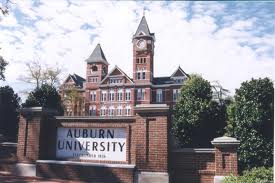
Home of the 2010 National Football Champions -- where I learned the first rule of Industrial Engineering, "Any Process Can Be Improved."
Industrial Engineering is all about the analysis and continuous improvement of complete systems or processes. We are taught to study and understand the big picture of any system before making any process changes and we are taught to tackle projects first that offer the biggest bang for the buck. After a 35-year plus career in process improvement and various senior corporate executive roles, I accidentally discovered what I have concluded is the largest potential process improvement opportunity in the history of the world — the process of how we feed ourselves — and the dramatic impact that it has on quality of life, the cost of health care and a host of environmental and moral issues.
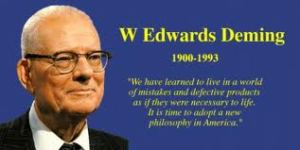
Dr. Deming taught me all about the "optimization of a system," a concept that played a prominent role in my getting my arms around the huge, inter-connected -- and incredibly wasteful system, employed by humans in the western world to feed themselves.
This is a classic example of what the great Dr. W. Edwards Deming was espousing shortly before his death in 1993 at the age of 93. I attended one of his last public seminars in the summer or 1992 at George Washington University in Washington, DC. After the lecture, I asked him to autograph a paper that I had written about “The Deming Process at Polo.” First, he looked through it and loudly asked where the “optimization of a system” was mentioned. He then took his pen and wrote carefully at the top of the page, “Keep on learning, study optimization of a system” and signed his name. I framed that page and still have it in my office today.
Toastmasters and the National Speakers Association
So how did I discover this process improvement opportunity? First a little background that is a key part of the story. After leaving Polo in the mid nineties, I founded my own executive search firm in Atlanta in 1999. Two years later I met Ruth Seydel, one of my neighbors in Ansley Park. While vacationing in Florida in 2001, Ruth commented to me, “you should think about becoming a professional speaker.” Not knowing exactly why she suggested that, I was nevertheless flattered by the suggestion and began to investigate doing what she suggested.
I did two things in early 2002: I joined a local Toastmasters Club in Atlanta and also attended several conventions of the National Speakers Association. While I got some valuable speaking experience at Toastmasters, I also learned about the two primary necessities for success in public speaking. Both organizations stressed the same two things:
- You need to be passionate about your topic.
- You need to write and publish a book documenting that passion.
At the time, I had neither—-but that was about to change. A month or so later in the winter of 2002 in Atlanta, I stumbled across something that would change my life. It took place in the Peachtree Presbyterian Church, where Ruth would occasionally take me on Sunday mornings. While waiting for the service to begin one Sunday, I read about a program that the church offered to people who were out of work. It was called CrossRoads and it seemed like a natural place for an executive recruiter to start doing some “giving back” that was way overdue.
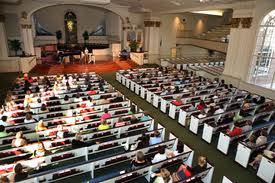
Peachtree Presbyterian Church -- Atlanta, Georgia
Peachtree Presbyterian and the Georgia Tech Alumni Association
So, the following week, I attended my first CrossRoads session with the leaders in the church that were in charge of the program. After a few months of training, they assigned me to my first group of unemployed folks that I would be coaching for the next 6 to 8 weeks. In addition to enjoying that warm feeling of helping other people, one of my group members inadvertently did something wonderful for me.
Being a graduate of Georgia Tech, he asked me if I would consider speaking at one of the monthly dinner meetings of their “out-of-work” Tech grads. I told him that I would be delighted to speak to his group. Long after I had forgotten about that conversation, I received a phone call from the Georgia Tech Alumni Association asking me to speak on the Tech campus one Tuesday night in November of 2002.

This place will always hold a special place in my heart; I still cherish the Cross pen with the Rambling Wreck logo that they gave me that Tuesday evening in November of 2002 following my speech.
After agreeing to speak, I began to give some thought as to what I might talk about that evening. Having just written an online article for my executive search monthly newsletter, I decided that I would just talk about the message in that article — “Getting a Life; then Getting a Job…My Seven Secrets.” Being a “big picture” guy as I said earlier, that article was all about asking the readers to step back and consider the many important facets of their life and then choose a career path or a future job that would enrich their complete lives.
In that “Get-a-Life” article, I mentioned that it was my belief that a great many people tended to drift from job to job without a great deal of thought about how those jobs fit into the more important aspects of their lives. Having done my share of “drifting” in the past, I could speak with some degree of authority on the subject.
In my speech that night, I told the Tech group about my own experience of being miserable in the latter years of working as a senior executive at Polo. At the height of my misery, I vividly remember one afternoon in 1992 while flying back home from a business trip. While sitting comfortably in the first class cabin of that Continental flight into Newark, I composed a list of six things that I thought that a person would need in order to be happy—-while working for someone else. They were: needed, wanted, trusted, respected, empowered and appreciated.
Of course, at the time, I had none of those things; but I did have the big job, big title, prestigious company, big paycheck, all the trappings of success…lots of stress too, but no joy. In addition to my job, there were some other things in my life that were not acceptable. On the bright side, I remember deciding on that airplane ride that I was going to do whatever it took to get my life in order. I just didn’t realize at the time that it was going to take fifteen years.
In my speech at Georgia Tech, I suggested that maybe the seven secrets that I discovered during my journey would possibly help reduce the time required for that process for all of my job seeker friends out there. As I explained, my list wouldn’t make it easy by any means, but it just might help in some way.

Ironically, this book by my Stonington friend appeared on my list of recommended books -- two full years before I met her. Now, she has just finished writing a blurb for my book and keeps telling me, "you are onto something very big."
- Lead a simple, uncluttered life.
- Get real serious about getting healthy and fit.
- Purge yourself of any relationships that don’t bring you joy.
- Follow your passion and find a way to make a living doing what you love.
- Learn to live on far less than you can earn and achieve financial freedom as early in life as possible.
- Get involved with some serious fun; things that bring you joy and satisfaction.
- Sort out your feelings about faith, hope and the things that motivate you to be all that you can be. This is a very important piece; assessing your major definite purpose in life.
I spoke for about 45 minutes that evening to a group of roughly 100 people. Their positive and engaging reaction to my presentation greatly exceeded my expectation; and it continued for the next week or so as I received personal e-mail messages from 30 or 40 of the attendees—-sincere words of thanks for actually helping them that evening. As I sifted through those e-mails in that post 9-11 era of high unemployment, I had an idea.
The Get-A-Life Seminar that Never Happened
Since 9-11, many search firms went out of business as employers drastically cut back their hiring plans across scores of industries. Our firm was hurt severely by those actions and we were always looking for ways to increase our revenues. My idea was to quickly develop a one-day “Get a Life” seminar aimed at all mid to senior level executives who were either unemployed or mis-employed. Statistics at the time suggested that over 70% of people who had jobs were not well-suited for what they were doing, hated going to work every day and were just working to support the lifestyle they had chosen.

Hartsfield-Jackson Airport -- Atlanta, Georgia. Never met Mr. Hartsfield but did have lunch with Mayor Maynard Jackson in 1980.
Being located near the busiest airport in the world was a real asset for us since almost everyone in the eastern half of the USA could easily book a non-stop flight to Atlanta and the prices were still a bargain at that time. We planned to host our first 10 AM to 4 PM seminar in Atlanta during the early spring of 2003. We figured that people could book a day-trip to Atlanta, take the subway from the airport, attend our seminar (including a free lunch) and be back at the airport before 5 PM. The price we had in mind was $199. With 100 people in attendance, our top line revenue would be $20,000 and we could net $15,000 after paying for their lunch and the facility. Everything was looking good except for one thing.
We didn’t have enough credible knowledge of our seven topics to put together a meaningful 45 minute presentation on each. So, the five of us in the firm at the time each took one topic and started doing some homework. If you have guessed by this time that my first topic was HEALTH, you would be right. Just before Thanksgiving of 2002, I got real serious about learning all that I could on the topic of achieving vibrant health, losing excess weight, preventing or reversing chronic disease, and doing all that was possible to live a long, healthy and active life that included zero time in the nursing home. This all led to some good news and some bad news.
The good news is that I had accidentally stumbled into to a field of study that I loved. The “big-picture” system of how our food affects so many things appealed to my Industrial Engineering mindset as I began to understand the absolutely mind-boggling global improvements that could be gained—-simply by beginning the process of having the human race return to the natural diet for our species. The bad news is that our Get-a-Life Seminar never happened.
Discovering My Passion and My Final Career
While researching my health topic for the seminar that never happened, I started with a short Internet search and quickly ordered two or three books on Amazon. Of course, Amazon tells you that many people who ordered one book, also ordered one or two from a list of 7 or 8 additional books. Within two months, I had devoured 25 books and I have never looked back.
After reading over 100 books that first year, I decided that I would write a book, since there wasn’t a book in print at the time that pulled together all that I was learning in a credible and organized manner. I had begun reading articles about Dr. T. Colin Campbell in 2003 and 2004 and already knew that his scientific work was serving to validate the work of a handful of medical doctors who had discovered the power of whole foods, plant-based nutrition on their own and had begun healing their patients with nothing but food.
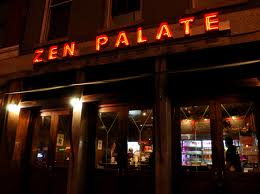
The Zen Palate in New York City -- Not only did I first meet Dr. Campbell there, but I also met Dr. Fuhrman and Dr. Esselstyn on two separate occasions. My thanks to EarthSave for organizing those events.
Then, in January of 2005, The China Study by Dr. T. Colin Campbell and his son, was published by none other than BenBella Books (my publisher). I bought my copy right away at a bookstore in New York that month and then met Dr. Campbell and his wife Karen the following December at the Zen Palate restaurant in New York City.
Since then, I have met and worked with many of the most prominent leaders of this exciting new field. After a few more years of working and exploring the field, I identified a missing piece in this vast puzzle — a simple explanation of the big picture on this topic, packaged with a no-nonsense approach to making this exciting new diet-style work for the long-time consumer of the typical western diet.
All of the above led to my getting my own book contract with BenBella in the spring of 2010. Due to hit the stores in October of 2011, it is my hope and dream that Healthy Eating – Healthy World will resonate with the hip young people of the world who will be driving some big changes in this world during the next 50 or 60 years. I like to think of the book as a handy field manual for the modern day foot-soldier of the grassroots revolution that will result in the restoration of harmony between humankind and nature on planet Earth.
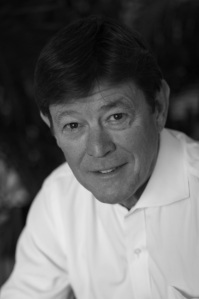
Thanks for sharing my personal journey "From Polo to Plant Food." Eat and be well, J. Morris Hicks
FYI, the Acknowledgements page of our book begins with the crucial contributions of the Peachtree Presbyterian Church and the Georgia Tech Alumni Association. And, since the first step occurred in church, maybe God Almighty had something to do with pointing me in the right direction. Now, thanks to all of the above, I am armed with the requisite passion and published book and I am finally ready to begin that professional speaking career.
Oh, that Toastmasters group that I mentioned earlier – they met each week at that very same Presbyterian Church.
If you like what you see here, you may wish to join our periodic mailing list. Also, for help in your own quest to take charge of your health, you might find some useful information at our 4-Leaf page. From the seaside village of Stonington, Connecticut – Be well and have a great day.
If you’d like to order our book on Amazon, visit our BookStore now.
—J. Morris Hicks…blogging daily at HealthyEatingHealthyWorld.com
PS: Occasionally an unauthorized ad may appear beneath a blog post. It is controlled by WordPress (a totally free hosting service). I do not approve or personally benefit whatsoever from any ad that might ever appear on this site. I apologize and urge you to please disregard.


 International. We’re now reaching people in over 100 countries. Follow us on Facebook and Twitter or get daily blog notices by “following” us in the top of the right-hand column. For occasional updates, join our periodic mailing list.