FISH — an unsustainable and unhealthy alternative to red meat

In a 6-13-2011 New York Times editorial, I thought they did a great job of explaining the sheer unsustainability of our dependance on fish as one of our primary sources of food. As they pointed out, many countries are now in the global fishing business with high quotas and modern equipment — and, as a result, we are now running out of fish.

A 2003 study by the Fisheries Center at the University of British Columbia shows the plunge in predatory fish over the last century. A map of the Atlantic in 1900, based on that data, is filled with colored splotches showing concentrations of fish. In 2000, the map is nearly empty.
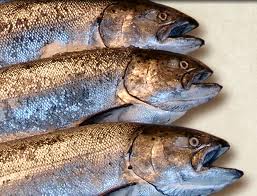
Widely regarded as a health food -- particularly if you compare it to beef or pork

In the past twenty years or so, millions of people around the globe have cut back on their consumption of red meat, but have simply replaced that “protein” on their plate with fish — a food that the vast majority of the western population believes is a truly healthy food. They also truly believe that we “need” to eat plenty of animal protein in order to be healthy.

Following my speech yesterday at the Graduate Club next to Yale University — and after hearing my comments about the natural diet for our species being whole plants, a gentleman came up to me and asked, “But fish is okay, right?” I didn’t have the time to give him the complete answer, which would have been the following summary of how I feel about our love affair with fish:

  1. Fish is not a whole plant and is not part of the natural diet for our species. If we were designed to eat fish, we’d be out there swimming around with them — and the bigger ones would be eating us.
  2. Fish were not put in the ocean by the creator to serve as a food source for humans; there were millions of fish in the ocean long before there were any humans on this planet.
  3. Fish are a key part of the delicate balance of harmony and biodiversity of this planet; by wiping out the predator fish population around the world, we have disrupted nature and have no idea how much damage we have done.
  4. Farmed fishing is no better; not only is it an environmental disaster, but the entire process is grossly inefficient and unsustainable.
  5. The animal protein in fish is just as harmful to humans as the protein in pigs and cows; it promotes cancer, heart disease and other chronic diseases.
  6. The only good news about fish is that it contains omega 3’s; of course we can get that from flaxseeds or walnuts without the heavy dose of cholesterol and pollutants that come along with the fish.
  7. We’re running out of fish with less than 2 billion of our 7 billion people eating them; just imagine how much worse it will be when more of us give up our “red meat” and more of the third world adopts our grossly unsustainable way of eating.
  8. In the great 2009 movie HOME, they reported that humankind has inflicted more damage on the fragile harmony of nature in just the past fifty years than all previous generations of humans in the past 200,000 years. Wiping out the predator fish of our oceans is a huge part of that damage.

J. Morris Hicks at the helm off Newport, RI. Unlike many human endeavors, sailing consumes no fossil fuels, harms no other creatures and provides recreation for humans without damaging the fragile harmony of nature.

Do yourself, your family and your planet a favor and return to the natural diet for our species just as quickly as you possibly can. Don’t want to be a vegan? Then you might want to climb aboard our 4-Leaf train and let us help you find your way to vibrant health.

The good folks at the New York Times have done us a great service by pointing out what a mess we have made with regards to the fish in the sea.

Although they haven’t yet learned about the fact that we don’t “need” to eat any animal protein whatsoever, they have clearly pointed out the unsustainability of our current way of feeding ourselves. The editorial ended as follows:

So far, the sensible remedies — including lowering quotas, limiting seasons and retiring fleets — have gone nowhere. Choosing a sustainable fish for supper isn’t enough. Both commercial fishermen and the politicians that do their bidding must recognize that global overfishing by many nations now threatens the oceans and the economies that depend on them. And the only way to deal with that threat is with strong international rules to end all unsustainable fishing.

You may want to check out one of my earlier posts on this topic:

FISH…the natural diet for humans? A “big picture” view

If you like what you see here, you may wish to join our periodic mailing list. Also, for help in your own quest to take charge of your health, you might find some useful information at our 4-Leaf page. From the seaside village of Stonington, Connecticut – Be well and have a great day.

If you’d like to order our book on Amazon,  visit our BookStore now.

—J. Morris Hicks…blogging daily at HealthyEatingHealthyWorld.com

PS: Occasionally an unauthorized ad may appear beneath a blog post. It is controlled by WordPress (a totally free hosting service). I do not approve or personally benefit whatsoever from any ad that might ever appear on this site. I apologize and urge you to please disregard.

Posted in Big Picture, Sustainability | 2 Comments

Eating animals — and the origin of disease in humans

A few weeks ago, we were hearing about the cucumbers in Germany that were linked to an outbreak of E. coli infections. Now, we’re hearing a lot about salmonella and sprouts — again in Europe. (See NYTarticle below my signature.) Lots of news these days about E. coli, salmonella and other diseases — but rare is the mention of the root cause. A quick internet search yielded over 14 million articles about E. coli and over 3 million for salmonella.

J. Morris Hicks, trying my best to help you and your family take charge of your health

Here’s what the USDA had to say about salmonella on their web site:

Any raw food of animal origin, such as meat, poultry, milk and dairy products, eggs, seafood, and some fruits and vegetables may carry Salmonella bacteria. The bacteria can survive to cause illness if meat, poultry, and egg products are not cooked to a safe minimum internal temperature as measured with a food thermometer and fruits and vegetables are not thoroughly washed. The bacteria can also contaminate other foods that come in contact with raw meat and poultry.

Of course, none of that information about the animal origin was mentioned in the New York Times article referenced below. So, the average reader is naturally going to be concerned about eating the products mentioned in that article. Here’s how that article entitled, “Sprouts, Poster Plant of Health Food, Can Pack Risks” led off:

Sprouts are a fixture of salad bars and the epitome of health food to many people. But the reality can be very different. As a horrified Europe learned over the past month, sprouts are a high-risk food for carrying harmful bacteria like salmonella or the toxic forms of E. coli, according to public health experts.

This year, at least two American growers have recalled sprouts contaminated with salmonella, and outbreaks of illness from tainted sprouts have occurred so often in the United States that health investigators have a special name for them: sproutbreaks.

After doing a little research for an earlier blog about E. coli (What they don’t ever tell you about E. coli infections), I determined the following root cause information from the CDC — pointing out that it vast majority of all of our problems goes back to the manure from farm animals that eventually pollutes our lakes, streams, rivers and soils.

The CDC has estimated that 85 percent of E. coli O157:H7 infections are foodborne in origin (Mead, et al., 1999).  In fact, consumption of any food or beverage that becomes contaminated by animal (especially cattle) manure can result in contracting the disease.  Foods that have been identified as sources of contamination include ground beef, venison, sausages, dried (non-cooked) salami, unpasteurized milk and cheese, unpasteurized apple juice and cider (Cody, et al., 1999), orange juice, alfalfa and radish sprouts (Breuer, et al., 2001), lettuce, spinach, and water (Friedman, et al., 1999).  Pizza and cookie dough have also been identified as sources of  E. coli outbreaks.

How about that? It begins with manure from our ten billion animals that we raise every year in the U.S. for our dinner tables. It all goes back to our deadly habit of consuming meat and dairy three meals a day — a habit that generates 87,000 pounds of solid manure per second – generating a staggering annual total of 1.37 billion tons of manure — in JUST the USA.

Meanwhile, the poor sprout-growers of the world are struggling to minimize the disastrous PR that they are suffering. From the NYT article,

Bob Sanderson, president of Jonathan Sprouts in Massachusetts and the head of the International Sprout Growers Association, said that it would be wrong to draw conclusions about the safety of American sprouts based on the German outbreak, since growers there may use different methods than their counterparts here. “Fresh food is the most nutritious food and inherently prone to these problems,” Mr. Sanderson said of sprouts and other vegetables. “That’s what makes it fresh. It’s not sterile.”

J. Morris Hicks...running a little late this year, went for my first sail on Moonglow, my 19 foot Cape Dory Typhoon yesterday.

Here’s the way I see it. There are many theories about the origins of all human diseases and the role that our domestication of animals has played in them. No one knows for sure how many millions of people have died throughout history from diseases that were related to our close relationship with animals.

My hunch, based on my limited research, is that our choice to start eating domesticated animals thousands of years ago has contributed greatly to most, if not all, of our diseases throughout the ages. We do know that it has been very significant and we do know that the healthiest diet for humans includes no animal products whatsoever.

To me, there is not a single legitimate reason for us to be eating animals. In addition to promoting all kinds of diseases, it has become a disaster for the environment. Comparing meat calories to plant calories — on a per calorie basis — it takes 20 times more energy, 20 times more land and far more than 20 times more water to produce the meat and dairy calories.

Then, when you throw in the global warming, the water pollution, the biodiversity issues and the suffering of 60 billion animals per year — it’s like a blinding flash of the obvious  — We are eating the wrong food! So why are we in love with our meat-based diet? Because we like the taste of cooked animal flesh — not a sufficiently legitimate reason for so much damage in my opinion.

If you like what you see here, you may wish to join our periodic mailing list. Also, for help in your own quest to take charge of your health, you might find some useful information at our 4-Leaf page. From the seaside village of Stonington, Connecticut – Be well and have a great day.

If you’d like to order our book on Amazon,  visit our BookStore now.

—J. Morris Hicks…blogging daily at HealthyEatingHealthyWorld.com

PS: Occasionally an unauthorized ad may appear beneath a blog post. It is controlled by WordPress (a totally free hosting service). I do not approve or personally benefit whatsoever from any ad that might ever appear on this site. I apologize and urge you to please disregard. 

Sprouts, Poster Plant of Health Food, Can Pack Risks – NYTimes.com.

Posted in Big Picture, Food Contamination, Health in General | 1 Comment

Dinner Party — What should I serve my meat-eating guests?

Now that I am a 4-Leaf eater, what do I serve at my next dinner party?

This question comes up often. My answer; everyone is different and must choose the “entertainment” policy that is right for them. All I can do is speak for myself and tell you how I handle the food issue when I am entertaining.

My house with the flag is one of the smallest in the entire village — not great for dinner parties, but it’s a great spot for a cozy cocktail party for about 20 people.

First of all, I am a single man with a very small house and a tiny kitchen; hence, not many dinner parties at my place. But I do have several cocktail parties each year and I serve an ample amount of tasty and filling food at each of them. And while everything I serve may not be at the 4-Leaf level — it is all most definitely 100% plant-based. But I never talk about it — I just prepare the food, put it out, people eat it and I have never had a single complaint.

So what should you do? My advice is to follow your own convictions and your overall philosophy on entertaining. In my case, after studying this topic since 2002, I have some pretty strong convictions about the way we humans should be eating and some strong convictions about the damage caused by the toxic western diet consisting of meat and dairy three meals a day.

In my case, at least 90% of my local friends are still eating the typical western diet and all of them know about my own preferences. When I am in their homes, I never expect anything special, I simply choose the plant-based options and try to be as inconspicuous as possible. When they are in my home, they seem to be following the same protocol — they just eat the food that I provide and the absence of meat and dairy has never even been mentioned.

I find that as long as the bar is well-supplied that everyone’s happy; it doesn’t really matter what I serve them to eat. Case in point; when I first moved into my home in 2005, I held an impromptu house warming party and invited some 75 people to join me for “Champagne and Popcorn.” It turned out to be an absolute blast and, six years later, people are still talking about that party.

J. Morris Hicks introduces Dr. Caldwell Esselstyn, just before our yacht club crowd of 100 sat down for an absolutely delicious plant-based meal — “Raise the Roof Lasagna.”

All of this cocktail party stuff is probably not helping you much with the planning of your next sit-down dinner for your 14 closest friends. So, I will tell you how Dr. and Mrs. Caldwell Esselstyn would handle a big party for a host of their meat-eating friends. They would prepare the most delicious plant-based meal and hors d’oeuvres possible and would never even mention what was in it.

When they spoke at our Stonington Harbor Yacht Club last August, they planned the meal that we served to over 100 people — a huge salad along with the “Raise the Roof Lasagna” from their son Rip’s Engine 2 Diet book. While it was not a 4-Leaf meal according to our definition, it was 100% plant-based and not a single person complained. The point here: the food just has to be good — it doesn’t have to have any animal-based products in it to make people happy.

Recently, I have used the word “poison” to describe animal-based foods in some of my blogs. I know…the word sounds extreme so why have I used it? Because those products meet the definition provided by Mr. Webster:

Poison is “a substance that can cause injury or death to a living organism.” And there is a mountain of scientific evidence suggesting that our toxic western diet most certainly causes “injury or death” to millions of humans every single year.

If we’re going to worry about the “possibility” that cell phones cause cancer, we need to come to grips with what science now knows for sure — that the casein in cow’s milk is a powerful carcinogen — and is therefore technically, a poison.

Here’s the way I see it. Once you know something to be true, you simply cannot ignore that newly acquired knowledge in your future endeavors. For the first 58 years of my life, I didn’t know anything about how damaging our toxic western diet really was. I had no idea that it promoted cancer and heart disease. I also had no idea that all drugs were toxic.

Now that I know these things, I can’t even imagine the idea of feeding these kinds of things to my family — or to my friends. They may not know these things yet — but I do, and I have to live with myself. From Chapter 11 in my book:

Simply knowing something doesn’t change anything or make anything better.  An ancient Persian proverb states, “It is nothing for one to know something unless another knows you know it.”

Let me close today by making one thing perfectly clear. While I may get carried away from time to time, I absolutely do my best to never be guilty of proselytizing. All of my friends know of my passions and I am confident that if they are interested in hearing my opinion on something that they will ask for it.

My friend Anne and I spent most of Sunday afternoon on one of our Race Committee boats.

Yesterday, I served on Race Committee with a good friend who has been reading my blog and is also in the process of improving her diet.  Although I spent over three hours with her yesterday, including dinner at the bar at the Water Street Cafe, the topic of food and health never came up.

But when I ordered my “special” meal from Kelly the bartender, my friend Anne simply said, “I’ll have what he’s having” — reminding me of an earlier post:

Friends…the fine line between caring and proselytizing

Special thanks to my good friends Mary and Erica, who provided me with the inspiration for today’s post. I will leave you with this thought:

People often say that humans have always eaten animals,as if this is some justification for continuing the practice. According to this logic, we should not try to prevent people from murdering other people, since this has also been done since the earliest of time”  —Issac Singer

Handy 4-piece take-charge-of-your-health kit—from Amazon.com

Want to find out how healthy your family is eating? Take our free 4Leaf Diagnostic Survey. It takes less than five minutes and you can score it yourself. After taking the survey, please give me your feedback as it will be helpful in the development of our future 4Leaf app for smartphones. Send feedback to jmorrishicks@me.com

International. We’re now reaching people in over 100 countries. Follow us on Facebook and Twitter or get daily blog notices by “following” us in the top of the right-hand column. For occasional updates, join our periodic mailing list.

To order more of my favorite books—visit our online BookStore now

J. Morris Hicks, working daily to promote health, hope and harmony on planet Earth.

For help in your own quest to take charge of your health, you might find some useful information at our 4Leaf page or some great recipes at Lisa’s 4Leaf Kitchen.

Got a question? Let me hear from you at jmorrishicks@me.com. Or give me a call on my cell at 917-399-9700.

SHARE and rate this post below.

Blogging daily at hpjmh.com…from the seaside village of Stonington, Connecticut – Be well and have a great day.

—J. Morris Hicks, board member, T. Colin Campbell Foundation

Posted in Social Challenges | 5 Comments