“Earthlings” — A documentary that we all NEED to see

After 130 consecutive days of blogging, I find myself becoming more concerned and saddened about the extremely irresponsible behavior of humankind. Clearly the most intelligent species, we have exploited that intelligence as we have taken “possession” of all of the land, all of the oceans and all of the other species.
Please take the time to watch this entire movie. Sincerely, J. Morris Hicks

With all of that power and control should come responsibility to make sure that all that we control is respected and nurtured. Instead, we have run roughshod over the planet; fouling the land, the air and the sea, while treating all of our fellow “earthlings” as if they were created to serve at the pleasure of the human race.

While I started out trying to learn about the optimal diet for humans, I have now become more motivated to help correct the horribly wasteful, irresponsible and cruel behavior of humankind toward the environment and our fellow “Earthlings” with whom we share this planet.

We forget that life began on this planet some 4 billion years ago and we humans didn’t arrive on the scene until a mere 200,000 years ago. But, it has been in just the past few hundred years that we have done most of our damage.

Swelling from less that one billion to over seven billion during that period, the human race has become the “infestation” of planet Earth. And, as the movie HOME reported, we have inflicted more damage to the fragile harmony of the planet in just the last fifty years than was inflicted by all generations of humans before us.

Although relative newcomers to the planet, we have adopted the attitude that we “own” everything and every creature. This blog and this movie is all about those other creatures. While surveys show that almost everyone claims to love animals, most of us have adopted an out-of-sight, out-of-mind mentality when it comes to every non-human species on earth. Most of us have no idea what goes on behind the scenes and most of us don’t want to know.

But, if we’re ever going to be able to fix the disastrous mess that we have created, more of us must become aware of exactly what has been happening between we humans and all of the other creatures. This powerful documentary, while painful at times, is a real good place to start.

EARTHLINGS is a feature length documentary about humanity’s absolute dependence on animals (for pets, food, clothing, entertainment, and scientific research) but also illustrates our complete disrespect for these so-called “non-human providers.” The film is narrated by Academy Award nominee Joaquin Phoenix (GLADIATOR) and features music by the critically acclaimed platinum artist Moby .

The following introductory trailer is less than 3 minutes, is painless, and gives you an excellent preview of what you will see in the full 95-minute movie.

Now, before you proceed to the full movie below, I invite you to take just three more minutes and watch this appeal from the Director, Shaun Monson, as he talks about the challenges he faced during this project. He eloquently and movingly explains why we ALL really need to see this entire movie and we need to watch ALL of it.

If you’ve been thinking about walking away from meat and dairy in your diet, but just can’t bring yourself to make a commitment to give up some of your favorite dishes, the movie Earthlings may help. If you can watch this entire 95-minute documentary, there is a real good chance that you will never even want to eat meat again — ever. So, get yourself some popcorn, put this movie on your full screen and watch this movie carefully and thoughtfully. Then, you will know what to do.
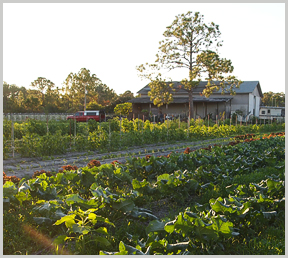
An early morning view of the Oakes organic farm in Florida -- this is the kind of place where I like to think my food is grown -- without harming the environment or a single creature.

So, let’s end this blog on a positive note. Now that you have seen how a major portion of our typical western diet foods are produced, let’s take a moment to consider how nature intended it to be. Take a look at the Oakes farm on the right — the kind of place that I believe nature had in mind for our bread basket.

Then, think long and hard about what you just saw in the documentary; then decide what you’re going to tell your children when you see it with them. Are you going to accept some of the responsibility? I am convinced that with enough knowledge, you will do the right thing.

If you like what you see here, you may wish to join our periodic mailing list. Also, for help in your own quest to take charge of your health, you might find some useful information at our 4-Leaf page. From the seaside village of Stonington, Connecticut – Be well and have a great day.

If you’d like to order our book on Amazon,  visit our BookStore now.

—J. Morris Hicks…blogging daily at HealthyEatingHealthyWorld.com

PS: Occasionally an unauthorized ad may appear beneath a blog post. It is controlled by WordPress (a totally free hosting service). I do not approve or personally benefit whatsoever from any ad that might ever appear on this site. I apologize and urge you to please disregard. 

Posted in Suffering of Animals | 1 Comment

“Disenthrall ourselves” and think anew — Abraham Lincoln

As I sat down at the Mystic Starbucks this morning, I received a message from a college friend of over forty years. After re-connecting with Stan through my new blog, it’s great to have him back in my life; he wrote from Arizona:

I’ve been liking your blogs, and because I identify with the ideas you present and your treatment of those ideas, it has made me think you might be interested in thoughts I have had over the years.  I haven’t developed the thoughts very extensively, but if any of them strike a chord with you, perhaps they could be of some benefit in promoting what you generally advocate.

With a credit to Abraham Lincoln, Stan concludes, “We as individuals have habits and beliefs and ways of being that we acquired long ago. Many of those do not serve our best interests.  We should frequently and critically examine the ways in which we are enthralled, and where appropriate “disenthrall ourselves.”

J. Morris Hicks

Thank you Stan for inspiring my blog today.  Believe it or not, I was thinking about “consumerism” this morning as I was making up my bed — thinking of the massive amount of “stuff” that we humans buy and dispose every day of our lives. Also thinking about the vast amount of unnecessary resources like water that we use to feed ourselves a harmful, wasteful and unsustainable diet-style for our species.

As others have concluded in the past, we humans have indeed become the “infestation of planet Earth” and, unless we begin making some serious changes sometime soon, Mother Nature will have her revenge — and it won’t be pretty. Changing our diet to plant-based won’t solve all of the world’s problems, but it would be a mighty fine step in the right direction.

Oftentimes in my speeches, after describing the environmental disasters that we humans have caused — emphasizing that we are the only species in the history of the planet that has chosen not to live in harmony with nature, I conclude with this quote from Mark Twain:

From Time Magazine (11-22-10). Twain had arrived at the not unreasonable but never popular conclusion that mankind “was not made for any useful purpose, for the reason that he hasn’t served any; that he was most likely not even made intentionally; and that his working his way up out of the oyster bed to his present position was probably a matter of surprise and regret to the creator.”

We could all learn a thing or two about the stewardship of our planet from this fine organization.

I think that Twain “nailed it” over 100 years ago — and his description is much closer to the reality of today’s world than the good folks at Leave No Trace would advocate. I just looked them up online and copied the following statement. As Stan suggested, “that while that fine organization focuses on outdoor ethics, their philosophies are generally applicable in every aspect of our lives.” From their website:

Leave No Trace is a national and international program designed to assist outdoor enthusiasts with their decisions about how to reduce their impacts when they hike, camp, picnic, snowshoe, run, bike, hunt, paddle, ride horses, fish, ski or climb. The program strives to educate all those who enjoy the outdoors about the nature of their recreational impacts as well as techniques to prevent and minimize such impacts. Leave No Trace is best understood as an educational and ethical program, not as a set of rules and regulations.

Great philosophies indeed, but I will bet that the environmental damage that our planet suffers from our outdoor recreation — pales dramatically compared to the damage inflicted by our overall lifestyle of eating, living, waging wars and moving about the world. But these principles could be applied to ALL of our human endeavors as we strive to learn how to once again live in harmony with nature.

But sadly, as I have stated in earlier blogs, my gut tells me that we humans are a selfish and greedy bunch who generally don’t care much for these kinds of highly principled endeavors. We want our big houses, swimming pools, cars, airplanes, meat and dairy at every meal, etc — and we’re not likely to adopt anywhere close to a “Leave No Trace” lifestyle until we are forced.

As I have said before, my thinking is that the force will come in the form of expensive oil, and I’m not talking about $5 and $6 gasoline; I am talking about $10, $15 and $20 gasoline within the next ten or fifteen years. Once the world realizes that we have indeed reached Hubbert’s predicted “peak oil,” prices will escalate to scary levels; at which time, people everywhere in the western world will be forced to totally re-think every aspect of their lives — the way they live, the way they eat, the way they travel, and the way they consume.

Abraham Lincoln provided our theme of "disenthrall ourselves" today.

The great 2009 movie HOME reported that humankind has inflicted more damage on the harmony of nature in just the last fifty years — than all previous generations of humans for the past 200,000 years. As Stan suggests, the time has come to “disenthrall ourselves” and correct the impending disaster that we have created — before it’s too late. From Lincoln’s address to Congress, 12-1-1862:

Is it doubted, then, that the plan I propose, if adopted, would shorten the war, and thus lessen its expenditure of money and of blood?….We can succeed only by concert. It is not “can any of us imagine better?” but, “can we all do better?” The dogmas of the quiet past, are inadequate to the stormy present. The occasion is piled high with difficulty, and we must rise — with the occasion. As our case is new, so we must think anew, and act anew. We must disenthrall ourselves, and then we shall save our country.

If you like what you see here, you may wish to join our periodic mailing list. Also, for help in your own quest to take charge of your health, you might find some useful information at our 4-Leaf page. From the seaside village of Stonington, Connecticut – Be well and have a great day.

If you’d like to order our book on Amazon,  visit our BookStore now.

—J. Morris Hicks…blogging daily at HealthyEatingHealthyWorld.com

PS: Occasionally an unauthorized ad may appear beneath a blog post. It is controlled by WordPress (a totally free hosting service). I do not approve or personally benefit whatsoever from any ad that might ever appear on this site. I apologize and urge you to please disregard. 

Posted in Big Picture, Environment | 1 Comment

Environmental horrors: hidden NEWS behind the headlines

Record Dead Zone Predicted in Gulf of Mexico (USA Today)

One of many "dead zones" in the oceans of the world -- driven by the raising of livestock

Almost every day there is a news story about some global problem that is related to our choice in the western world to consume meat and dairy three meals a day. Earlier this month it was E. coli and salmonella, yesterday it was a “record dead zone” in the Gulf of Mexico. (See USA Today link below my signature)

What you almost never see in any of these stories is the root cause of so many of the problems. To shed a little light on the “dead zone” issue, I want to provide you with an excerpt from Chapter 4 of our book. That chapter deals with a plethora of environmental problems that are driven by our livestock agriculture and is entitled — Running Roughshod.

The Food and Agriculture Organization of the UN estimates that nearly two-thirds of ocean fisheries are exploited at or beyond capacity.  At the same time, our agricultural practices on land are beginning to foul the oceans as well.

Dr. Bruce Monger, who teaches Oceanography at Cornell University, has uncovered some alarming facts on that topic.  After plotting the explosive growth of human population, CO2 increase in the atmosphere, deforestation and the increase in the use of industrial nitrogen fertilizer—all on the same graph (1980 to present), he was “blown away” by what he saw.  In a 2009 online lecture, he exclaimed, “Boy, I’ve got to get interested in what’s going on with nitrogen, because it’s by far the most rapidly increasing item of this group.” That stems from the rapid increase of chemical fertilizer; some estimate that we’ve put more nitrogen-based fertilizer on the ground in the last 20 years than we’ve put on the ground since fertilizer was invented.  Remember all that livestock manure mentioned earlier?  That unprecedented increase in the use of chemical fertilizer has been driven in large part by the feed crops that were grown for those billions of animals.

So, just as the manure pollutes our rivers and streams, the fertilizer to grow the livestock feed is beginning to do a number on our oceans….this whole process leads to what oceanographers call dead zones, areas of very low or zero oxygen where nothing that uses oxygen for growth can live.  Dr. Monger goes on to explain that this is not just a problem for the Mississippi River, or for the U.S., but for the entire world.  The same blights we see along the gulf and east coasts of the U.S., we are also seeing in Europe, South America, Asia and Australia.  As he said, “They’re not just ours—they’re a global problem.”

Our book is available now on pre-order at Amazon -- shipping Oct. 1

Throughout our Chapter 4, we chronicled the vast environmental damage that is being driven by the steadily increasing amount of livestock production in the world. As China and India follow our lead, the number of animals grown and killed for our dinner tables gets larger every year — now standing at 60 billion. And since less than 20% of world’s population can afford to eat our “rich” western diet, we’re talking 60 billion animals to feed less than 2 billion people.As the world continues to embrace our harmful, wasteful and unsustainable diet-style, our problems will only get worse — far worse. How many animals will be needed when 5 or 6 billion people are eating the way we do? When is the end of this madness? 200 billion animals? 500 billion animals? Back to the “dead zone” issue, USA Today reported:
The “Dead Zone” in the Gulf of Mexico – a region of oxygen-depleted water off the Louisiana and Texas coasts that is harmful to sea life and the commercial fishing industry – is predicted to be the largest ever recorded this year, federal scientists announced Tuesday.

Scientists say the area could measure between 8,500 and 9,421 square miles, or an area about the size of New Hampshire. If it does reach those levels, it would be the largest since mapping of the Gulf Dead Zone began in 1985.

J. Morris Hicks, trying my best to bring your the real "NEWS" behind the headlines -- news that will help save our lives and our planet.

Unfortunately, the most important causative facts behind the headlines are rarely shared with the public. Just as the raising of livestock is fouling are oceans, it is also threatening biodiversity on both land and sea, it is a primary driver of global warming and is also the principal cause of land degradation and deforestation. In the 2009 movie HOME, they reported that humankind has inflicted more damage on the fragile harmony of nature on this planet in just the last fifty years — than all previous generations of humans for the past 200,000 years.

When does this madness end? When enough people learn about it? But how can we learn about it when our government and our media is not telling us exactly what is causing all these problems? By sharing books and blogs on this topic with everyone that you care about. Our current way of life is grossly unsustainable — please join this blog or periodic mailing list and help us spread the word… planting the seeds of change around the world.

If you like what you see here, you may wish to join our periodic mailing list. Also, for help in your own quest to take charge of your health, you might find some useful information at our 4-Leaf page. From the seaside village of Stonington, Connecticut – Be well and have a great day.

If you’d like to order our book on Amazon,  visit our BookStore now.

—J. Morris Hicks…blogging daily at HealthyEatingHealthyWorld.com

PS: Occasionally an unauthorized ad may appear beneath a blog post. It is controlled by WordPress (a totally free hosting service). I do not approve or personally benefit whatsoever from any ad that might ever appear on this site. I apologize and urge you to please disregard. 

Record ‘Dead Zone’ predicted in Gulf of Mexico – Science Fair: Science and Space News – USATODAY.com.

Posted in Environment | Leave a comment