From Lisa’s Kitchen, “Cream” of Broccoli Soup; hold the cream

The “Greenest” Cream of Broccoli 4Leaf Soup

By pouring this great soup over brown rice and potatoes, this becomes a hearty meal all by itself.

This broccoli soup has more broccoli in it then any broccoli soup recipe I have come across. It has 20 cups! That is a lot of green! It makes enough to last a week or more! It is a great winter or rainy day soup.

Ingredients:

    • 1 medium sized onion, diced
    • 6-8 cloves of garlic, chopped
    • 3 medium sized potatoes any variety
    • 6 heads of broccoli, or about 20 cups, roughly chopped
    • 1 32 oz. container of low sodium vegetable broth
    • 2 cups of nondairy milk, such as rice, almond or hemp
    • 10 cups of water
    • 1/4 cup of arrowroot (or 5 tablespoons cornstarch) mixed and dissolved in 1/4 cup cold water
    • salt and pepper to taste
    • nutmeg or cumin to taste (optional)
    • Optional: cooked brown rice or potatoes, diced and boiled (see #8 below).

Directions:

  1. Sautee the onions and garlic in any liquid, i.e.water, vegetable broth in an 8-quart pot over medium heat for about 3 minutes.
  2. Add the broccoli and the potatoes. They should take up almost the entire pot.
  3. Stir in the vegetable broth, nondairy milk, and water. The liquid should cover the vegetables. If it does not, add more water.
  4. Add the salt, pepper and nutmeg or cumin (if using).
  5. Cover the pot, increase the heat to high, bring to a boil, and reduce the heat to a simmer. Cook until the broccoli is very tender.
  6. Blend with a hand blender if you have one or transfer the mixture to a blender a little at a time.
  7. Return to pot on medium high heat. When the soup begins to simmer, add the arrowroot mixture.
  8. Want to make it even heartier? Pour soup over cooked brown rice or cooked potatoes (1 cup of brown rice and/or 1/2 cup to 1 cup of cooked potatoes).
  9. Enjoy!

With love from Lisa...

For a “printer-friendly” one-pager, ideal on your fridge with a magnetJust click here for a PDF.

Click here for a list of all of  my recipes.

If you’d like to order our book on Amazon,  visit our BookStore now.

Be sure to tell your friends about our easy-to-remember website at www.4leafprogram.com and if you like what you see here, you may wish to join our periodic mailing list.

Let me hear from you: lisa@4leafprogram.com

If you like what 4Leaf eating is doing for you and your family, you might enjoy visiting our new “4Leaf Gear” store. From the New England village of Holden, Massachusetts — Be well and have a great day.

SHARE and rate this post below…One more thing, occasionally an unauthorized ad may appear beneath a blog post. It is controlled by WordPress (a totally free hosting service). I do not approve or personally benefit whatsoever from any ad that might ever appear on this site. I apologize and urge you to please disregard.

Posted in Recipes & meals, Uncategorized | 1 Comment

Seeking “common ground” with Dr. David Agus

A more difficult task than I envisioned

His new book, The End of Illness (Free Press, 1-17-12) is off to a good start, currently selling in Amazon’s top fifty. I haven’t read the book yet, but I did watch a 17-minute video (see link below) of Dr. Agus lecturing about his premise for eliminating disease—and he’s not talking about a healthy diet.

In fact, he thinks that the word “health” in the title of a book is a turn-off to readers because it somehow implies that you will have to eat food like Brussels sprouts to be healthy. From Amazon:

In “The End of Illness,” David B. Agus, MD, one of the world’s leading cancer doctors, researchers, and technology innovators, tackles fundamental questions, challenging long-held wisdoms and dismantling misperceptions about what “health” means.

Finding common ground. Dr. Agus strongly advocates an active lifestyle and presents data proving that a body in motion is much more likely to be healthier than the sedentary one. Unfortunately that’s the only common ground that I have found so far. On the contrary, I have discovered why this book has become so controversial; here are two other points in the book’s description on Amazon:

      • How three inexpensive medications—aspirin, statins, and an annual flu vaccine—can substantially change the course of our health for the better.
      • How taking shortcuts to health via blending fruits and vegetables, and sometimes even by purchasing what we think is “fresh,” could be shortchanging our health.

Dr. David Agus

What I find most troubling about his message is that it encourages the reader to seek the magic bullet instead of taking the more difficult (and sustainable) route of nourishing our complex bodies with the simple, natural diet for our species. There is overwhelming evidence in both science and medicine proving that our top diseases (heart disease, cancer and type 2 diabetes) would hardly ever occur if we ate a whole foods, plant-based diet for our entire lives.

But, like so many in the health care field, Dr. Agus tells people what they want to hear; that you can eat whatever you want as long as you exercise and take the “right drugs for you”—for your entire life. With no apparent training in nutrition, he’s making a great many bold statements about how our bodies operate.

We didn’t ignore the “harmony” issues in our book—in fact, promoting health, hope and harmony is the overall theme.

Then, there are a great number of critical issues (driven by our food choices) that Dr. Agus is completely ignoring. He is not considering the overall “big picture” when he ignores facts like these:

    • Our Western diet requires at least ten times as much land to feed the same number of people when compared to the plant-based diet.
    • We’re running out of land and are now burning trees in the Amazon to provide land to grow soybeans that are then shipped to China to feed pigs—Talking about not living “green.”
    • Available land for food is getting scarce; our population grows by 200,000 people every single day while, at the same time, we’re losing a chunk of arable land the size of South Carolina every year.
    • And to further exacerbate the problem, millions of people in China and India are moving up the food chain (adopting Western diet) every month.
    • Livestock is the single largest contributor to greenhouse gases; at least 40% more than ALL of transportation combined.

Like so many well-educated professionals, Dr. Agus ignores the fact that humans are just one of millions of species—yet we’re the only species in the history of the world that is not living in harmony with Nature. Like so many others, he forgets that everything is connected in this world and that we humans have greatly disrupted that fragile harmony that is essential for the longterm survival of the entire system, including us humans.

Although 15 reviewers gave him 5 stars, several gave him 1 star out of 5 on Amazon. One wrote:

My congratulations to the brilliant marketer from Dr. Agus’ companies, Proteomics and Navigenics. What a marvelous way to sell genetic testing. I would imagine Dr. Agus has a wonderful reputation in the medical arena but his self serving pontificating and self congratulating book does nothing to “end illness”. Just what the US needs, another rich doctor becoming even wealthier feeding off disease and fear.

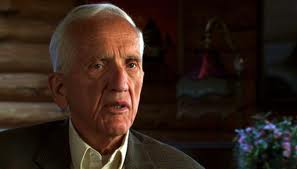
Dr. T. Colin Campbell, author of “The China Study”

So what would Dr. Campbell say about this book? As a new member of his foundation’s board of directors, I reached out to him before this blog. I won’t quote him directly, but suffice it to say that he was okay with what I am writing today.

I am often reminded of two quotes from this great man of integrity—both appearing early in our book, and both are relevant here:

In the Introduction. “It turns out that if we eat the way that promotes the best health for ourselves, we also promote the best health for the planet.”

In Chapter One. “When a whole foods, plant-based diet is demonstrably beneficial for such a wide variety of diseases, is it possible that humans were meant to consume any other diet? I say no, and I think you’ll agree.”

Six from Hicks —for your health, your planet & the future of our species

  1. The movie that’s changing the lives of millions: Forks Over Knives DVD 
  2. Healthy Eating, Healthy World, The “big picture” about food (our book)
  3. An essential scientific resource: The China Study by Dr. T. Colin Campbell
  4. Dr. McDougall’s latest book, The Starch Solution, with lots of great recipes
  5. Dr. Campbell’s new book: WHOLE, Rethinking the Science of Nutrition
  6. ENVIRONMENTAL Bonus. Comfortably Unaware by Richard Oppenlander. Eating for your own health is also best for the sustainability of our ecosystem.

Why should we be eating mostly plants? The “big picture” in 4 minutes.

Want to find out how healthy your family is eating? Take our free 4Leaf Survey. It takes 2 or 3 minutes and you can score it yourself. After taking the survey, please give me your feedback as it will be helpful in the development of our future 4Leaf app for smartphones. Send feedback to jmorrishicks@me.com

International. We’re now reaching people in over 100 countries. Follow us on Facebook and Twitter or get daily blog notices by “following” us in the top of the right-hand column. For occasional updates, join our periodic mailing list.

J. Morris Hicks, working daily to promote health, hope and harmony on planet Earth.

To order more of my favorite books—visit our online BookStore now

For help in your own quest to take charge of your health, visit our 4Leaf page and also enjoy some great recipes from Lisa’s 4Leaf Kitchen.

Got a question? Let me hear from you at jmorrishicks@me.com. Or give me a call on my cell at 917-399-9700.

SHARE and rate this post below.

—J. Morris Hicks, board member since 2012; click banner for more info:

Nutrition Certificate

Posted in Big Picture | 10 Comments

A popular vegan organization asks me a dozen questions.

The following interview was conducted yesterday via email and will soon be published online along with a review of our book on another one of their websites. When those are ready for viewing, I will let you know. In the meantime, I just finished responding to twelve excellent questions and wanted to share them with you today.
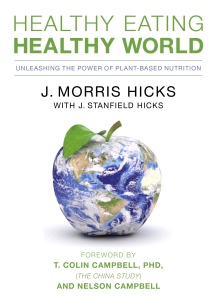
Published by BenBella Books of Dallas Texas in October of 2011

1. What motivated you to become vegan and was it an overnight switch or more gradual shift? In late 2002, I became interested in learning more about the optimal diet for humans, and after reading 30 or 40 books on the topic, quickly moved in the direction of a whole foods, plant-based diet. Then in May of 2003, I read two books; one by John Robbins and the other by Howard Lyman. In those books, I learned about the many non-human health reasons for eating plant-based—and that’s when I had my blinding flash of the obvious and concluded, “We’re eating the wrong food.” For the detailed version of all of this, take a look at the About Us tab on my website.

2. Tell me about your book, Healthy Eating Healthy World, and what inspired you to write it. After reading hundreds of books since 2002, I realized that there was no single book that succinctly explained the “big picture” about what we eat and how it relates to the promotion of health hope and harmony on planet Earth. You see, we’re the only species in history that doesn’t eat what Nature intended for us to eat, and I wanted to explain in simple, everyday terms, the vast consequences of our “unnatural” food choices, beginning with our own health. I really felt like there was a need for a “big picture” book on this topic—one aimed at the mainstream 95% who are not vegan or vegetarian. I wanted a fact-filled, entertaining read that would be ideal for vegans to give to their meat-ending friends and family. 

3. Your book covers such a wide breadth of topics, yet they are so strongly interrelated. How long did it take you to put all of the pieces of the puzzle together? I have been pulling the information together since 2002 and started presenting it to the public on my Harmony Earth website in 2006. After getting a contract with BenBella Books in April of 2010, it took me about six months to complete the book.

4. What piece of information did you come across that surprised you the most while writing the book? The overwhelming preponderance of evidence supporting a whole foods, plant-based diet for humans—coupled with the almost unanimous belief within that Western world that we truly need to eat animal protein to be healthy.

5. Are you optimistic that we as a world population will be able to solve the environmental and nutritional crisis’ we face? My feeling is that in the long run, a return to the natural diet for our species (whole plants) is inevitable. The question is whether we’ll make that transition voluntarily or if we’ll have to be forced. It will probably be a little of both. I’m optimistic that millions of people will start moving in the right direction once they are provided with the necessary information. Unfortunately, I think that the masses will have to be forced to change — either by the cost or simply to avoid starvation in a world where the population grows by 200,000 people per day and we’re losing a chunk of arable land about the size of South Carolina every year.
Based on what we DO eat -- not what we're avoiding.

6. Please explain what 4Leaf For Life is. We developed the 4Leaf Program to help people understand that healthy eating should be focused on what we ARE eating; not on what we’re avoiding. So it’s a real simple concept of maximizing the percent of one’s daily calories from whole plants, still in Nature’s package.

Lately, I have realized that the 4Leaf for Life slogan represents a mentality of being aware of what we’re eating as we always strive to eat mostly plants. The 4Leaf level begins at 80%, an arbitrary number but one that delivers over 15 times more whole plant calories than the typical Western diet.

7. Walk me through a day in your life. I wake up at 0515; then drive to the Mystic Starbucks, where I have one “Tall Pike” (black) while doing my daily blog. I return to my studio around 0800 and watch the first half hour of the Today Show on my DVR. Most of my day is devoted to writing, promoting our book and 4Leaf brand, working on civic or yacht club tasks, and at least one hour of outdoor exercise. I strive to eat at the 4Leaf level at every meal, enjoy a cocktail or wine before dinner and hit the sack at about 9:30 p.m. One more thing, with a daily consumption of over 70 grams of fiber from whole plants, I don’t waste much time in the men’s room—no reading material necessary.

8. What do you typically eat in the span of a day and are you a snacker? Bowl of fresh fruit at 0830. Large bowl of oatmeal (cold) with water and almond milk and piled high with more fruit at 1100. Eating only when I get hungry, my largest meal of the day is usually around 2 p.m. and typically consists of some combination of brown/wild rice, black/red beans, broccoli, carrots, mushrooms, tomato, avocado, olive, celery, and a half Joseph’s whole wheat pita with a touch of hummus. My evening meal is usually eaten outside the home and typically consists of entrées that are not on the menu—whole plants with minimal oil, butter, cheese or salt. As for snacks, I indulge occasionally in the healthiest popcorn that I can find or I might snack on nuts, grapes, or a little carrots & celery dipped in hummus. You can find my Sailors Daily Oatmeal and Sailors Super Lunch recipes at www.4leafprogram.com

9. What is your favorite vegan indulgence? I do enjoy a glass of wine or a cocktail from time to time; although I realize that they are not whole plants. As a part of the 20% of my calories that is non-whole plants, I am very thankful that these indulgences are 100% plant-based.

10. When people learn that you are vegan, what is the #1 question they ask and what is your response? Without a doubt, “Where do you get your protein?” I usually say “Great question; one that I hear quite often. That’s the first thing I asked back in 2002.” Then, I typically talk about the strongest animals in the world and the fact that all of them eat nothing but raw plants. I usually add that almost every plant has some protein, and many plants have more protein per calorie than sirloin steak.
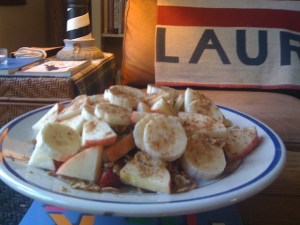
Sailors Daily Oatmeal - complete with lighthouse and book of knots

11. What vegan product could you not live without? My Sailors Daily Oatmeal.

12. In your wildest dreams what will your life and the world look like in 5 years? While the meat & dairy-laden Western diet will still be prevalent, many millions of people will have learned more about the health, environmental and other benefits of plant-based eating. Further, as the cost of energy and food continues to rise; more and more people will be choosing the cheaper, healthier and greener option of eating more plants. As for me in 2017, I would like to be speaking on college campuses around the world at least ten times a month—sharing our message with the young people who will be the leaders of the great food revolution of the 21st century. 

*****************
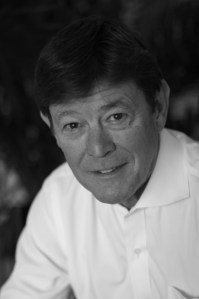
J. Morris Hicks, author and activist. Working daily to promote health, hope and harmony on planet Earth.

Want to receive some occasional special news from us? You may wish to join our periodic mailing list. Also, for help in your own quest to take charge of your health, you might find some useful information at our 4-Leaf page.

If you’d like to order our book on Amazon,  visit our BookStore now.

And if you like what 4-Leaf eating is doing for you and your family, you might enjoy visiting our new “4-Leaf Gear” store. From the seaside village of Stonington, Connecticut – Be well and have a great day.

—J. Morris Hicks…blogging daily at HealthyEatingHealthyWorld.com

SHARE and rate this post below…One more thing, occasionally an unauthorized ad may appear beneath a blog post. It is controlled by WordPress (a totally free hosting service). I do not approve or personally benefit whatsoever from any ad that might ever appear on this site. I apologize and urge you to please disregard.
Posted in 4Leaf for Life, Book Promotion | 3 Comments