“Dust Bowl” debate. Experts are missing the main point.

Six environmental experts and one Nobel Prize winner

What comes to mind when you think about preventing another “dust bowl?” Naturally I thought about the downright scary prospect of what would happen if we suddenly had far less land to feed all the people in the world. I also thought about how we could completely annihilate the primary driver of global warming, reduce water consumption by over fifty percent, cut our fossil fuel consumption by thirty percent and return billions of acres of farmland to forests and grasslands.

Do you think the combination of all of of the above might go a long ways toward preventing another “dust bowl?” I think that it could have a mind-boggling positive effect. And all we have to do is change the way we eat. By returning to the natural diet for our species, we’ll do all of these wonderful things for the environment while being rewarded with vibrant health for ourselves.

A pretty good deal for all concerned—particularly those two billion animals that we kill every single week for our dinner tables. But not a single one of the experts in the New York Times debate on this topic thought of this idea. Why not? Because it is very likely that ALL six of them truly believe that we “need” to eat animal protein to be healthy.

This ‘protein myth’ is killing us. It prevents many world-changing solutions from even making it to the table for consideration.

So what did the six experts had to say? The article began:

The famous dust bowl of the 1930s

The worst drought in 50 years is scorching crops across the heartland and, as a result, the government has declared one-third of the nation’s counties federal disaster areas.

Are we at risk for another Dust Bowl? If so, what can we do to prevent it? (See link below for complete article)

1. The first expert basically thinks it’s too early to tell. John Nielsen-Gammon, a professor of atmospheric sciences at Texas A & M University, is the Texas State Climatologist. At this point, we still have a ways to go before things dry out enough over a long enough period of time to give us another Dust Bowl. The impact of rising temperatures is still relatively modest, and the current drought could be finished as early as this winter by effects from the developing El Niño. Nonetheless, rising temperatures make an extreme and prolonged drought more and more likely.

2. Second expert says the “only answer” is slashing carbon pollution. Joseph Romm, a former acting assistant secretary of energy for energy efficiency and renewable energy, is a senior fellow at the Center for American Progress and the editor of the Climate Progress blog. Only one thing can stop ever-worsening Dust Bowls here and around the world — slashing carbon pollution. Climate scientists have predicted for decades that man-made global warming would worsen droughts and dust storms in the Southwest and around the world because of the combined effects of warming, drying and the melting of snow and ice.

3. Third expert says we must start by renewing the farm bill. Mark Tercek is president and chief executive of The Nature Conservancy. This summer’s devastating drought and record temperatures are an ominous reminder of the Dust Bowl that ravaged American agriculture in the 1930s. They also are a stark warning of what could happen again if we fail to act decisively to help farmers protect America’s soil and water.

4. Fourth expert says we must reduce the consumption of fossil fuels. Cynthia Burbank, a former federal transportation official, is a vice president at Parsons Brinckerhoff . Drought, wildfires, record heat, huge losses in the Greenland ice sheet, intense wind and thunder storms – these occurrences are the latest in unusual, if not unprecedented, weather events. Some scientists are careful to say that these are not proof of climate change. But regardless of the symptoms, climate is changing. We need to take steps to reduce fossil fuel use and “adapt” to these new weather extremes. Hopefully if we do, another Dust Bowl will be avoided.
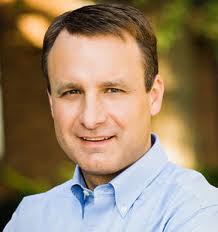
Jonathan Foley, the lone “glimmer of hope” within a sea of uninformed experts

5. Fifth expert was the only one who suggested farming changes. Jonathan Foley is the director of the Institute on the Environment at the University of Minnesota, where he holds a McKnight Presidential Chair in global environmental sustainabilityA system that replaces some of the corn-soybean belt with grains, fruits and vegetables that go directly into the human diet and with grasslands to feed animals and create cellulosic biofuels would feed more people, and be far more resilient to climatic extremes.

6. Sixth expert thinks “odds are fairly remote.” Gary McManus joined the Oklahoma Climatological Survey in May 1999 and currently serves as the Associate State Climatologist for Oklahoma. The odds of another “Dust Bowl” style environmental disaster, even with the severity of the current drought, are still fairly remote thanks to the lessons learned from that era. 

So what’s my point? Apparently none of these highly educated experts are aware of the leading cause of global warming, deforestation and soil erosion. Only expert #5, Jonathan Foley, seemed to understand at least a piece of what could be possible with a whole foods, plant-based diet for humans. His statement bears repeating:

 A system that replaces some of the corn-soybean belt with grains, fruits and vegetables that go directly into the human diet and with grasslands to feed animals and create cellulosic biofuels would feed more people, and be far more resilient to climatic extremes.

But instead of replacing “some” of that animal feeding “belt,” we ultimately must replace all of it—and none of our experts seem to understand that simple, yet inevitable “big picture.” As such, I become more convinced every day that this highly conspicuous oversight by many groups of brilliant people is a direct result of the ubiquitous “protein myth” in the western world.
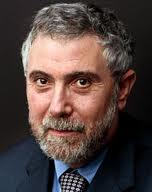
Paul Krugman, winner of the 2008 Nobel Prize in Economics

Further proof of the “protein myth.” From a Nobel Prize-winning columnist at the New York Times. Just three days before the “dust bowl” article, Paul Krugman wrote a piece entitled “Loading the Climate Dice.”

How should we think about the relationship between climate change and day-to-day experience? Almost a quarter of a century ago James Hansen, the NASA scientist who did more than anyone to put climate change on the agenda, suggested the analogy of loaded dice.

Imagine, he and his associates suggested, representing the probabilities of a hot, average or cold summer by historical standards as a die with two faces painted red, two white and two blue. By the early 21st century, they predicted, it would be as if four of the faces were red, one white and one blue. Hot summers would become much more frequent, but there would still be cold summers now and then.

The Bottom Line. Brilliant article. Brilliant Nobel Prize winner. But no mention whatsoever of the primary cause of global warming. I hereby rest my case—and offer a few other blogs to back up my point, including the final one below about what me must do to “dispel the protein myth,” thereby freeing up lots of brilliant minds to think about plant-based solutions more powerful than their wildest dreams.

The following five books and one DVD can be purchased on Amazon for a grand total of less than $60—and will enable you to understand the overwhelming challenges we face—along with the single most-powerful solution of all.

Six-Pack from Hicks—for health, hope & harmony on planet Earth

  1. Healthy Eating, Healthy WorldThe “big picture” about food (our book)
  2. A life changer for millions, including James Cameron. Forks Over Knives DVD 
  3. An essential scientific resource: The China Study by Dr. T. Colin Campbell; the primary book that influenced Bill Clinton to adopt a whole food, plant-based diet.
  4. What have we done to our planet? Full Planet, Empty Plates by Lester Brown
  5. A horrifying wake-up call for leaders. TEN BILLION by Dr. Stephen Emmott
  6. Food choices are the primary cause of our environmental problems, yet our world leaders, scientists & experts are Comfortably Unawareby Richard Oppenlander.

Why should we be eating mostly plants? The “big picture” in 4 minutes.

Want to find out how healthy your family is eating? Take our free 4Leaf Survey. It takes 2 or 3 minutes and you can score it yourself. After taking the survey, please give me your feedback as it will be helpful in the development of our future 4Leaf app for smartphones. Send feedback to jmorrishicks@me.com

International. We’re now reaching people in over 100 countries. Follow us on Facebook and Twitter or get daily blog notices by “following” us in the top of the right-hand column. For occasional updates, join our periodic mailing list.

J. Morris Hicks, working daily to promote health, hope and harmony on planet Earth.

To order more of my favorite books—visit our online BookStore now

For help in your own quest to take charge of your health, visit our 4Leaf page and also enjoy some great recipes from Lisa’s 4Leaf Kitchen.

Got a question? Let me hear from you at jmorrishicks@me.com. Or give me a call on my cell at 917-399-9700.

—J. Morris Hicks, board member since 2012; click banner for more info:

Nutrition Certificate

Posted in Climate Change, Food Policy, Harmony Project | Leave a comment

Projected “doctor shortage” driven by new health law.

Our $2.7 trillion “disease care” business is about to get bigger.

Due to 30 million new patients accompanying our new health care law, the experts are projecting a severe shortage of doctors in many parts of the country. From a 7-28-12 New York Times article (See link below):

The Association of American Medical Colleges estimates that in 2015 the country will have 62,900 fewer doctors than needed. And that number will more than double by 2025, as the expansion of insurance coverage and the aging of baby boomers drive up demand for care. Even without the health care law, the shortfall of doctors in 2025 would still exceed 100,000.

A government council has recommended that a given region have 60 to 80 primary care doctors per 100,000 residents, and 85 to 105 specialists. The Inland Empire has about 40 primary care doctors and 70 specialists per 100,000 residents — the worst shortage in California, in both cases.

What would this graph look like if everyone were taught the whole foods, plant-based method of taking charge of their own health?

According to those numbers, our nation will need approximately 550,000 physicians and they say we’re going to almost 70,000 short by 2015 and 140,000 short by 2025.

But how many fewer doctors would be needed if we told our citizens EXACTLY what they should eat to promote the best health? What if we provided total clarity about the healthiest possible diet?

A whole foods, plant-based diet. According to Dr. T. Colin Campbell and Dr. Caldwell Esselstyn in Forks Over Knives (movie), if we all ate an optimal diet, we’d soon need 70% fewer doctors.

Doing the math, that means that instead of needing 550,000 physicians, we’d need 385,000 fewer (70% of 550,000). So we would need only 165,000 physicians if everyone immediately began eating a whole foods, plant-based diet. That would work out to be be 50 doctors for every 100,000 citizens. So what would happen to the former doctors who were no longer needed?

The Good News. Many of those former “disease care” doctors could become “health-promotion” specialists. Many advantages would ensue:

  • Much less time and money needed to prepare a health-promotion specialist.
  • Less chronic disease, less testing, less procedures, less drugs, less costly health insurance—and far less money in the overall “health care system.”

Would you believe about two trillion dollars less?

But guess what? Along with two trillion fewer dollars in the system goes millions of jobs in the pharmaceutical, health insurance, and cancer screening/treatment businesses—to name just a few. But as I said, there will be new jobs created as people (at least in the near term) will need help in learning how to take charge of their health—ushering in the era of the health-promotion specialist.

More good news. Long-term, parents will teach their own children how to take charge of their health and we won’t nearly as many “health promotion” specialists. But we’re going to need lots of them in the next forty years. And we’re going to need millions of new small, organic farmers as we start utilizing our overworked arable land much more efficiently—growing food for humans instead of feed for billions of farm animals.

Like the Maytag Repairman, there will be much fewer disease care physicians and many of them will be lonely.

Long-term, it will be a much better deal for all concerned: For the people, for the planet, for the energy and water supply and for those two billion animals per week (worldwide) that are tortured and killed for our dinner tables during this first half of the 21st century.

Ultimately, we will all be in a much better place and the “disease care” specialist of the 22nd century will be as rare—and as lonely—as the old Maytag Repairman of the late 20th century.

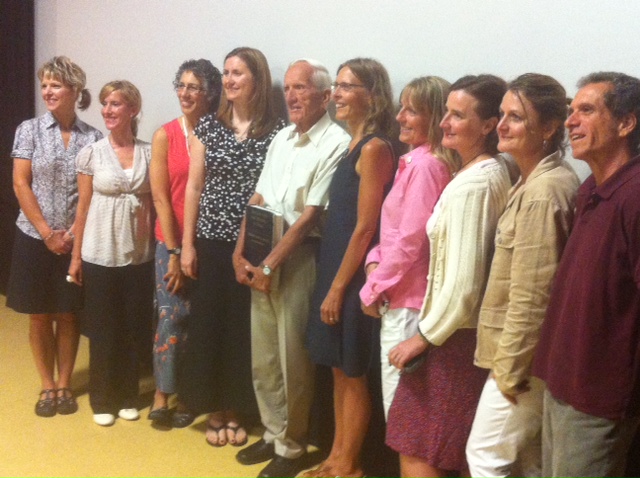
Replacing all those “disease care” specialists will be millions of health-promotion specialists. Here is a picture of the first wave—nine of the eleven Plant-Based Nutrition Instructors at the T. Colin Campbell Foundation. From Boston to Texas to Oregon and California, this team is changing the world. For more information on the Plant-Based Nutrition Certificate Course (with eCornell), scroll to the bottom.

Alison, Jill, Kathy, Katie — Dr. Campbell — Rebecca, Leigh, Katherine, Anne & Lewis

One of these instructors, Lewis Freedman, just published a wonderful new cookbook with his wife Priscilla. It features about 100 whole foods, plant-based recipes (vegan & gluten-free) and lots of cooking tips. Entitled The Great Life Cookbook, you can click here to take a look and purchase online. ($26.50 includes shipping in the USA)

Handy 4-piece take-charge-of-your-health kit—from Amazon.com

Want to find out how healthy your family is eating? Take our free 4Leaf Diagnostic Survey. It takes less than five minutes and you can score it yourself. After taking the survey, please give me your feedback as it will be helpful in the development of our future 4Leaf app for smartphones. Send feedback to jmorrishicks@me.com

International. We’re now reaching people in over 100 countries. Follow us on Facebook and Twitter or get daily blog notices by “following” us in the top of the right-hand column. For occasional updates, join our periodic mailing list.

To order more of my favorite books—visit our online BookStore now

J. Morris Hicks, working daily to promote health, hope and harmony on planet Earth.

For help in your own quest to take charge of your health, you might find some useful information at our 4Leaf page or some great recipes at Lisa’s 4Leaf Kitchen.

Got a question? Let me hear from you at jmorrishicks@me.com. Or give me a call on my cell at 917-399-9700.

SHARE and rate this post below.

Blogging daily at hpjmh.com…from the seaside village of Stonington, Connecticut – Be well and have a great day.

—J. Morris Hicks, board member, T. Colin Campbell Foundation

Posted in Cost of Health Care, M.D.s---Health-Promoting, Medical Experts | Tagged , | 1 Comment

Prostate Cancer; Patient regrets radiation treatment…

…saying that he would have preferred “close surveillance.”

A 67-year old Massachusetts man consulted with a number of physicians in the Boston area; and although they didn’t all agree on the recommended treatment regimen, he reports that they did agree on one thing:

 I asked about ‘close surveillance’ and they said, no, you have to do something!

The PSA Blue Ribbon

So he did—and later regretted it. (See link below to his story in the Boston Globe.) Since publishing a blog a few weeks ago on this topic (Professor of medicine says NO to the PSA test…) I have heard from lots of people, some of whom say that they would not be alive today had they not had the PSA test and the prescribed treatment of surgery and radiation. No doubt, there are millions of stories on both sides of this debate.

In my opinion, the preferred method for fighting cancer is by preventing it—primarily by not providing a hospitable host body, in which cancer can grow and spread. I recall a book by a scientist friend of mine—Raymond Francis, author of Never Be Sick Again. In that book, he said that there was really only one disease and it only had two causes.

  • The one disease is “malfunctioning cells.”
  • The two causes: (1) Not enough of the health-promoting nutrients that the body needs. (2) Too many toxins that the cells do not need.

Published by BenBella — October 2011

As for nutrients and toxins. In our book, I reported how the body replaces about ten trillion cells per year. And the only raw material it has to work with (other than water and air) is the food that we eat. Therefore, I concluded that I would try to make every bite count. After doing the math, I computed that the health of approximately 100 million new cells is riding on every single bite of food that we put in our mouths.

It turns out that the best food for getting all the right nutrients is whole plants. We also get most of those un-needed toxins in our food supply—particularly if we’re eating a meat and dairy based diet.

According to the work of Dr. T. Colin Campbell, it seems that the lifelong consumption of the toxic western diet creates just the right environment for cancer to thrive. By simply eating a whole foods, plant-based diet, we could probably prevent 80% of the cancer cases in this country.

But most men trying to decide whether or not to have surgery or radiation are men who’ve been eating that toxic western diet for 50 years or more. And it’s tough for them to decide what they should do. A sad situation indeed.

Deborah Kotz, The Boston Globe

As you can see from this anecdote reported in the Boston Globe, at least one man in Massachusetts wishes he’d never agreed to have the treatment that was recommended by his physicians. From the 7-23-12 Deborah Kotz article; here’s his story (See link below to full article)

Walter Chorney of North Attleboro told me in an e-mail and subsequent phone conversation that he regretted having radiation treatment for his early stage prostate cancer, after experiencing pain and bleeding for 19 months after treatment. Nearly three years ago, Chorney was told, at age 67, that his elevated PSA of 2.7 ng/ml required him to get a biopsy. Only one tissue sample out of 12 taken showed cancer, but the cancer was deemed to be moderately aggressive based on the look of the cells under the microscope.

Chorney consulted several doctors at Boston-area hospitals, and some suggested surgery, while others advised radiation. None recommended that he do what he actually preferred: surveillance of the cancer with no immediate surgery or radiation. “I asked about it and they said, no, you have to do something,” Chorney told me.

After doing online research and interviews with prostate cancer specialists, Chorney said he settled on radiation treatments using a newer robot-assisted technique called Cyberknife that targets only the tumor without destroying the entire prostate. He was comforted by the low rate of side effects; the website said moderate to severe urinary problems occur in “0 to 3.5 percent” of patients and bowel problems occur in “0 to 2 percent” of patients.

Regardless, Chorney was one of the unlucky ones who experienced lingering symptoms after his five rounds of radiation treatments over the course of a week. He had severe abdominal pain, bleeding when he urinated, and the urge to void his bladder every 20 minutes. Once he was nearly arrested after he pulled his bike over to the side of the road to urinate during a four-mile ride to a store.

“I was miserable for over a year,” Chorney wrote to me. “The radiation killed the small amount of cancer but zapped me physically and mentally.”

He finally found relief this past January after having surgery to reduce the size of his prostate, which had become enlarged following the radiation treatments. (His doctors suspect that the enlarged gland occurred from damage from the radiation, but they don’t know for certain.)

“I regret having my prostate cancer treated,” he said. “My gut told me that I did not need any treatment but the experts told me that I did. If I was diagnosed today I think my doctors would have been more willing to let me choose monitoring.”

One final point. Over the weekend, Dr. T. Colin Campbell reminded me that although all cancers cannot be reversed, that many of them will either be slowed or arrested by a whole foods, plant-based diet. That diet, coupled with “close surveillance,” may have yielded a much happier ending for Mr. Chorney.

Want to prevent cancer in the first place? Take charge of your own health as early in life as possible. Then teach this method to your children.

Handy 4-piece take-charge-of-your-health kit—from Amazon.com

Want to find out how healthy your family is eating? Take our free 4Leaf Diagnostic Survey. It takes less than five minutes and you can score it yourself. After taking the survey, please give me your feedback as it will be helpful in the development of our future 4Leaf app for smartphones. Send feedback to jmorrishicks@me.com

International. We’re now reaching people in over 100 countries. Follow us on Facebook and Twitter or get daily blog notices by “following” us in the top of the right-hand column. For occasional updates, join our periodic mailing list.

To order more of my favorite books—visit our online BookStore now

J. Morris Hicks, working daily to promote health, hope and harmony on planet Earth.

For help in your own quest to take charge of your health, you might find some useful information at our 4Leaf page or some great recipes at Lisa’s 4Leaf Kitchen.

Got a question? Let me hear from you at jmorrishicks@me.com. Or give me a call on my cell at 917-399-9700.

SHARE and rate this post below.

Blogging daily at hpjmh.com…from the seaside village of Stonington, Connecticut – Be well and have a great day.

—J. Morris Hicks, board member, T. Colin Campbell Foundation

Posted in Cancer | Tagged | 2 Comments