Leading us to believe that if we’re not taking some drug, we’re not “human”
 This blog is all about confusion, confusion and more confusion. An article in the New York Times caught my attention last week. It was entitled Diagnosis: Human and was all about the drug-happy psychiatric medical care that is taking place in the United States today (See link below). This single paragraph summarizes the entire article quite well:
Ours is an age in which the airwaves and media are one large drug emporium that claims to fix everything from sleep to sex. I fear that being human is itself fast becoming a condition. It’s as if we are trying to contain grief, and the absolute pain of a loss like mine. We have become increasingly disassociated and estranged from the patterns of life and death, uncomfortable with the messiness of our own humanity, aging and, ultimately, mortality.
The author, Ted Gup (a Harvard Fellow) began his thought-provoking piece with the chilling diagnosis of ADHD among the young. He writes, “THE news that 11 percent of school-age children now receive a diagnosis of attention deficit hyperactivity disorder — some 6.4 million — gave me a chill. My son David was one of those who received that diagnosis.” He went on to say more about his son’s diagnosis:
In his case, he was in the first grade. Indeed, there were psychiatrists who prescribed medication for him even before they met him. One psychiatrist said he would not even see him until he was medicated. For a year I refused to fill the prescription at the pharmacy. Finally, I relented. And so David went on Ritalin, then Adderall, and other drugs that were said to be helpful in combating the condition.
In another age, David might have been called “rambunctious.” His battery was a little too large for his body. And so he would leap over the couch, spring to reach the ceiling and show an exuberance for life that came in brilliant microbursts.
This story didn’t have a happy ending. The rambunctious first-grader described above tragically died as a college senior fifteen years later—from a fatal mix of alcohol and drugs. The author blames himself and you can read more about his grief in the article.
But this story is just the tip of the iceberg. We have become a drugged society which has become accustomed to trusting our health to the money-driven drug-makers—who are gearing up for the biggest boost to their business since cholesterol, hypertension and erectile dysfunction. I am talking about the emerging “personalized” medicine based on our human genome map—a HUGE piece of business that’s just getting started.

Cancer—now one of the biggest businesses in the USA
Cancer, Drugs and Big Money. In a related story, we learn about the major “cancer centers racing to map patients’ genes.” See New York Times source article below. Make no mistake; cancer is big business today and any talk about finding the “cure” is just so much smoke.
While the “industry” would like us to believe that they’re all “racing for the cure;” in reality, they’re all racing to make sure they all get their share of the HUGE personalized medicine business. You know, the right drug for you at the right time—made possible by your own unique human genome map. From the article:
Electric fans growl like airplanes taking off and banks of green lights wink in a basement at Mount Sinai’s medical school, where a new $3 million supercomputer makes quick work of huge amounts of genetic and other biological information.
Just a couple of miles away, a competitor, Weill Cornell Medical College and NewYork-Presbyterian Hospital/Weill Cornell hospital are building a $650 million research tower. Across the street is a newly completed $550 million tower housing labs for another competitor, Memorial Sloan-Kettering Cancer Center.
Major academic medical centers in New York and around the country are spending and recruiting heavily in what has become an arms race within the war on cancer. The investments are based on the belief that the medical establishment is moving toward the routine sequencing of every patient’s genome in the quest for “precision medicine,” a course for prevention and treatment based on the special, even unique characteristics of the patient’s genes.
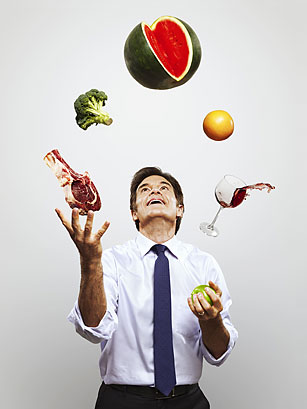
You will always hear Dr. Oz recommending some form of animal protein in your diet—ignoring the well documented facts from Ornish, Esselstyn, Furhman, McDougall & Barnard.
Then there’s America’s favorite doctor. In this month’s AARP magazine, there was a lengthy article about 90-year-old billionaire David Murdock who is on a quest to live to the ripe old age of 125. And he’s primarily doing it by virtue of a whole foods, plant-based diet.
Yet, in the same magazine, Dr. Oz offers special health tips to women and men and offers the same old advice about screenings and eating fish with omega-3s. But he makes not a single mention of the most powerful health-promoting step we can take—eating a whole foods, plant-based diet.
The Bottom Line. With a whopping $2.8 trillion health care bill in the United States still growing by hundreds of millions of dollars every year—our “system” continues to provide us with a daily stream of confusion about the whole mess. The three articles referenced in this blog are typical of what we see every day. What to do?
You really have no other choice but to educate yourself and your family and learn how to take charge of your own health. My latest recommendation is Dr. Campbell’s new book, WHOLE, which begins shipping on May 7. Dr. Campbell makes it very clear why our health care “system” is not working.
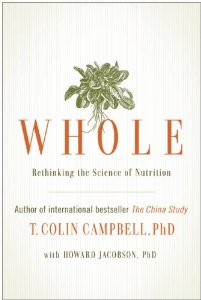 WHOLE, Rethinking the science of nutrition. Dr. T. Colin Campbell’s new book. As a member of the T. Colin Campbell Foundation Board of Directors, I was one of the lucky ones who received an advance copy of this great book in January. And I was privileged to be asked to write an endorsement. Here’s what I wrote,
“Why is the most expensive health care system in the world not working? This book provides scientific “big picture” clarity amidst a sea of confusion about how commercially driven “disease management” is costing us millions of lives—while wasting trillions of dollars. Understanding how this “health care monster” operates is the first step toward creating a system that truly promotes health.” Click here to order this book on Amazon.
- Source article. Diagnosis – Human – NYTimes.com
- Source article. Patients’ Genes Seen as Future of Cancer Care – NYTimes.com
- Source article. Dr. Oz’s Health Guide for Men and Women – Living a Long Life – AARP
- My recent blog about cancer. CANCER. The Suffering. The Expense. The Tragedy
- Earlier blog about Dr. Oz. Oz shares colon story; “screening business” gets bigger
Handy 4-piece take-charge-of-your-health kit—from Amazon.com
- The movie that’s changing the lives of millions: Forks Over Knives DVD
- Healthy Eating, Healthy World, The “big picture” about food (our book)
- An essential scientific resource: The China Study by Dr. T. Colin Campbell
- Dr. McDougall’s new book, The Starch Solution, with lots of great recipes.
Want to find out how healthy your family is eating? Take our free 4Leaf Survey. It takes less than five minutes and you can score it yourself. After taking the survey, please give me your feedback as it will be helpful in the development of our future 4Leaf app for smartphones. Send feedback to jmorrishicks@me.com

 International. We’re now reaching people in over 100 countries. Follow us on Facebook and Twitter or get daily blog notices by “following” us in the top of the right-hand column. For occasional updates, join our periodic mailing list.
To order more of my favorite books—visit our online BookStore now

J. Morris Hicks, working daily to promote health, hope and harmony on planet Earth.
For help in your own quest to take charge of your health, you might find some useful information at our 4Leaf page or some great recipes at Lisa’s 4Leaf Kitchen.
Got a question? Let me hear from you at jmorrishicks@me.com. Or give me a call on my cell at 917-399-9700.
SHARE and rate this post below.
—J. Morris Hicks, board member, T. Colin Campbell Foundation



 J. Morris Hicks, engineer. writer. big picture guy.