Do you breathe air, drink water and have sex?

Even with no randomized studies proving that you should?

What should humans be eating? That’s the question that I began studying in 2002. Six months later, I concluded—without a doubt—that we should be eating a whole foods, plant-based diet. From my “big picture” industrial engineering point of view, it just made total sense. For me, it was a blinding flash of the obvious. But, it has still never been “proven” with randomized clinical studies that WFPB is the best diet for humans.
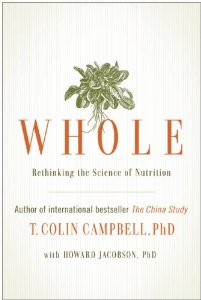
Dr. Campbell says we must study the entire human body to understand how nutrition works.

Like Dr. Campbell, I am a “big picture” guy that doesn’t like to try to solve problems in a vacuum.

It has also never been proven from randomized studies that we should be breathing air, drinking water and having sex. But we all do it anyway. So why is our food any different? Because there’s a lot of money riding on the continuation of our love affair with meat, dairy, eggs and processed foods three meals a day. And the “experts” who want that diet-style to continue have tons of randomized studies to support their case.

Why aren’t there any randomized studies supporting a whole foods, plant-based diet? Because no one has put up the money to pay for them. But like air, water and sex—I don’t think we need those studies in order to be certain what we should be eating.

I think we just need to explain the WHOLE impact that the way we eat has on our health, our planet and the long-term sustainability of our species. Once people everywhere fully understand the “big picture,” many of them will choose WFPB—because it’s the “obvious” solution to so many of the world’s problems.

Promoting health, hope and harmony on planet Earth

The image on our book tells the WHOLE story.

Dr. Campbell says you must study the WHOLE body to understand how nutrition really works. Likewise, I say that we must study the WHOLE world to understand what we should be eating—indeed what we must be eating—if we want to ensure the long-term survival of our great-grandchildren and their great-grandchildren.

On Sunday morning, I watched two videos (provided below) featuring two separate debates between Dr. Campbell and “experts” who promote meat-based eating.

Both of the experts he debated have impressive credentials as you can see at the end of this blog. My conclusion after watching both videos was that we can’t win these battles with a bunch of randomized studies. We must appeal to the common sense of the billions of humans who truly want to do the right thing.

What if I were debating? Since I am not a doctor or a scientist, I would rely on my “industrial engineering” view of the “BIG PICTURE” to make my case—and I think that I could get that done in four minutes with a dozen slides.

The Bottom Line. The arguments supporting a whole foods, plant-based diet are many and they are sound. The problem is that arguing about the findings of randomized clinical studies does nothing to help enlighten the casual listener to the staggering and disturbing consequences of our highly popular food choices in the western world.
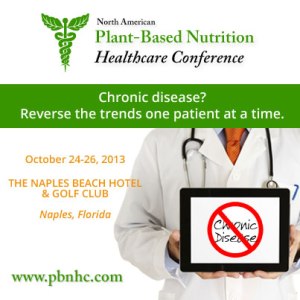
Contact them at pbnhc.com and tell them J. Morris Hicks sent you.

For doctors who truly want to help their patients prevent or reverse chronic disease, they can earn CMEs by learning how to get that done. Tell them J. Morris Hicks sent you.

Another problem is that over 90% of our medical doctors and our nutritional scientists are currently eating meat, dairy and eggs on a regular basis. Naturally, they want to go on believing that they (and their parents) haven’t been wrong all these years. They want to hear good news about their bad habits and they particularly like it when they hear that news from highly pedigreed experts.

Regarding the debates mentioned earlier; it was watching them that inspired me to go ahead and publish my 4-minute PowerPoint (soon to be a video) mentioned earlier.

For your convenience, here are the credentials for the two MDs featured in the following debates with Dr. Campbell.

Dr. Eric C. Westman. Associate professor of medicine at Duke University Health System and director of the Duke Lifestyle Medicine Clinic. He combines clinical research and clinical care to deliver lifestyle treatments for obesity, diabetes and tobacco dependence. He is an internationally-known researcher specializing in low-carbohydrate nutrition. Dr. Westman is currently the vice president of the American Society of Bariatric Physicians and a fellow of the Obesity Society and the Society of General Internal Medicine. He is also co-author of New Atkins for a New You.

Dr. Loren Cordain. Professor in the Department of Health and Exercise Science at Colorado State University in Fort Collins, Colorado. His research emphasis over the past 15 years has focused upon the evolutionary and anthropological basis for diet, health and well being in modern humans. Dr. Cordain is the author of more than 100 peer review publications, many of which were funded by both private and governmental agencies. He is the recent recipient of the Scholarly Excellence award at Colorado State University for his contributions into understanding optimal human nutrition. He is the author of The Paleo Diet.

In this debate (Campbell v. Westman), each of them had 18 minutes to make their case. Dr. Campbell for a whole foods, plant-based diet and Dr. Westman for a high protein, high fat, low carb diet. Then, they had a rebuttal and some Q & A from the audience. My guess is that the people who arrived as meat-eaters also left as meat-eaters. Each side probably feels like their guy won.

80-minute debate with Dr. Westman

30-minute discussion with Dr. Cordain on Larry King Now

Handy 5-piece take-charge-of-your-health kit—from Amazon.com

Want to find out how healthy your family is eating? Take our free 4Leaf Survey. It takes less than five minutes and you can score it yourself. After taking the survey, please give me your feedback as it will be helpful in the development of our future 4Leaf app for smartphones. Send feedback to jmorrishicks@me.com

International. We’re now reaching people in over 100 countries. Follow us on Facebook and Twitter or get daily blog notices by “following” us in the top of the right-hand column. For occasional updates, join our periodic mailing list.

J. Morris Hicks, working daily to promote health, hope and harmony on planet Earth.

To order more of my favorite books—visit our online BookStore now

For help in your own quest to take charge of your health, visit our 4Leaf page and also enjoy some great recipes from Lisa’s 4Leaf Kitchen.

Got a question? Let me hear from you at jmorrishicks@me.com. Or give me a call on my cell at 917-399-9700.

SHARE and rate this post below.

—J. Morris Hicks, board member, T. Colin Campbell Foundation
Posted in 4Leaf for Life, Big Picture, Bill Clinton, Environment, Harmony Project | Tagged | 9 Comments

Rx for slashing the cost of healthcare at CVS

America’s largest drugstore chain—#18 on the Fortune 500 list

CVS logoApparently the “CVS” stands for “convenience, value and service.” A huge organization, they report $108 billion in sales, profits of $3.5 billion and have 203,000 employees.

Since much of their profits depend on sick people buying drugs, my sense is that they might not be real keen on all of their customers getting healthy. But, on the other hand, they might be VERY keen on shaving a few hundred million off their own cost of healthcare—a number that is probably in the BILLION DOLLAR neighborhood.

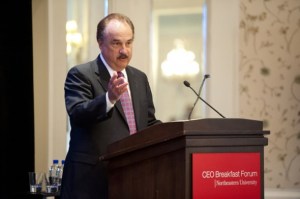
Mr. Merlo speaking at Northeastern University

Mr. Merlo speaking at Northeastern University

Earlier this month, the CEO, Larry J. Merlo, spoke at a CEO Breakfast Forum at Northeastern University in Boston. From Northeastern’s online news site:

Larry J. Merlo, pres­i­dent and CEO of CVS Care­mark, said on Tuesday…that the chal­lenges pre­sented by America’s rapidly evolving health­care land­scape will require inno­v­a­tive solu­tions that lower costs and improve patient access to quality care.

Describing the chal­lenges related to cus­tomer inter­ac­tion, Merlo told the story of a Min­ute­Clinic nurse prac­ti­tioner who noticed a high-​​school athlete’s heart murmur during a rou­tine phys­ical and directed the family to a spe­cialist. The boy’s mother ini­tially ques­tioned the finding, but the specialist’s later con­fir­ma­tion com­pelled her to write a warm letter to CVS Care­mark lauding the nurse practitioner’s careful attention.

“This is just one story about what is hap­pening out there every day, whether it’s a nurse prac­ti­tioner or a phar­ma­cist doing won­derful things that ulti­mately end up saving people’s lives,” Merlo said.

Saving lives? How many lives could be saved if Mr. Merlo helped ALL of his 203,000 employees learn how to take charge of their health? How many heart attacks would never happen? How many cancer cases would be prevented? And how many dollars could Mr. Merlo add to the bottom line of CVS Caremark?

Since the CVS corporate offices are only an hour’s drive from my home, I decided to write Mr. Merlo a letter and request a visit. Like my letter to the CEO of CostCo two weeks ago and my letter to the CEO of Walmart on June 21, here’s my letter that went out today via Priority Mail along with a copy of our book and a hard copy of our 4Leaf Corporate Wellness vision document. (Still no response to my 6-7-13 letter to Mr. Jelinek at CostCo)

      • June 26, 2013
      • Mr. Larry J. Merlo, CEO
      • CVS Caremark Corporation
      • Woonsocket, Rhode Island
      • Subject: Slashing the cost of healthcare in businesses

CVS peopleDear Mr. Merlo,

You have a reputation for being a leader that likes to innovate—and are often quoted as being proud of the strong CVS track record of health care innovation. Just last week you mentioned in your remarks at Northeastern University that “America’s rapidly evolving healthcare landscape will require innovative solutions that lower costs and improve patient access to quality care.”

As for innovation, it’s time for a prominent leader to step forward and show the world how to do some serious innovation when it comes to promoting health (vs. managing disease) in this country. We’re talking about slashing the CVS cost of healthcare by helping associates learn how to take charge of their own health. I am writing to propose a meeting with you to talk about ideas for getting that done.

Your estimated cost of healthcare. With over 200 thousand employees, I estimate that the CVS annual cost of healthcare is in the neighborhood of one billion dollars. Not only are you the largest drug retailer in the USA, you probably also have the industry’s largest healthcare bill. Lowering that bill begins with the food that we eat.

Did you know that our unhealthy food choices are driving up to 80% of the cost of healthcare in the USA? That means that you could conceivably eliminate several hundred million dollars of expense—while further enhancing your company’s already sterling reputation for innovation.

Who am I and how can I help? Although I live in southeastern Connecticut, I am originally from Mississippi. I studied Industrial Engineering at Auburn University and later earned an MBA from the University of Hawaii while on active duty in the U.S. Coast Guard. Since then, most of my career has been devoted to improving profitability in numerous enterprises by eliminating waste in diverse companies like Sears, ITT, and Holiday Inns. My last executive position was EVP of Operations with Polo Ralph Lauren Corporation.

So what’s that got to do with the cost of healthcare? It’s a long story that I can explain when we meet. The attached “vision” document outlines our detailed approach to helping you lower your cost of healthcare by anywhere from 15% to 50%. Those are VERY big dollars at CVS and I would like the opportunity to review our powerful new approach to corporate wellness with you in person.

As you can see from my website (hpjmh.com), I am now directing my “waste reduction” skills to a new arena, focusing on something that may be the most important issue in the history of the world. I am talking about our food choices and the collective impact that they have on our health, our cost of healthcare, our environment—and, ultimately, the long-term sustainability of the human species.

Since 1960, the cost of health care in the United States as a percent of our gross domestic product (GDP) has risen sharply from 5.2% in 1960 to the 18% that we have today. Most of this huge problem is driven by our food choices—and it’s still getting worse. I have concluded that our only way out of this mess is for the CEOs of America to take the lead. That’s because corporate CEOs are the only prominent leaders in our nation with a strong financial incentive for all of their employees to be healthy.

Corporate Wellness. The 4Leaf vision of a whole new ballgame

Corporate Wellness. The 4Leaf vision of a whole new ballgame

In developing our attached “corporate wellness” vision document, I drew heavily on the counsel of my friend Paul Allaire, the former CEO of Xerox. Now retired, he is a strong believer in the approach outlined in our book and has made it very clear to me that this kind of initiative does not have a prayer unless the top guy is driving it.

We agree. That’s why I am writing directly to you. By the way, Mr. Allaire provided the following endorsement that appears on the back cover of our book (which is attached):

“We all know we should eat more fruits and vegetables—with this book, we now know why. The authors make a well-documented case for why it is important for your personal health and why it is critical for the health of the planet. A compelling book; it is both informative and a pleasure to read!” —Paul Allaire, Fortune 100 CEO (Xerox, 1990–1999)

Please take a look at the attached document; then let’s meet in person to discuss. On the last page of the enclosed document, you will see a summary of my credentials for helping you take billions of dollars a year out of your cost of health care—while yielding a healthier, happier and more productive workforce as a fringe benefit.  I think your CVS customers would approve.  As for the CVS emphasis on sustainability, influencing your associates to adopt plant-based eating will do more good than ALL of your current sustainability initiatives—combined.

I live in nearby Stonington, CT and am looking forward to hearing from you soon; please call me at 917-399-9700.

Sincerely,

J. Morris (Jim) Hicks

PS: There are only two prominent CEOs (to my knowledge) who are doing anything close to resembling what I describe in the attached “vision” document. They are John Mackey at Whole Foods Market and Mayor Rahm Emanuel at the City of Chicago. And, in both cases, their cost of healthcare is going down.

ATTACHMENT. 4Leaf Corporate Wellness—Vision Document

Phillip Wollen---argues in Australia for taking meat off the menu.

Phillip Wollen—one of Australia’s most prominent citizens (former Citibank to exec)

Endorsement from down under. After reading my similar letter to the CostCo CEO, my friend Philip Wollen (former Citibank top executive in Australia) sent me this note; gotta just love that second line.

Dear Jim,

You have written a powerful document. Any CEO who does not read it with a racing pulse should be fired.

At the very least, any CEO worth his/her salt should assign the task of meeting you to a key executive responsible directly to the CEO. . . . . . .with a requirement that he addresses all your issues and makes a recommendation (one way or another) to the CEO within 60 days.

Philip Wollen

Click here to hear Philip’s fiery 10-minute speech from down under—the best 10-minute summary of our international food/health/sustainability dilemma that I have ever heard.

The Bottom Line. Eventually, some of our nation’s most enlightened CEOs will embrace the 4Leaf Corporate Wellness Solution. Soon, they will begin to reap staggering savings in healthcare expenditures AND the improved productivity of a healthier workforce.

Ultimately those CEOs who don’t choose to truly promote health in the workplace will no longer be able to compete with those who do. In recent weeks, I have sent similar letters to the CEOs of CostCo and Walmart respectively. I will continue reaching out to CEOs until I find one who is ready to show America how to FIX healthcare while adding hundreds of millions of dollars to his/her bottom line.

Send this blog to the CEOs of corporations where you are a shareholder. Ultimately, they work for you. Please ask them to give me a call at 917-399-9700 or email me: jmorrishicks@me.com

Mr. Merlo was named the 2013 March of Dimes Citizen of the Year in Rhode Island. With a mission of "saving babies," nothing could be more important than starting them out eating the right food for our species.

Mr. Merlo was named the 2013 March of Dimes Citizen of the Year in Rhode Island. With a mission of “saving babies,” nothing could be more important than starting them out eating the right food for our species.

Handy 4-piece take-charge-of-your-health kit—from Amazon.com

Want to find out how healthy your family is eating? Take our free 4Leaf Survey. It takes less than five minutes and you can score it yourself. After taking the survey, please give me your feedback as it will be helpful in the development of our future 4Leaf app for smartphones. Send feedback to jmorrishicks@me.com

International. We’re now reaching people in over 100 countries. Follow us on Facebook and Twitter or get daily blog notices by “following” us in the top of the right-hand column. For occasional updates, join our periodic mailing list.

To order more of my favorite books—visit our online BookStore now

J. Morris Hicks, working daily to promote health, hope and harmony on planet Earth.

For help in your own quest to take charge of your health, you might find some useful information at our 4Leaf page or some great recipes at Lisa’s 4Leaf Kitchen.

Got a question? Let me hear from you at jmorrishicks@me.com. Or give me a call on my cell at 917-399-9700.

SHARE and rate this post below.

—J. Morris Hicks, board member, T. Colin Campbell Foundation

Posted in Activism & Leadership, Corporate Wellness | Tagged , | 1 Comment

Humans “need” no animal products—EVER!

The old “protein myth” won’t go away quietly.

Corporate Wellness. The 4Leaf vision of a whole new ballgame

Leveraging the power of maximizing the percent of your calories from whole, plant-based foods.

Many vegetarians continue to believe that they “need” to add some animal foods to their diets in order to make sure they get enough of all the essential nutrients. I do not believe that “any” animal products are necessary or desirable—and neither do my colleagues at the T. Colin Campbell Foundation.

In our 4Leaf approach, we try to give people a little “wiggle room” in the interest of a broader acceptance of a “mostly whole plants” dietary regimen. We simply encourage everyone to derive the vast majority of their calories from whole plants.

As for animal protein—we never recommend eating any of it but acknowledge that a near-opimal diet might (unintentionally) include a little from time to time. In my own case, I don’t buy it, I don’t order it, and I don’t plan to have any animal foods. That’s because I know that I don’t “need” it. But if I happen to have a morsel or two in someone else’s home, I don’t worry about it.

So how do we help the plant-based eaters who continue to believe that they need to eat some animal protein to be healthy? Send them this blogpost. Earlier this week, my friend Joanne Irwin made me aware of an article that she saw in VegHealth (See link below) entitled “Why Do Vegans Add Meat Back Into Their Diets?” She had reached out to the T. Colin Campbell Foundation and shared with me the response that she received.

The basic problem is the way nutritional science is studied. The entire food industry and virtually all of the scientists study one nutrient at a time. But not Dr. T. Colin Campbell. He has been writing and speaking for years about this misleading “reductionist” approach to science and asserts that the mainstream is missing the “big picture” when it comes to understanding what really happens in the body when we eat food.

TCCF New Logo

Dr. Campbell does a great job of explaining that “big picture” in his new book, Whole, Rethinking the Science of Nutrition. Likewise, Katherine Lawrence, the Instructor Team Leader of the foundation’s eCornell Plant-Based Nutrition course, did a great job of responding to Joanne’s concerns.

With a degree in Aerospace Engineering, Katherine Lawrence now heads up the instructor team at the T. Colin Campbell Foundation.

With a degree in Aerospace Engineering and after serving as a Air Force officer in Saudi Arabia and Iraq, Katherine Lawrence now heads up the instructor team at the T. Colin Campbell Foundation.

She responds below to some of  Dr. Michael Klaper’s statements in the article. As for Dr. Klaper, he is one of our nation’s most “plant-savvy” physicians and he is also featured on our MD Help page.

I am confident that he would totally agree with the foundation’s position once he discussed it in depth with Dr. Campbell. See Katherine’s remarks below:

Dr. Michael Klaper asserts that “without the right game plan (for combining foods), a plant-based diet has its pitfalls.” Fortunately, the biochemistry of plants and research suggests otherwise.

For example, he states that “only 10-20% of the iron in plant foods is absorbed by the body (vs. the “heme” iron available in meat and fish)”. To the layperson, this might ensue panic and worry. However, with a basic understanding of biochemistry, we can see that this is actually a benefit of eating plant foods.  Plant foods contain iron in a different form, called “non-heme” iron.  When eaten in this form, the body can determine how much it needs at that moment and only absorb this limited amount.(1)  Additionally, the body can easily discard any excess iron of this form.  In contrast, the “heme” iron found in animal products that Dr. Klaper suggests is superior (or somehow the bar to measure others against) is in a form that the body can not regulate.

Dr. Michael Klaper, one of the three medical doctors on our MD Help page

Dr. Michael Klaper

The body ends up storing excess of this form of iron, which can be quite dangerous.  We know that excess iron can encourage production of free radicals, which can lead to cause heart disease, cancer, advanced aging, etc… New research has shown that Iron is a major contributor to Alzheimer’s Disease; patients with the highest iron levels in their blood had the lowest cognitive function (2).  Beans and leafy greens are the most healthful sources of iron.

Finally, fruits and vegetables contain vitamin C, which also enhances iron absorption.  So, consuming meals filled with whole, plant foods will provide all of the iron we need.  One thing that’s interesting to note about heme iron from animal sources is that dairy products and eggs interfere with the absorption of iron in the digestive tract (3).  Therefore, avoiding these foods altogether will give you adequate iron intake and allow your body to decide for itself how much to absorb.

Dr. Neal Barnard, one of the brave medical pioneers featured in our book.

Dr. Neal Barnard is referenced in this article.

Dr. Klaper also claims “The beta carotene in plant foods is only 1/12 as potent as animal-based Vitamin A.” Again, this is partially true, but is not the complete story. Vitamin A is only found in animals. Animals eat plants that contain beta-carotene and their bodies convert as much beta-carotene into Vitamin A as their body needs at the time.  This is an important and valuable quality of eating whole plant foods; we allow our bodies to decide how much it needs at that moment in time.  When we consume animal foods (or use that as a standard to measure from), we are receiving the amount of Vitamin A that that animal needed, not necessarily the amount that we need.  Additionally, too much vitamin A has shown to be toxic and can increase cancer risk (4).

By now, you’re probably seeing a pattern.  Dr. Klaper also mentions Vitamin D, Calcium and B12.  I’ll list some additional resources for you to look into at the end of this article.  Even the ADA (American Dietetic Association, now the Academy of Nutrition & Dietetics) has concluded that food combining is not necessary when eating a whole, plant foods diet (5).

Most researchers agree that Vitamin B12 is necessary supplementation when eating a plant-based diet. Dr. Campbell describes this as a “separation from nature” problem, rather than a plant deficiency problem. In that, we live in a much more sterile environment than in centuries past and our soil is less nutrient-dense and contains less of these important microorganisms. (6)

In summary, we should approach nutrition from a wholistic perspective, recognizing that it is the symphony of thousands of nutrients in whole, plant foods working together to create health in the body. When we reduce nutrition to individual absorption of single nutrients, we lose sight of the overall effect on the body.  A diet rich in whole, plant foods has proven our best medicine to prevent disease, time and time again, without any “magic” food combinations.  I would encourage everyone to be cautious of gimmicks that proclaim health is more complicated that eating a simple, whole diet. After all, there is much money to be made in obfuscating the process.

  1. Dr. Barnard’s Program for Reversing Diabetes (p 68)
  2. Power Foods For the Brain – Dr. Barnard
  3. http://www.tcolincampbell.org/courses-resources/article/iron-deficiency-anemia-overview-and-symptoms/category/hematology
  4. http://www.tcolincampbell.org/courses-resources/article/do-you-need-vitamin-supplements
  5. http://www.eatright.org/about/content.aspx?id=8357
  6. The China Study – T. Colin Campbell, PhD

The Bottom Line. Once more, we have a case of “confusion over clarity” when it comes to our “need” for animal protein. But in her article, Katherine did a magnificent job of bringing some much-needed clarity to the murky animal protein debate.

In my opinion, this ongoing “protein myth” is the single biggest obstacle standing in the way of a widespread acceptance of a plant-based diet. The main problem is that it is still believed by the majority of physicians, scientists, professors and over 90% of the best-educated people in the world.

One more thing. Even if animal products were the healthiest foods for humans (which they definitely aren’t), the continued use of them by a growing population is grossly unsustainable. I have provided few more links below on this topic. Don’t miss the second one—it features a video of Katherine Lawrence.

Handy 4-piece take-charge-of-your-health kit—from Amazon.com

Want to find out how healthy your family is eating? Take our free 4Leaf Survey. It takes less than five minutes and you can score it yourself. After taking the survey, please give me your feedback as it will be helpful in the development of our future 4Leaf app for smartphones. Send feedback to jmorrishicks@me.com

International. We’re now reaching people in over 100 countries. Follow us on Facebook and Twitter or get daily blog notices by “following” us in the top of the right-hand column. For occasional updates, join our periodic mailing list.

To order more of my favorite books—visit our online BookStore now

J. Morris Hicks, working daily to promote health, hope and harmony on planet Earth.

For help in your own quest to take charge of your health, you might find some useful information at our 4Leaf page or some great recipes at Lisa’s 4Leaf Kitchen.

Got a question? Let me hear from you at jmorrishicks@me.com. Or give me a call on my cell at 917-399-9700.

SHARE and rate this post below.

—J. Morris Hicks, board member, T. Colin Campbell Foundation

Posted in Big Picture, Protein Concerns | 2 Comments