Are humans the “infestation” of planet Earth?

I say YES! And a prominent Microsoft scientist agrees. Although he didn’t actually refer to infestation specifically, his 3600-word article left no doubt. The title itself speaks volumes:

“Humans: the real threat to life on Earth.”

Microsoft’s head of Computational Science (based in Cambridge, UK), Dr. Stephen Emmott recently presented the world with a terrifying wake-up call. And his message is simply this. Unless we make some HUGE changes in the way we live and reproduce, our future descendants are in deep trouble. A link to his entire article (an edited extract from his new book, Ten Billion) is provided below.

85-second video, Ten Billion Book trailer (August 20130

Book description. Deforestation. Desertification. Species extinction. Global warming. Growing threats to food and water. These driving issues of our times are the result of one huge problem: Us.
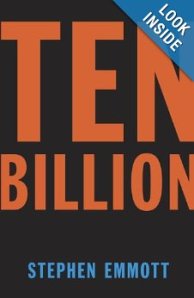
Dr. Emmott's book comes out in Sept. 2013.

Dr. Emmott’s book comes out in Sept. 2013.

Dr. Emmott does a magnificent job of describing the global issues that we face yet, like others before him, he makes no mention of the single most powerful “behavioral change” that we could make to alleviate many of those dire realities. Like practically all of our most brilliant scientists, he probably believes that we truly “need” to eat animal protein in order to be healthy.

Once he realizes that we don’t need ANY animal protein, he will quickly grasp the staggering benefits of using 90% less land, 90% less water and 90% less energy to produce the same number of food calories. Maybe then he will see the ray of hope that I see—a plant-based pathway out of this horrible mess that our species has created.

As he says, “The only solution left to us is to change our behavior, radically and globally.” Yes, but let’s start with the single “behavioral change” that will yield the greatest benefit—in the least amount of time. Let’s put together a “dream team” of leaders to teach the entire world what we should be eating. Let’s stop destroying the lungs of the world (our rain forests) in the search for more arable land to perpetuate the most harmful, wasteful and unsustainable diet-style imaginable.
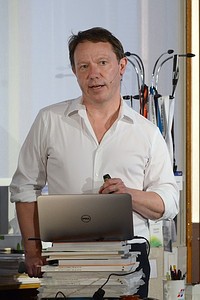
Dr. Stephen Emmott as he appears in the Forbes article referenced below.

Dr. Stephen Emmott as he appears in the Forbes article referenced below.

Otherwise, I agree with Dr. Emmott’s dismal conclusion. In his book he appeals to the world leaders to take decisive action, but confesses that he doesn’t think that they will, concluding in his own words, “I think we’re f_ _ _ _ d.”

His well-researched article appeared in The Guardian on 6-29-13 and reminded me a great deal of one of my earlier blogs, Too many people, wasting resources, eating the wrong food. Dr. Emmott’s article begins:

If population levels continue to rise at the current rate, our grandchildren will see the Earth plunged into an unprecedented environmental crisis.

We currently have no known means of being able to feed 10 billion of us at our current rate of consumption and with our current agricultural system. Indeed, simply to feed ourselves in the next 40 years, we will need to produce more food than the entire agricultural output of the past 10,000 years combined.

Yet food productivity is set to decline, possibly very sharply, over the coming decades due to: climate change; soil degradation and desertification – both of which are increasing rapidly in many parts of the world; and water stress. By the end of this century, large parts of the planet will not have any usable water.

90-second interview with Dr. Emmott (August 2013)

Pretty chilling stuff. So, who is Stephen Emmott? You can read his entire bio at the link below, but here are a few highlights.

    • He has two jobs. Professor of Computational Science at the University of Oxford, and head of Computational Science at Microsoft (Cambridge, UK)
    • His new book is entitled Ten Billion and will begin shipping in September of 2013. Now available on Amazon.
    • With a PhD in Computational Neuroscience, a prior stint as a post-doctoral fellow & scientist at Bell Labs, and now heading up computational science at Microsoft, he is arguably one of the world’s most prominent “big picture” thinkers.

Land, Water and Energy? One of my slides that I use frequently in my presentations.

Land, Water and Energy? One of my slides that I use frequently in my presentations.

He makes his case with numbers. Here are a few of his points about our “big three” finite natural resources that caught my eye:

    • Water. It takes 4 liters of water to produce a one-liter plastic water bottle.
    • Land. Demand for land for food is going to double – at least – by 2050, and triple – at least – by the end of this century. This means that pressure to clear many of the world’s remaining tropical rainforests for human use is going to intensify every decade.
    • Energy. We are going to have to triple – at least – energy production by the end of this century to meet expected demand. To meet that demand, we will need to build, roughly speaking, something like: 1,800 of the world’s largest dams, or 23,000 nuclear power stations, 14 million wind turbines, and 36 billion solar panels.

The Solution. He writes, The only solution left to us is to change our behaviour, radically and globally, on every level. In short, we urgently need to consume less. A lot less. Radically less. And we need to conserve more. A lot more.

To accomplish such a radical change in behaviour would also need radical government action. But as far as this kind of change is concerned, politicians are currently part of the problem, not part of the solution, because the decisions that need to be taken to implement significant behaviour change inevitably make politicians very unpopular – as they are all too aware.

What would our word leaders do if they knew that a huge asteroid would collide with our planet on June 3, 2072?

What would our word leaders do if they knew that a huge asteroid would collide with our planet on June 3, 2072?

Leadership. Since beginning this blog in February of 2011, at least 100 of my 777 blogs to date have dealt in some way with leadership.

We need powerful leadership coupled with a lot of money to organize and execute a plan that is capable of addressing these catastrophic issues that are unmistakable products of the human species.

Although Dr. Emmott doesn’t think we’re capable of getting it done, he does offer a solution to an imaginary disaster of a similar scope:

Asteroid approaching. If we discovered tomorrow that there was an asteroid on a collision course with Earth and – because physics is a fairly simple science – we were able to calculate that it was going to hit Earth on 3 June 2072, and we knew that its impact was going to wipe out 70% of all life on Earth, governments worldwide would marshal the entire planet into unprecedented action.

Every scientist, engineer, university and business would be enlisted: half to find a way of stopping it, the other half to find a way for our species to survive and rebuild if the first option proved unsuccessful. We are in almost precisely that situation now, except that there isn’t a specific date and there isn’t an asteroid. The problem is us.

The Dream Team for Change. Here’s the line-up. Stephen Emmott works for Microsoft and understands the “big picture” perhaps better than any other person. Bill Gates has been talking lately about the unsustainability of our feeding model. He’s also got the billions necessary to quickly teach the world what we should be eating. I am thinking that we should organize an “Asteroid-type” task force to begin the urgent process of preparing our planet for the rapidly approaching disasters of epic proportions. Now, who else do we need on our team?

Bill Clinton went vegan in 2010 and it probably saved his life. He remains our most prominent spokesman for eating plant-based.

Bill Clinton went vegan in 2010 and it probably saved his life. He remains our most prominent spokesman for eating plant-based.

I have been writing for years about the necessity of a globally-recognized leader who truly “gets it” about food. And I wrote recently about 5 reasons why Bill Clinton should be the Global King of WFPB.

He already has first-hand knowledge of the disease-reversing power of plant-based nutrition. Now, he just needs to spend a few hours with Dr. Emmott to help him connect the rest of the dots. Then he’ll be ready to ask Mr. Gates for all the money we need to get this Asteroid Type Project underway—perhaps under the umbrella of the Clinton Global Initiative.

It’s going to be real tough to curb population growth and change the way we live. But, in comparison, it will be relatively simple to start changing the way all of us eat. We just need leadership and MONEY—and lots of it.

Back to Infestation. Does Dr. Emmott agree with me that humans are the infestation of planet Earth? You be the judge:

Infestation. The state of being invaded or overrun by pests or parasites. To be present (in a place or site) in large numbers, typically so as to cause damage or disease.

Sounds to me like he agrees with the “infestation” label. He writes: “Earth is home to millions of species. Just one dominates it. Us. Our cleverness, our inventiveness and our activities have modified almost every part of our planet. In fact, we are having a profound impact on it. Indeed, our cleverness, our inventiveness and our activities are now the drivers of every global problem we face. And every one of these problems is accelerating as we continue to grow towards a global population of 10 billion. In fact, I believe we can rightly call the situation we’re in right now an emergency – an unprecedented planetary emergency.”

“We can rightly call the situation we’re in an unprecedented emergency. We urgently need to do – and I mean actually do – something radical to avert a global catastrophe. But I don’t think we will. I think we’re fucked. I asked one of the most rational, brightest scientists I know – a scientist working in this area, a young scientist, a scientist in my lab – if there was just one thing he had to do about the situation we face, what would it be? His reply? “Teach my son how to use a gun.”

Still not convinced? This one-minute cartoon may do the trick.

The YouTube description of the above cartoon, “A wonderfully crafted animation depicting the infestation of Earth by the parasites known as “Humans.” They mentioned that humans work fast; how fast? If the 4 billion years of life on Earth were crammed into one year, humans have been around for only 26 minutes and we have inflicted the vast majority of the damage in just the last one second. 

Chelsea Clinton as she appears on the Clinton Foundation website. A vegan herself, she may have had a major influence on her father's dietary change.

Chelsea Clinton as she appears on the Clinton Foundation website. A vegan herself, she may have had a major influence on her father’s dietary change.

What can I do? I can do my best to facilitate an alliance between the kinds of brains, power and resources that have the combined ability to help us all avert this unprecedented planetary emergency. And since I have had no luck in getting an audience with Bill Clinton or Bill Gates, I have written a letter to Chelsea and mailed it on 7-12-13 along with a copy of our book. (See link below).

If only she would decide to make this her #1 project for the rest of her life. As the only child of POTUS 42 and probably 45, she may be the best person on Earth to inspire the  leadership, resources and support necessary to make those radical changes that Dr. Emmott mentions. No less than our future as a species hangs in the balance.

My second blog on “infestation” posted one month after this one, on August 9. Responding to a reader who objected to my terminology. “Infestation” IS the best word—if it gets your attention For your convenience, a few links to the primary source article, relevant blogs and information on Dr. Emmott.

Handy 5-piece take-charge-of-your-health kit—from Amazon.com

Why should we be eating mostly plants? The “big picture” in 4 minutes.

Want to find out how healthy your family is eating? Take our free 4Leaf Survey. It takes less than five minutes and you can score it yourself. After taking the survey, please give me your feedback as it will be helpful in the development of our future 4Leaf app for smartphones. Send feedback to jmorrishicks@me.com

International. We’re now reaching people in over 100 countries. Follow us on Facebook and Twitter or get daily blog notices by “following” us in the top of the right-hand column. For occasional updates, join our periodic mailing list.

J. Morris Hicks, working daily to promote health, hope and harmony on planet Earth.

To order more of my favorite books—visit our online BookStore now

For help in your own quest to take charge of your health, visit our 4Leaf page and also enjoy some great recipes from Lisa’s 4Leaf Kitchen.

Got a question? Let me hear from you at jmorrishicks@me.com. Or give me a call on my cell at 917-399-9700.

SHARE and rate this post below.

—J. Morris Hicks, board member, T. Colin Campbell Foundation

Posted in Activism & Leadership, Big Picture, Bill Clinton, SOS (Saving Our Species), Sustainability | Tagged , , , | 6 Comments

“Air, Water, Sex and FOOD” revisited — Blog # 777

On this 7th day of the 7th month at 7 a.m.

On February 11th of this year, I posted my 737th consecutive daily blog, ending my two year daily streak. Since then, I have posted forty more blogs, now averaging about two per week. Last week, I posted a blog about the fact that we don’t need randomized studies to prove that we should be breathing air, drinking water and having sex.

Why should we need randomized studies proving what we should be eating? Why are we the only species (of millions) that can’t quickly understand what Nature had in mind for us? Mother Nature has a feeding plan for all of her creatures—including us. Some animals prey on other animals, some animals eat plants, some animals eat both—and so forth. And no one has to explain to all those millions of species what they should be eating.

But we humans have hundreds of thousands of scientists, dietitians and nutritionists spending millions of person-hours every year trying to figure out something that should be a blinding flash of the obvious to most casual observers. I provided a link to my earlier blog below, but have some additional thoughts that I want to share with you now.

I just googled “What do bears eat?” And in a millisecond, here’s what I learned from Wiki.Answers.com:

"Omnivore like us?" Right. Except they are equipped to kill and eat everything raw, whether it be fish or mammal.

“Omnivores like us?” Yeah, right. Except they are equipped to kill and eat their prey raw, whether it be fish or mammal.

Although they are classified as carnivores, or meat-eaters, bears are really omnivores, like we are. They eat meats and plants. About 90% of the diet of the Eastern Black bear is plants such as:

  • Leaves
  • Flowers
  • Grasses
  • Mushrooms
  • Berries
  • Roots
  • Other fruits
  • Nuts, including acorns
  • Honey
  • Grubs
  • Small mammals

Polar Bears eat mostly Seals, Sea lions, Walruses, Fish and sometimes dolphins.

Omnivores, like we are? Excuse me, but that’s the big problem. We have deluded ourselves into believing that we’re omnivores and that our bodies were designed to eat whatever we want. That works fine in Nature when every animal has a chance for survival—but it fails miserably in an unnatural world where seven billion humans are killing two billion animals (counting fish) every single week for their dinner tables.

Whatever those bears eat are all according to Nature’s plan. Those bears are the “natural predators” of those small animals and by eating them, they are part of  a master plan of harmony on planet Earth. With humans, our out-of-control eating of land and sea animals has absolutely nothing to do with Nature.

Consider that only 100 billion humans have ever lived, yet in the early 21st century—seven billion of us are consuming 100 billion animals every year (after raising most of them in horrendous conditions). And in the process, we’re squandering precious finite resources that will not be available a few generations from now—our land, our water and our fossil fuel energy sources. No one could possibly use the word Harmony to describe how we’re feeding ourselves.

So how did we get into this mess? As the most intelligent (but maybe not the smartest) species, the one that has thousands of scientists doing randomized studies to figure out what we should beating—how did we make such a mess of things?

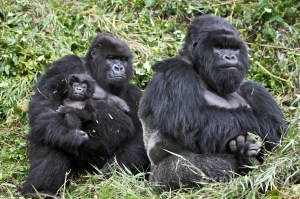
GorillasHere’s my take. The first humans ate nothing but raw plants—like our closest relative in the wild today, the gorilla. Later, as we developed our cognitive niche, built tools, learned to use fire, etc.—we began to eat things that were not necessarily a part of Nature’s plan.

No doubt, it was all about survival and we tended to eat anything we could get our hands on. Speaking of gorillas, what does wiki.answers.com have to say about their natural diet?

Gorillas are NOT omnivores, they are herbivores. The fact that they might occasionally consume insects while eating fruit, leaves and nuts does nothing to negate that fact. They have no need for animal foods, and zoos do not include animal products in their normal diet (though animal fat may be included in commercially prepared foods as an inexpensive source of lipids). In fact, meat fed regularly to a gorilla would result in its early death.

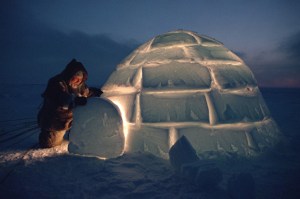
You will need to eat animals here to survive---but that doesn't make it the natural diet for our species.

You will need to eat meat here to survive—but that doesn’t make it is the natural diet for our species.

As our ancestors began to explore the cold and barren parts of the Earth, the only things to eat were other animals. So we did. Then eventually, as we settled in every single region of the planet, we gave ourselves the name omnivore. Nature had nothing to do with it.

About 20,000 years ago, humans began learning about agriculture. We could then settle in one place, grow plant foods and keep domesticated animals for work, pleasure and food. Things went along pretty well for the next 19,800 years. Then in 1804, just 200 years ago, we reached the one billion population mark. About 100 years later, we discovered cheap energy—and that’s when the trouble began.

In a mere blink of history, our species went from eating meats for survival or special occasions—to eating meat and dairy three meals a day, 365 days a year. We also went from one billion to seven billion in just over 200 years and have systematically taken over every square inch of land to feed ourselves. And, when we need more land, we simply burn down a rainforest—with no understanding of the damage we’re inflicting on our ecosystem in the process.

When does the madness end? Some have referred to the human species as the infestation of planet Earth. Let’s take a look at the definition and see if you think we qualify.

Infestation. The state of being invaded or overrun by pests or parasites. To be present (in a place or site) in large numbers, typically so as to cause damage or disease.

Planet EarthPutting things in perspective. Scientists report that our planet began supporting life some four billion years ago. Humans came along just 200,000 years ago.

If those 4 billion years of life on Earth were crammed into just one year, we humans have been here for only 26 minutes. Jesus Christ lived 20 seconds ago, we went from two billion to seven billion population in the last two seconds, and in the last 1/2 of one second (fifty years), we humans have inflicted more damage on the harmony of nature than all previous generations of humans combined—for the last 200,000 years.

Do we qualify as an infestation? I believe that we do. What do you think? And what should we do about dealing with it?

Z Logo Life RThe Bottom Line. In my “air, water and sex” blog last week, I featured some very well-educated medical doctors who were promoting the correctness of a meat-based diet for our species. One of them wrote New Atkins for a New You and the other wrote The Paleo Diet.

Although there is a mountain of evidence that challenges their beliefs, what if they were right? Even if they were right, the meat-based diet for humans is not sustainable for much longer. There’s simply not enough land, not enough water and not enough energy. Even today, if all seven billion of us tried to eat the way we do in the USA, we’d need two planet Earths to feed us all and we only have one.

The single most powerful step we could take toward a return to living in harmony with Nature is a deliberate move in the direction of a whole foods, plant-based diet for humans.

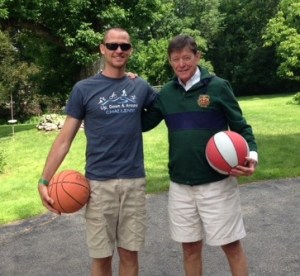
My oldest grandson, Collin (11) took this picture of the co-authors on Father's Day.

My oldest grandson, Collin (11) took this picture of the co-authors on Father’s Day. Notice the 4Leaf colors of green, blue, orange in the photo.

It promotes our own health, ends world hunger, and curbs global warming—to name just a few. But most importantly, by re-learning how to live in harmony with Nature, we preserve our planet’s ability to sustain us as a species.

Forget “saving the planet.” Think about saving your own great-great-great grandchildren. The planet’s going to be just fine; she’s seen mass extinctions before. It’s the human species that’s in jeopardy.

Need more sevens? At 12:25 EDT in the USA, Andy Murray just won Wimbledon —breaking Britain’s 77-year drought in the Championship. Maybe the stars are lining up for something big. Now, I am going to try to share this blogpost with Dr. Stephen Emmott, who may very well have been in attendance at the All England Club today.

Handy 4-piece take-charge-of-your-health kit—from Amazon.com

Want to find out how healthy your family is eating? Take our free 4Leaf Survey. It takes less than five minutes and you can score it yourself. After taking the survey, please give me your feedback as it will be helpful in the development of our future 4Leaf app for smartphones. Send feedback to jmorrishicks@me.com

International. We’re now reaching people in over 100 countries. Follow us on Facebook and Twitter or get daily blog notices by “following” us in the top of the right-hand column. For occasional updates, join our periodic mailing list.

To order more of my favorite books—visit our online BookStore now

J. Morris Hicks, working daily to promote health, hope and harmony on planet Earth.

For help in your own quest to take charge of your health, you might find some useful information at our 4Leaf page or some great recipes at Lisa’s 4Leaf Kitchen.

Got a question? Let me hear from you at jmorrishicks@me.com. Or give me a call on my cell at 917-399-9700.

SHARE and rate this post below.

—J. Morris Hicks, board member, T. Colin Campbell Foundation

Posted in Big Picture, Sustainability | 3 Comments

Kroger spending more than one billion on healthcare

America’s largest grocery chain—#23 on the Fortune 500 list

AKroger carts huge organization (5th largest retailer in the world), Kroger reports for 2012: $90 billion in sales, $1.3 billion in profits and 343,000 employees. My estimate is that by cutting their cost of healthcare in half, they could increase their profits by up to 50%—without selling any more groceries.

Like all large food chains, Kroger serves a market of millions of people and must cater to ALL of their grocery needs. But, as we know from the CEO of Whole Foods Market, just because his store has to sell all forms of meat, dairy eggs and processed foods—it doesn’t mean that he and his employees must eat all of them.

But unlike the other large grocery chains, John Mackey of WFM understands the health-promoting qualities of a whole foods, plant-based diet and he’s sharing that knowledge with his 64,000 employees—a move that is resulting in a decline in his cost of health care as a percent of revenue. Mr. David Dillon of Kroger could do the same, and since he’s got five times as many employees as Mackey, his potential savings are five-fold that of the savings beginning to accrue at Whole Foods. 

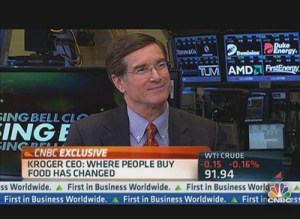
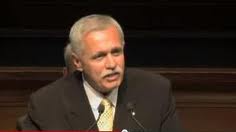
David Dillon, CEO

David Dillon, CEO of The Kroger Company

So why would Mr. Dillon want to copy Mr. Mackey? Because he is a good businessman and he believes in delivering value to his customers and his shareholders. He also sounds like the kind of guy that enjoys doing wonderful things for his employees.

And with a toal cost of healthcare that is probably well north of ONE BILLION DOLLARS, he could be looking at a virtual goldmine in savings. Not to mention the benefits of a healthier, happier and more productive sales force and the many PR benefits that would follow.

Leadership. I recently saw Mr. Dillon in a KU (Kansas) sponsored video in which his topic was “Leadership: Is anyone following you?” Then, just this week, I saw that Kroger had reported their first quarter 2013 results—posting their 38th consecutive quarter of positive sales increases.

“Kroger achieved strong sales and record earnings per share for the quarter, and our customers’ positive view of us continues to improve,” said David B. Dillon, Kroger’s chairman and chief executive officer. “This is because of our continued focus on the Customer 1st strategy.

“The Kroger team’s relentless focus on delivering on our Customer 1st strategy, quarter after quarter, continues to set us apart,” Mr. Dillon said. “We will continue to build on this strong momentum to drive growth and greater shareholder value.”

Sounds to me like there are about 343,000 people following the positive leadership of Mr. Dillon. Also included in the June 20 news release: “Recognized by Forbes as the most generous company in America, Kroger supports hunger relief, breast cancer awareness, the military and their families, and more than 30,000 schools and grassroots organizations….”

Kroger Sus Report 2013Kroger also places a great deal of interest on the environment. From the Kroger Sustainability website, Mr. Dillon’s letter includes:

We remain committed to making thoughtful and responsible choices to minimize our impact on the environment—some examples include, among others: (1) Achieving total energy reduction of 32.7 percent from our base year. We are on track to meet our goal of a 35 percent reduction by 2015. (2) Continuing our partnership with the World Wildlife Fund and supported four wild-caught fishery improvement projects around the world.

From what I read about Mr. Dillon, I like his style. And I sincerely believe that he would soon have hundreds of  thousands of his fellow associates “following” his lead if he began helping them to learn how to take charge of their health. So, I sent him a letter, book and 4Leaf Wellness Vision document to his office in Cincinnati:

      • July 3, 2013
      • Mr. David Dillon, CEO
      • The Kroger Company
      • 1014 Vine Street, Cincinnati, Ohio 45202
      • Subject: Slashing the cost of healthcare in businesses

Dear Mr. Dillon,

Congratulations on being recognized by Forbes as the most generous company in America. You have a great reputation for taking care of your customers, shareholders and employees, while being exceptionally generous when it comes to social, environmental and economic sustainability. As for taking even better care of your employees and your shareholders, I have an idea that I would like to discuss with you.

A Kroger store in Denver

A Kroger store in Denver

It has to do with the out-of-control cost of healthcare in our nation. With 343,000 employees, I estimate that Kroger is currently spending well over one billion dollars a year, and that number will continue to increase until we shift the paradigm from managing disease to truly promoting health. By helping your employees take charge of their own health, you’ll save a fortune while making the world a much better place to live. 

Did you know that our unhealthy food choices are driving up to 80% of the cost of healthcare in the USA? That means that you could conceivably eliminate several hundred million dollars of expense—while further enhancing your company’s already sterling reputation as an industry leader.

As the leader of the world’s 5th largest retail chain, you’re in a perfect position to lead the way when it comes to addressing the cost of healthcare in the USA. As you said in a Kansas University sponsored speech earlier this year, “Leadership: Is anyone following you?” You begin with helping your employees take charge of their health, and they will reward you by pushing more profits to your bottom line. You will then gradually educate your customers while continuing to provide them ALL of the food products that they wish to buy.

Who am I and how can I help? Like you, my working career began in the grocery business—at the National Food Store in Murfreesboro, Tennessee. I studied Industrial Engineering at Auburn University and later earned an MBA from the University of Hawaii while on active duty in the U.S. Coast Guard. Since then, most of my career has been devoted to improving profitability in numerous enterprises by eliminating waste in diverse companies like Sears, ITT, and Holiday Inns. My last executive position was EVP of Operations with Polo Ralph Lauren Corporation. 

So what about promoting health and saving money? The attached “vision” document outlines our detailed approach to helping you lower your cost of healthcare by anywhere from 15% to 50%. Those are VERY big dollars at Kroger and I would like the opportunity to review our powerful new approach to corporate wellness with you in person.

As you can see from my website (hpjmh.com), I am now directing my “waste reduction” skills to a new arena, focusing on something that may be the most important issue in the history of the world. I am talking about our food choices and the collective impact that they have on our health, our cost of healthcare, our environment—and, ultimately, the long-term sustainability of the human species.

Since 1960, the cost of health care in the United States as a percent of our gross domestic product (GDP) has risen sharply from 5.2% in 1960 to the 18% that we have today. Most of this huge problem is driven by our food choices—and it’s still getting worse. I have concluded that our only way out of this mess is for the CEOs of America to take the lead. That’s because corporate CEOs are the only prominent leaders in our nation with a strong financial incentive for all of their employees to be healthy.

Corporate Wellness. The 4Leaf vision of a whole new ballgame

Corporate Wellness. The 4Leaf vision of a whole new ballgame

In developing our attached “corporate wellness” vision document, I drew heavily on the counsel of my friend Paul Allaire, the former CEO of Xerox. Now retired, he is a strong believer in the approach outlined in our book and has made it very clear to me that this kind of initiative does not have a prayer unless the top guy is driving it.

We agree. That’s why I am writing directly to you. By the way, Mr. Allaire provided the following endorsement that appears on the back cover of our book (which is enclosed):

“We all know we should eat more fruits and vegetables—with this book, we now know why. The authors make a well-documented case for why it is important for your personal health and why it is critical for the health of the planet. A compelling book; it is both informative and a pleasure to read!” —Paul Allaire, Fortune 100 CEO (Xerox, 1990–1999)

Please take a look at the attached document; then let’s meet in person to discuss. On the last page of the enclosed document, you will see a summary of my credentials for helping you take hundreds of millions of dollars a year out of your cost of health care—while yielding a healthier, happier and more productive workforce as a fringe benefit. 

As for Kroger’s well-known emphasis on sustainability, influencing your associates to adopt plant-based eating will do more good for the environment and world hunger than ALL of your current sustainability initiatives—combined.

I look forward to hearing from you and meeting you soon.

Sincerely,

J. Morris (Jim) Hicks

PS: There are only two prominent CEOs (to my knowledge) who are doing anything close to resembling what I describe in the attached “vision” document. They are John Mackey at Whole Foods Market and Mayor Rahm Emanuel at the City of Chicago. And, in both cases, their cost of healthcare is going down.

ATTACHMENT. 4Leaf Corporate Wellness—Vision Document

Phillip Wollen---argues in Australia for taking meat off the menu.

Phillip Wollen—one of Australia’s most prominent citizens (former Citibank to exec)

Endorsement from down under. After reading my similar letter to the CostCo CEO, my friend Philip Wollen (former Citibank top executive in Australia) sent me this note; gotta just love that second line.

Dear Jim,

You have written a powerful document. Any CEO who does not read it with a racing pulse should be fired.

At the very least, any CEO worth his/her salt should assign the task of meeting you to a key executive responsible directly to the CEO. . . . . . .with a requirement that he addresses all your issues and makes a recommendation (one way or another) to the CEO within 60 days.

Philip Wollen

Click here to hear Philip’s fiery 10-minute speech from down under—the best 10-minute summary of our international food/health/sustainability dilemma that I have ever heard.

The Bottom Line. Eventually, some of our nation’s most enlightened CEOs will embrace the 4Leaf Corporate Wellness Solution. Soon, they will begin to reap staggering savings in healthcare expenditures AND the improved productivity of a healthier workforce.

Ultimately those CEOs who don’t choose to truly promote health in the workplace will no longer be able to compete with those who do. In recent weeks, I have sent similar letters to the CEOs of CostCoWalmart and CVS respectively. I will continue reaching out to prominent corporate leaders until I find one who is ready to show America how to FIX healthcare while adding hundreds of millions of dollars to his/her bottom line.

Send this blog to the CEOs of corporations where you are a shareholder. Ultimately, they work for you. Please ask them to give me a call at 917-399-9700 or email me: jmorrishicks@me.com

The primary image on the 2013 Kroger Sustainability Report.

The primary image on the 2013 Kroger Sustainability Report.

Handy 4-piece take-charge-of-your-health kit—from Amazon.com

Want to find out how healthy your family is eating? Take our free 4Leaf Survey. It takes less than five minutes and you can score it yourself. After taking the survey, please give me your feedback as it will be helpful in the development of our future 4Leaf app for smartphones. Send feedback to jmorrishicks@me.com

International. We’re now reaching people in over 100 countries. Follow us on Facebook and Twitter or get daily blog notices by “following” us in the top of the right-hand column. For occasional updates, join our periodic mailing list.

To order more of my favorite books—visit our online BookStore now

J. Morris Hicks, working daily to promote health, hope and harmony on planet Earth.

For help in your own quest to take charge of your health, you might find some useful information at our 4Leaf page or some great recipes at Lisa’s 4Leaf Kitchen.

Got a question? Let me hear from you at jmorrishicks@me.com. Or give me a call on my cell at 917-399-9700.

SHARE and rate this post below.

—J. Morris Hicks, board member, T. Colin Campbell Foundation
Posted in Activism & Leadership, Corporate Wellness | Tagged , | 2 Comments