Saving civilization is not a spectator sport!

That’s the way Lester Brown finished his latest book.
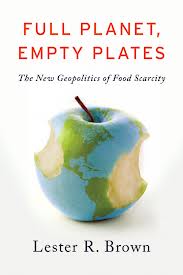
Like ours, Mr. Brown's book features a single apple on the cover. And like our apple, his tells a story.

Like ours, Mr. Brown’s book features a single apple on the cover. And like our apple, his tells a story.

Full Planet, Empty Plates–The New Geopolitics of Food Scarcity. AND, an alarming story of unsustainability in the way we humans are feeding ourselves in the 21st century. The book is not brand new (Sept. 2012) but the information in it is still chillingly relevant—and it’s the kind of information that every world leader, indeed every literate citizen of the planet, should be forced to read.

It’s not about saving the planet, the planet is going to be just fine. It’s about saving our civilization. Here are a few excerpts to get you started:

Chapter One — Food: The Weakest Link

While the decline of early civilizations can be traced to one or possibly two environmental trends such as deforestation and soil erosion that undermined their food supply, we are now dealing with several. In addition to some of the most severe soil erosion in human history, we are also facing newer trends such as the depletion of aquifers, the plateauing of grain yields in the more agriculturally advanced countries, and rising temperature.

Chapter Three — Moving Up the Food Chain

In every society where incomes have risen, the appetite for meat, milk, eggs, and seafood has generated an enormous growth in animal protein consumption. Today some 3 billion people are moving up the food chain. For people living at subsistence level, 60 percent or more of their calories typically come from a single starchy food staple such as rice, wheat, or corn. As incomes rise, diets are diversified with the addition of more animal protein.

Chapter Six — Peak Water and Food Scarcity

Although many analysts are concerned about the depletion of oil resources, the depletion of underground water resources poses a far greater threat to our future. While there are substitutes for oil, there are none for water. Indeed, modern humans lived a long time without oil, but we would live for only a matter of days without water.

Chapter Eleven. Can We Prevent a Food Breakdown?

We all have a stake in the future of civilization. Many of us have children. Some of us have grandchildren. We know what we have to do. It is up to you and me to do it. Saving civilization is not a spectator sport.
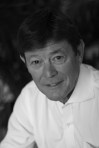
J. Morris Hicks, always trying to focus on the big picture.

J. Morris Hicks, always trying to focus on the big picture.

My take on this book. It is a wonderful compilation of facts and figures about our current dilemma—when it comes to our food, our environment and their collective impact on the future of our civilization. Although Mr. Brown talks extensively about the inefficiency of meat and dairy, he never openly acknowledges that we don’t really need to eat it—and the tremendous gains in the efficient use of land, water and energy that would ensue if we didn’t.

He never summarizes the blinding flash of the obvious conclusion that we’re eating the wrong food. And that if we don’t get back on track soon, our civilization will likely collapse before the end of this century.

It is this failure to get really clear about exactly what we must do that disturbs me most. And it’s not just Lester Brown. It’s most of the best, brightest and most educated thinkers of our time. They all seem to be mentally paralyzed by the “protein myth”—the misguided notion that we NEED to eat animal protein to be healthy. For more on this myth, see my earlier blog: Why are the “world’s greatest thinkers” missing the boat…

Ending on a good note in the final chapter, Brown implored all of us to leverage our own talents and knowledge to make a difference in the part of our collective mess that interests each of us most.

For me, my interest is in the big picture, simplicity, leadership and focus. We’ve got to focus the greatest effort on solving the vital few problems that have the greatest payback potential. We’ve got to aggressively and proactively change what we eat. I simply don’t believe we can get out of this mess without a huge, coordinated effort to work on the single biggest step we can take that will have the most beneficial effect. As stated on the back cover of our book:

What is the single most powerful decision humans can make for their health and for the planet? What to Eat.
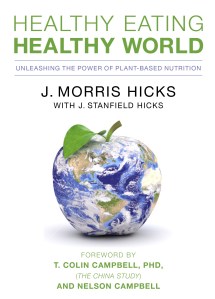
All about improving the health of humans while preserving nature's ability to sustain our species

All about improving the health of humans while preserving nature’s ability to sustain our species

Here’s what I’m doing. I have been writing, blogging and speaking about many of these topics for over 1,000 days and am now in the process of leveraging my “big picture” engineering background, knowledge and creativity—coupled with my problem solving, writing & public speaking skills in two primary ways:

ONE. Working aggressively to launch that “huge coordinated effort” mentioned above. I call it the S.O.S. Global Initiative—the first step in this crucial process (the S.O.S. Summit) is already being planned. Ideally, our initial planning summit (of 10 to 12 experts) will hopefully be sponsored by a highly respected, internationally recognized individual who totally “gets it” about food and its impact on our environment and sustainability.

His/her fame, knowledge and wealth will enable us to get the necessary combination of knowledge, power, leadership and funding to the table. My target date for that first summit meeting is November. And, by the way, “S.O.S.” stands for Save Our Species. Project status: I have contacted our prospective S.O.S. leader’s office (by phone and emailed letter) and have requested a meeting. Stay tuned.

TWO. Greatly accelerating the pace of my public speaking activities—on the topic of sustainability. The title of my next major presentation (In Tucson next month) is Our Health, Our Planet, Our Future as a Species. This effort and the S.O.S. effort goes hand in hand. The more I speak and the wider my audience—the more likely I will be able to garner support for the critically necessary S.O.S. Global Initiative. For more information on my speaking activities, click here.

What about YOU? What are YOU going to do?

A billboard promoting my next speech  — Tucson, AZ
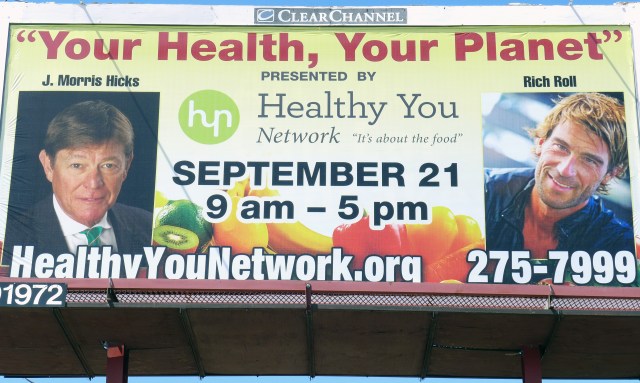
The highway billboard promoting my 9-21-13 speech in Tucson, AZ

The highway billboard promoting my 9-21-13 speech in Tucson, AZ

The following links are all related to this blog.

A milestone: sometime this afternoon, this site will pass the half million mark—in views since February of 2011. Now being seen regularly in over 100 countries.

Handy 5-piece take-charge-of-your-health kit—from Amazon.com

Why should we be eating mostly plants? The “big picture” in 4 minutes.

Want to find out how healthy your family is eating? Take our free 4Leaf Survey. It takes less than five minutes and you can score it yourself. After taking the survey, please give me your feedback as it will be helpful in the development of our future 4Leaf app for smartphones. Send feedback to jmorrishicks@me.com

International. We’re now reaching people in over 100 countries. Follow us on Facebook and Twitter or get daily blog notices by “following” us in the top of the right-hand column. For occasional updates, join our periodic mailing list.

J. Morris Hicks, working daily to promote health, hope and harmony on planet Earth.

To order more of my favorite books—visit our online BookStore now

For help in your own quest to take charge of your health, visit our 4Leaf page and also enjoy some great recipes from Lisa’s 4Leaf Kitchen.

Got a question? Let me hear from you at jmorrishicks@me.com. Or give me a call on my cell at 917-399-9700.

SHARE and rate this post below.

—J. Morris Hicks, board member, T. Colin Campbell Foundation
Posted in Activism & Leadership, Environment, Sustainability | 6 Comments

Were humans the “infestation” of Easter Island?

YES! And that’s why we MUST learn from what happened there.

A few weeks ago, I posted a blog entitled Are humans the “infestation” of planet Earth? (see link below). Just before writing that blog, I learned about a Microsoft scientist in the UK who had been writing and speaking about what lies ahead for our species if we don’t make some seriously radical changes in the VERY near future.

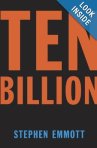
Dr. Emmott's book comes out in Sept. 2013.

Dr. Emmott’s published in Sept. 2013.

Dr. Emmott lays the blame for all of our problems on the behavior of just one species of animal—the human being. He writes in his about-to-be-published book, Ten Billion:

Earth is home to millions of species. Just one dominates it. Us. Our cleverness, our inventiveness and our activities have modified almost every part of our planet. In fact, we are having a profound impact on it. Indeed, our cleverness, our inventiveness and our activities are now the drivers of every global problem we face.

And every one of these problems is accelerating as we continue to grow towards a global population of 10 billion. In fact, I believe we can rightly call the situation we’re in right now an emergency – an unprecedented planetary emergency.

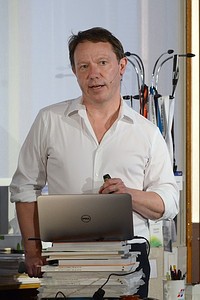
Dr. Stephen Emmott as he appears in the Forbes article referenced below.

Dr. Stephen Emmott as he appears in the Forbes article referenced below.

While scary, I actually found Dr. Emmott’s views refreshing from the standpoint of CLARITY. Many of our scientific experts write about the human-driven problems on our planet, but few ever get real clear about the urgently needed solution. But Emmott pulls no punches; boldly stating:

The only solution left to us is to change our behaviour, radically and globally, on every level. In short, we urgently need to consume less. A lot less. Radically less. And we need to conserve more. A lot more.

In my earlier blog, I concluded that Dr. Emmott would agree with me that humans are indeed the infestation of planet Earth. We have clearly created all the problems that will ultimately threaten our very existence as a species. But, the planet is going to be just fine; what’s at stake is her ability to sustain us as a species.

As for the word infestation, I am not the first person to use that word to describe our species. Mark Twain may have been first. Just now, I found this short animated video on YouTube today that was launched in 2006:

Human Infestation—one minute worth watching

The YouTube description of the above cartoon, “A wonderfully crafted animation depicting the infestation of Earth by the parasites known as “Humans.” They mentioned that humans work fast; how fast? If the 4 billion years of life on Earth were crammed into one year, humans have been around for only 26 minutes and we have inflicted the vast majority of the damage in just the last one second. 

Objection from reader. Earlier this week, “Veggie Mom” posted this comment below my blog:

You lost me at “infestation”….. Hope you rethink your terminology before you go forward with this.

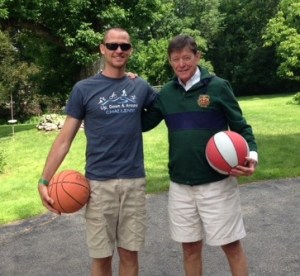
My oldest grandson, Collin (11) took this picture of the co-authors on Father's Day.

The latest picture of the authors of “Healthy Eating, Healthy World” — Fathers Day 2013

Hi Veggie Mom,

You’re right. “Infestation” is not a very pretty word, but I do believe in calling a spade a spade. Trained as an industrial engineer, I know that before any problem can be solved, we must first understand exactly what the problem is—and what caused it.

Only then can we map out a viable solution along with a plan for execution. Infestation? Consider these facts:

  • Do you realize that we’re the only species (of millions) in the history of the world that has not lived in harmony with Nature?
  • Also consider that we’ve now taken over every square inch of the Earth to feed ourselves and we simply burn down another rainforest when more land is needed. Philosopher E.O. Wilson had this to say about that insane practice:

Destroying rainforest for economic gain is like burning a Renaissance painting to cook a meal.

How many humans can our planet support? We’ve grown seven-fold since 1804, from one billion to seven billion and are exhausting our precious resources at the speed of light. Imagine that you were among a group of highly intelligent alien beings looking down at Earth from outer space. Your group might be saying:

Look at those ignorant creatures down there using up all their finite resources. Didn’t they learn anything from the collapse of civilization on Easter Island?

They spend far more time talking about one silly ballplayer (someone called A-Rod?) than the fact that they will soon not have enough land, water and energy to feed their exploding population. What a stupid bunch they are!

Know what happened on Easter Island? Find out in 7 minutes

When I talk about Easter Island in my presentations, I have two slides. The first shows a lush tropical island that it took nature 4 billion years to create. The second one shows how it looked after just 1,000 years of human occupation. Consider this: If the 4 billion years of life on Earth were crammed into just one year, the human occupation of Easter Island lasted just the last ten seconds of that year.

So Veggie Mom, can you think of a better word to describe the mess we’ve made? I suggest you read Lester Brown’s book if you need more information. “Full Planet, Empty Plates.”

Like ours, Mr. Brown's book features a single apple on the cover. And like our apple, his tells a story.

Like ours, Mr. Brown’s book features a single apple on the cover. And like our apple, his tells a story.

In his book, he talks about how the French use a simple riddle to explain exponential growth to children. They’re told about the rapid growth of lily pads in a huge pond. There is one on the first day, two on the second day, four on the third day, and so forth—doubling every day. After thirty days, the pond is full. Then the children are asked “If the pond is full on the 30th day, at what point is it half full?” ANSWER: On the 29th day.

Lester Brown says we seven billion humans are in our 30th (and final) day now. And we’ve already far exceeded the sustainable carrying capacity of our planet. Dr. Emmott nailed the problem precisely—but he offered no workable solution; concluding instead that we’re doomed to go the way of Easter Island.

But Dr. Campbell and I are more optimistic. And we’re working now on the organization of a high-level, well-funded task force to get started on the urgent process of radical, global change described by Dr. Emmott.

Promoting health, hope and harmony on planet Earth

Vast, complex, inter-connected problems. One simple solution.

Since our food choices determine how most of our planet is used, we see how an improvement in those choices could be our salvation. Once our brightest scholars and scientists fully grasp the fact that we don’t ever NEED any animal foods, they will quickly see how we can produce the same number of food calories with 90% less land, 90% less water and 90% less energy.

The improvement potential is staggering and I believe that a well-conceived, properly led and urgently executed plan to shift our food from animals to plants will take us over halfway to the goal expressed by Dr. Emmott. Not only do we save our planet and our species—we all get much healthier in the process. Win-Win-Win for sure.

The following three quotes sum up our dilemma and our hope for the future—the second and third referring to the “high level, well-funded task force” mentioned earlier.

In short, we urgently need to consume less. A lot less. Radically less. And we need to conserve more. A lot more. — Stephen Emmott, PhD

Never doubt that a small group of thoughtful, committed, citizens can change the world. Indeed, it is the only thing that ever has. — Margaret Mead

People who are crazy enough to think that they can change the world—are the ones who do. — Steve Jobs 

The following five books and one DVD can be purchased on Amazon for a grand total of less than $60—and will enable you to understand the overwhelming challenges we face—along with the single most-powerful solution of all.

Six-Pack from Hicks—for health, hope & harmony on planet Earth

  1. Healthy Eating, Healthy WorldThe “big picture” about food (our book)
  2. A life changer for millions, including James Cameron. Forks Over Knives DVD 
  3. An essential scientific resource: The China Study by Dr. T. Colin Campbell; the primary book that influenced Bill Clinton to adopt a whole food, plant-based diet.
  4. What have we done to our planet? Full Planet, Empty Plates by Lester Brown
  5. A horrifying wake-up call for leaders. TEN BILLION by Dr. Stephen Emmott
  6. Food choices are the primary cause of our environmental problems, yet our world leaders, scientists & experts are Comfortably Unawareby Richard Oppenlander.

Why should we be eating mostly plants? The “big picture” in 4 minutes.

Want to find out how healthy your family is eating? Take our free 4Leaf Survey. It takes 2 or 3 minutes and you can score it yourself. After taking the survey, please give me your feedback as it will be helpful in the development of our future 4Leaf app for smartphones. Send feedback to jmorrishicks@me.com

International. We’re now reaching people in over 100 countries. Follow us on Facebook and Twitter or get daily blog notices by “following” us in the top of the right-hand column. For occasional updates, join our periodic mailing list.

J. Morris Hicks, working daily to promote health, hope and harmony on planet Earth.

To order more of my favorite books—visit our online BookStore now For help in your own quest to take charge of your health, visit our 4Leaf page and also enjoy some great recipes from Lisa’s 4Leaf Kitchen.

Got a question? Let me hear from you at jmorrishicks@me.com. Or give me a call on my cell at 917-399-9700.

—J. Morris Hicks, board member since 2012; click banner for more info:

Nutrition Certificate

Posted in Activism & Leadership, Harmony Project, Sustainability | Tagged | 6 Comments

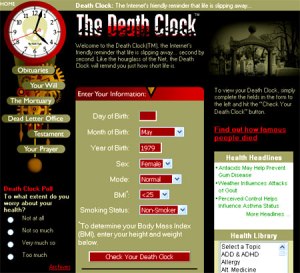
What does the “death clock” mean to you?

For some it’s depressing; for others, it’s a powerful call to action.

It was featured recently in a New York Times article entitled “The TickTock of the Death Clock” written by Steven Petrow, an author and former editor now in his mid-fifties. The death clock exercise helped him put his life in perspective and led him to make some radical changes for the better in his life.

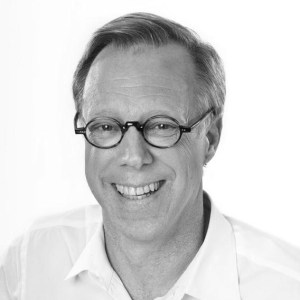
Steven Petrow---discovered a new zest for living.

Steven Petrow—discovered a new zest for living.

When he first learned that he probably only had another 18 years to live, he was troubled. But then, after lots of thinking, he decided to make some changes that has resulted in a joy of living that never existed before. After quickly deciding to quit his full-time job, this is what he was thinking:

I’ve got only one life to live, and if I don’t do it now, when? I couldn’t sleep the next few nights, the loud echoes of my naysayers circling through my head. But over the weeks that followed, things began to shift. I started to get new assignments and finished up a book proposal. I’d get up at 5 a.m. as excited as a kid on Christmas morning. I felt a new sense of ownership, joy and meaning to my days. This wasn’t my work, it was my life. And I didn’t just like it – I loved it.

Of course, I know I won’t spend the rest of my days in this state of euphoria. I will struggle with blank pages and intermittent paychecks. But I will appreciate each day more.

You can find the Death Clock at deathclock.com

You can find the Death Clock at deathclock.com

More on the Death Clock. It takes less than a minute for the online Death Clock (link below) to project the exact date that you will likely die—along with how many seconds you have left to live. It computes both based on the following:

  • Your sex and current age
  • Your BMI
  • Your smoking status
  • Your general outlook on life

In my case, I learned that even though I am much older than Petrow, I am expected to live nine years longer than his projected 18. To be exact, the clock projected that I would meet the grim reaper on the day after Christmas in the year 2040—at the ripe old age of 95. Happy Holidays to me!

The clock projected that I have well over 800 million seconds remaining—and even features a count-down digital clock, showing those precious seconds ticking away. After doing the exercise, like Petrow, I chose to look on the bright side and use the information to motivate me to do much more with the time that I have remaining.

Feeling GREAT at 68

Feeling GREAT at 68. The Death Clock didn’t ask about diet, and I know that might give me a few extra years.

The Bottom Line. Lying in bed a few nights ago, I was thinking that I probably only have around ten or fifteen solid work years left. That would put me at 83.

And although I expect to get a lot done between 83 and 95, it has been my observation that the elderly are simply not taken that seriously after a certain age. Sad, but true.

So as I lay there, I decided that I needed to accelerate my pace on three things: my public speaking career, my corporate wellness business, and my grand plan for helping to facilitate an “asteroid” type of global project to prevent the collapse of our civilization before the end of this century. Why would I think that I can make a difference on something that important? Two reasons:

Never doubt that a small group of thoughtful, committed, citizens can change the world. Indeed, it is the only thing that ever has. — Margaret Mead

People who are crazy enough to think that they can change the world—are the ones who do. — Steve Jobs

I will leave you with two questions. How many years do you have left? What are you going to do with those years?

If everyone in the world ate the we do in the USA, we'd need two planet Earths to feed us all. We only have one and she's in trouble.

If everyone in the world ate the we do in the USA, we’d need two planet Earths to feed us all. We only have one and she’s in trouble.

Want to help spread the word? Call me at 917-399-9700 if you’d like me to speak at your venue. That’s one thing that you can do to help our “small group of thoughtful, committed citizens” accomplish the audacious goal of ensuring the longterm sustainability of our species.

Not sure about the possible collapse of our civilization? You might want to read Lester Brown’s new book, Full Planet, Empty Plates. Here’s an excerpt:

While the decline of early civilizations can be traced to one or possibly two environmental trends such as deforestation and soil erosion that undermined their food supply, we are now dealing with several. In addition to some of the most severe soil erosion in human history, we are also facing newer trends such as the depletion of aquifers, the plateauing of grain yields in the more agriculturally advanced countries, and rising temperature.

Handy 5-piece take-charge-of-your-health kit—from Amazon.com

Want to find out how healthy your family is eating? Take our free 4Leaf Survey. It takes less than five minutes and you can score it yourself. After taking the survey, please give me your feedback as it will be helpful in the development of our future 4Leaf app for smartphones. Send feedback to jmorrishicks@me.com

International. We’re now reaching people in over 100 countries. Follow us on Facebook and Twitter or get daily blog notices by “following” us in the top of the right-hand column. For occasional updates, join our periodic mailing list.

J. Morris Hicks, working daily to promote health, hope and harmony on planet Earth.

To order more of my favorite books—visit our online BookStore now

For help in your own quest to take charge of your health, visit our 4Leaf page and also enjoy some great recipes from Lisa’s 4Leaf Kitchen.

Got a question? Let me hear from you at jmorrishicks@me.com. Or give me a call on my cell at 917-399-9700.

SHARE and rate this post below.

—J. Morris Hicks, board member, T. Colin Campbell Foundation
Posted in Activism & Leadership, Happiness, Sustainability | 6 Comments