The TERRIFYING repercussions of our DEMAND for meat

From the well-researched point of view of another “big picture” guy

When I first began learning about the many repercussions of our food choices in 2002, I immediately wanted to understand the “big picture.” After more than ten years of studying and three years of writing and blogging about this crucial topic, I have found another “big picture” guy—Dr. Richard Oppenlander, who has been studying, writing and speaking about this topic for more than thirty years.
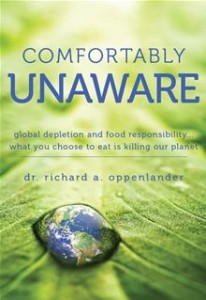
Comfortably UnawareLike me, his background is not related to food, health, or the environment; yet he has become an expert in the big picture as it relates to our food choicesHis book, Comfortably Unaware, was published in 2011 by Beaufort Books and is an incredible source of information on a plethora of issues related to what we eat. From the book’s description on Amazon:

In Comfortably Unaware, Dr. Richard Oppenlander tackles the crucial issue of “global depletion” as it relates to food choices. We should all be aware of our diet’s consequences on the environment and commit to seeking food products that are in the best interest of all living things. His stark mental images are often disturbing–and that’s how it should be. We need to be shaken out of our complacency and understand how to ensure the well-being of our planet–and of ourselves.

Oppenlander presents this information in easy-to-read chapters on issues including rainforests, oceans, and the air we breathe. His fresh insight on this controversial topic goes beyond the familiar warnings about “global warming.” His book is essential reading; he provides new perspectives on how this global crisis reached such startling proportions, and how to solve the problem. 
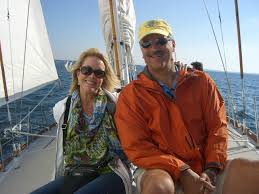
I took this picture of Susan Benigas and her husband when they were in CT for our book launch party.

I took this picture of Susan Benigas and her husband  Jon when they were in CT for our book launch party. I urge you to click on her pbnhc.com link and share it with every MD that you know.

Last week, my good friend Susan Benigas (Co-founder of the Plant-Based Healthcare Conference) sent me a note telling me that she had found someone who would surely become my kindred spirit—telling me that she felt like she was reading something that I wrote—and knew that I want to get to know Richard.

On Friday, I began by watching an 84-minuted video of his presentation at the March 2013 McDougall Advanced Study Weekend. I began watching the video at home, watched another half hour at the Mystic Starbucks and finished watching it on the train to New York.

As the video ended, I purchased a Kindle copy of Richard’s book on Amazon and was reading Chapter 3 as I arrived at Grand Central Station. After watching this video, I am confident that you will also want to buy the book.

I mentioned that Richard Oppenlander has been studying this topic for much longer than I—here is something that he wrote in 1989:

Regarding Food“Every day each of us must make choices and then, ultimately, take responsibility for the comprehensive impact of those decisions. Therefore, it seems to be the inherent duty of everyone to make as informed a choice as possible. We should all be committed to understanding the reality and consequences of our diet, the footprint it makes on our environment, and seek food products that are in the best interest of all living things.” Richard A. Oppenlander, 1989
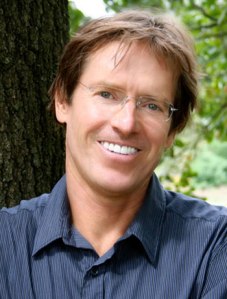
Dr. Richard A. Oppenlander

Dr. Richard A. Oppenlander

Telling it like it is. Like other authors in this field, Richard focuses on the truth, regardless of how uncomfortable hearing the cold hard facts might be for some people. From the book’s introduction, he explains why he has chosen to be totally candid in telling the world these much-needed truths:

Numerous books have been written about various diets and food as it relates to our health. Many also are now available about global warming and climate change. Comfortably Unaware is the first to bring to light the much larger and more insidious issue of global depletion as it relates to food.

I have not cut corners or suppressed topics to avoid exposing businesses, institutions, or individuals and I am not concerned whether or not it is a risky business move for me to write this book. I also have not withheld or modified information because it may be difficult for you, the reader, to accept it or because it may be culturally or socially overloading for you.

So, my agenda is clear: to provide you with complete truth and compel you to understand all the issues of this critical topic. It is my sincere hope that you become more aware of and sensitive to the ubiquitous effect of your food choices and that a positive difference can be made in your life and in the health of our planet and all its inhabitants.
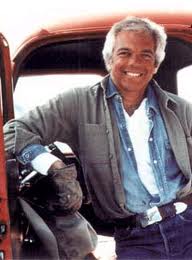
Ralph Lauren -- and his relaxed "style" that has changed the way the world thinks about clothes, home and life in general

I spent much of my career working in the fashion industry with people like Ralph Lauren, my boss from 1987 to 1994 when I was EVP.

One final point. As you may know, I come from a 35-year career in business; working ten or more years in three primary roles: industrial engineer, corporate executive and executive recruiter. During that career, I learned a lot about focusing on the big picture, improving processes, building teams, identifying talent and recruiting leaders. I learned nothing about healthy eating or saving our species. But, since 2002, I have invested the requisite 10,000 hours in learning all about the big picture of our food choices.

Since writing my book in 2011, I have published about another million words in 800 separate blogposts and am now lining up speaking engagements every chance I get. Like me, Dr. Oppenlander’s primary career has not been in food, health and environmental studies. A graduate of the University of Michigan, he has earned his living as a dentist—and still maintains an active practice in the Kalamazoo area.

But his primary message has nothing to do with dentistry—rather, it’s all about the terrifying planetary repercussions that are driven by our demand for meat, dairy and fish. Nowadays, in addition to his practice in Michigan, he has started an organic vegan food production company, operates an animal rescue sanctuary, and is the founder and president of Inspire Awareness Now.
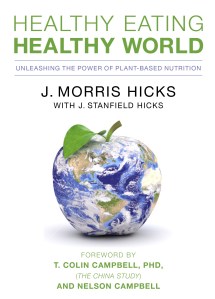
All about improving the health of humans while preserving nature's ability to sustain our species

All about improving the health of humans while preserving nature’s ability to sustain our species

Both of us, because of our passion for this topic, have studied it enough to be able to offer a fresh, big picture perspective that you may not always get from the “insiders.” Dr. Campbell mentioned this phenomenon in the foreword to my book:

Too often in a field of study, we rely solely on those people who have established themselves as “inside experts.” Yet, sometimes the most interesting perspectives are those that come from outside the field. And that is the case here—Jim’s perspective has enabled him to tell a story in his book that is informative, engaging and compelling.

I feel the same way about the work of Dr. Oppenlander. Yesterday I sent him an introductory email but we have not yet spoken—I look forward to getting to know this remarkable man.

Handy 5-piece take-charge-of-your-health kit—from Amazon.com

Why should we be eating mostly plants? The “big picture” in 4 minutes.

Want to find out how healthy your family is eating? Take our free 4Leaf Survey. It takes less than five minutes and you can score it yourself. After taking the survey, please give me your feedback as it will be helpful in the development of our future 4Leaf app for smartphones. Send feedback to jmorrishicks@me.com

International. We’re now reaching people in over 100 countries. Follow us on Facebook and Twitter or get daily blog notices by “following” us in the top of the right-hand column. For occasional updates, join our periodic mailing list.

J. Morris Hicks, working daily to promote health, hope and harmony on planet Earth.

To order more of my favorite books—visit our online BookStore now

For help in your own quest to take charge of your health, visit our 4Leaf page and also enjoy some great recipes from Lisa’s 4Leaf Kitchen.

Got a question? Let me hear from you at jmorrishicks@me.com. Or give me a call on my cell at 917-399-9700.

SHARE and rate this post below.

—J. Morris Hicks, board member, T. Colin Campbell Foundation
Posted in Activism & Leadership, Big Picture, Environment, Harmony Project, Sustainability | Tagged | 6 Comments

Bill Clinton connects “sustainability” and food choices.

In the August/September Issue of AARP Magazine

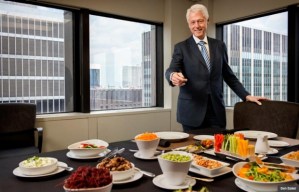
Bill Clinton about to enjoy a plant-based lunch in his Manhattan office. (Photo from the AARP article)

Bill Clinton about to enjoy a plant-based lunch in his Manhattan office. (Photo from the AARP article)

When my copy arrived in the mail this week, two articles featured on the cover caught my attention. (See links to source articles below)

The first article (Bill Clinton. His Life-Saving Diet) provides highly creditable documentation of the uncanny power of a whole food, plant-based diet to reverse heart disease, promote vibrant health, end obesity, slash the nation’s cost of healthcare and curb global warming. Not a bad start. From the beginning of the article:

My Lunch With Bill. Over a heart-healthy meal, President Clinton reveals how he came to crave his veggies—honest!—and how the rest us of can (and must) too.

The second article (Warren Buffett. On Money, Success, Happiness and Life) features a generous man with enough means ($59 Billion) to leverage Mr. Clinton’s knowledge in a big way. With just a fraction of that number and a well-conceived PLAN, Mr. Buffett and Mr. Clinton could accomplish far more than the few huge, diet-driven benefits listed above. With Bill’s leadership skills and Warren’s money, these guys have what it takes accomplish the ultimate goal—ensuring the longterm sustainability of humanity.

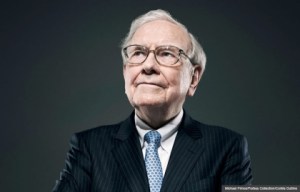
Warren Buffett as he appeared in the AARP article.

Warren Buffett as he appeared in the AARP article.

A philanthropist’s dream—a chance to effect true, world improving, systemic change. As Mr. Buffett’s son said in his recent New York Times article, just giving away tons of money to thousands of causes is not going to provide the systemic change that we need. That’s like treating the symptoms of heart disease instead of treating the causes—which Mr. Clinton has done so well with regards to his own heart disease.

While reading both of these articles, I became excited about how this latest news would bode well for our S.O.S. (Saving Our Species) Global Initiative that we have been discussing. I then reached out to share this great news with Dr. Campbell:

Hi Colin,

Just got my AARP Magazine in the mail, the one with the big Clinton article. You, Ess and Ornish are mentioned, along with statements by Clinton that demonstrate his understanding that the repercussions of our food choices go far beyond our waistlines. The author (Joe Conason) says that Clinton sent him books from all three of you after the author’s heart attack in 2010.

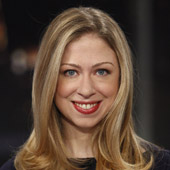
Chelsea Clinton as she appears on the Clinton Foundation website. A near- vegan herself, she may have had a major influence on her father's dietary change.

Chelsea Clinton as she appears on the Clinton Foundation website. A near-vegan herself, she may have had a major influence on her father’s dietary change.

Armed with this kind of information, I think that if Chelsea went to our first SOS Summit and got to hear people like Emmott and Brown talk about the likely collapse of our civilization unless we make some radical changes—she might get inspired to take some BOLD action. We both know that changing everyone to a plant-based diet will do more to ensure the longterm survival of our species than all other possible initiatives combined.

Chelsea just needs to understand the URGENCY and the need for a PLAN of action. Here are some excerpts from the article along with a link to the online version. 

Beginning of article. When Bill Clinton invited me to lunch in May, I knew better than to expect fried catfish or barbecued ribs. The former president is now a devoted vegan, meaning no meat, fish or dairy products, and he has pursued a healthier way of life for more than three years. While I figured our lunch menu might be bland, that would be a small price to pay for private time with a world leader who is anything but.

Prodded into action, Clinton started by rereading Dr. Dean Ornish‘s Program for Reversing Heart Disease, which urges a strict, low-fat, plant-based regimen, along with two books that were, if possible, even more militantly vegan: Prevent and Reverse Heart Disease, by Caldwell Esselstyn, M.D., and The China Study, by Cornell biochemist T. Colin Campbell, Ph.D. (When I suffered a heart attack in late November 2010, Clinton sent me all three books.)

“I just decided that I was the high-risk person, and I didn’t want to fool with this anymore. And I wanted to live to be a grandfather,” says Clinton. “So I decided to pick the diet that I thought would maximize my chances of long-term survival.”

Sounding the themes that still drive him every day, Clinton wraps up our meeting with a message, reminding me that “the way we consume food and what we consume” are driving the unsustainable level of health care spending in America. To truly change the conditions that lead to bad habits and poor health, he warns, “we have to demand it by changing the way we live. You have to make a conscious decision to change for your own well-being, and that of your family and your country.”

I would also add to his final sentence—“also for your planet, your great-grandchildren, and for the longterm sustainability of humanity.” For your convenience, I have provided online links to the two source documents along with a link to a blog describing our SOS (Saving our Species) Global Initiative—an effort aimed not at “saving the planet,” but rather preserving her ability to sustain us.

Our SOS initiative is just in the idea stage at the moment. With the vast leadership and financial resources of Clinton and Buffett, this initiative could effect staggering global benefits in just a few years—maybe soon enough to preserve the longterm sustainability of humanity.

Handy 5-piece take-charge-of-your-health kit—from Amazon.com

Why should we be eating mostly plants? The “big picture” in 4 minutes.

Want to find out how healthy your family is eating? Take our free 4Leaf Survey. It takes less than five minutes and you can score it yourself. After taking the survey, please give me your feedback as it will be helpful in the development of our future 4Leaf app for smartphones. Send feedback to jmorrishicks@me.com

International. We’re now reaching people in over 100 countries. Follow us on Facebook and Twitter or get daily blog notices by “following” us in the top of the right-hand column. For occasional updates, join our periodic mailing list.

J. Morris Hicks, working daily to promote health, hope and harmony on planet Earth.

To order more of my favorite books—visit our online BookStore now

For help in your own quest to take charge of your health, visit our 4Leaf page and also enjoy some great recipes from Lisa’s 4Leaf Kitchen.

Got a question? Let me hear from you at jmorrishicks@me.com. Or give me a call on my cell at 917-399-9700.

SHARE and rate this post below.

—J. Morris Hicks, board member, T. Colin Campbell Foundation
Posted in Activism & Leadership, Big Picture, Bill Clinton, Celebrities | Tagged , | 2 Comments

S.O.S. (Saving Our Species) — An urgently needed PLAN

A plant-based pathway to the longterm sustainability of humanity

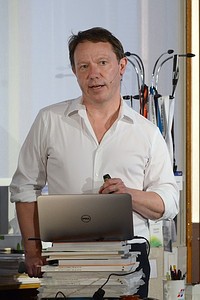
Dr. Stephen Emmott as he appears in the Forbes article referenced below.

Dr. Stephen Emmott as he appears in the Forbes article referenced below.

Earlier this summer, I posted a blog (See link below) about the works of Stephen Emmott, an Oxford professor and the head of computational science at Microsoft in the UK. In his new book, Ten Billion, he paints a bleak picture regarding the likely fate of our species. He talks bluntly about the longterm repercussions of the gross overconsumption of our exploding population, stating…

Our cleverness, our inventiveness and our activities are now the drivers of every global problem we face. And every one of these problems is accelerating as we continue to grow towards a global population of 10 billion.

The only solution left to us is to change our behaviour, radically and globally, on every level. In short, we urgently need to consume less. A lot less. Radically less. And we need to conserve more. A lot more. We can rightly call the situation we’re in an unprecedented emergency. We urgently need to do – and I mean actually do – something radical to avert a global catastrophe. But I don’t think we will. I think we’re f _ _ _ _ d!

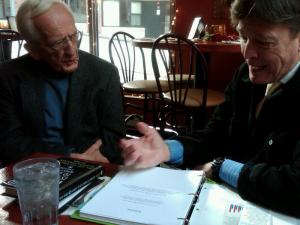
J. Morris Hicks reviewing his book manuscript with Dr. T. Colin Campbell at Cornell University

J. Morris Hicks reviewing his book manuscript with Dr. T. Colin Campbell at Cornell University

Dr. Campbell and I are more optimistic. We believe that there is a plant-based pathway out of this mess that we humans created. We agree with all that Dr. Emmott says about the unsustainability of exploding population and its extremely wasteful, harmful and inefficient lifestyle.

We also agree that we must make some radical changes—but we believe we should start with the single systemic “behavioral change” that will yield the greatest benefit—in the least amount of time. In short, we believe that:

Shifting to a whole food, plant-based diet will do more to ensure the long-term survival of our species than ALL other possible initiatives combined.

13 HEHWSo how do we get hundreds of millions of people to change? How do we get them to forego the wildly popular typical western diet with meat and dairy three meals a day? And how do we get them to move quickly as they shift to a mostly whole food, plant-based diet?

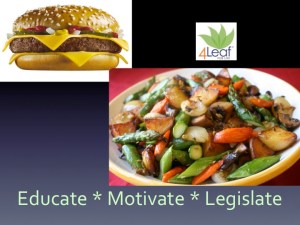
We propose to do that with a combination of heavily funded, globally-coordinated efforts to educate, motivate and legislate.1 Title We begin by putting together a “dream team” of leaders, scholars and philanthropists to oversee the multi-faceted global initiative aimed at teaching the entire world what we should be eating.

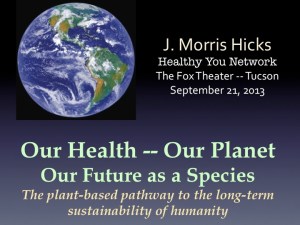
My first public presentation of our envisioned SOS Global Initiative will be delivered at a Healthy You Network one day seminar at the Fox Theater in Tucson, Arizona on September 21, 2013. Click here 2 Easterfor program details. The remainder of this blog is an abbreviated preview of my Tucson presentation.

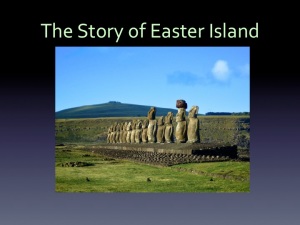
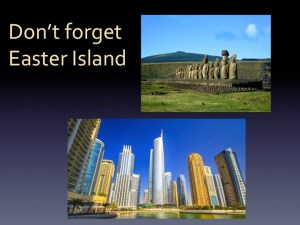
Learning from History. We simply must learn from what happened at Easter Island hundreds of years ago. After exhausting the natural resources that sustained them, their thriving civilization of 15,000 collapsed—resulting in an every-man-for-himself chaos that became a hell on Earth for all of its 3 Our Easterpeople.

Like Easter Island, our planet Earth receives no “supplies” from anywhere else. All of us Earthlings must provide for ourselves and we mustn’t squander our limited natural resources without fully comprehending how nature utilizes those resources to sustain all of its creatures—including us.5 Nature

Putting things into perspective. Our precious planet has been supporting life for four billion years and humans have been here for just 200,000 years. If we crammed those 4B years into just one year, the first humans arrived just 26 minutes ago.

6 GarbageEven more alarming, we have grown from one billion to seven billion people in just the last two seconds, and we have inflicted more damage on the fragile harmony of nature in the last 1/2 second (fifty years) than all previous generations of humans combined for the last 200,000 years.

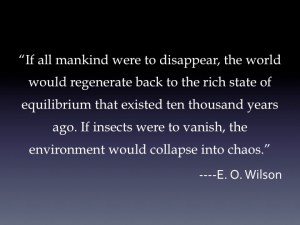
In just a mere blink of the eye of history, we humans have taken over every square inch of arable land to feed ourselves and when we need more, we just burn another rainforest. As we squander our land, water 7 Humans Wilsonand energy; we’re also destroying the ecosystem that provides life itself for all who live here.

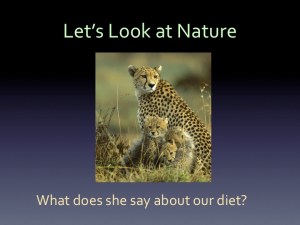
Driven by destructive human activity, the rate of species extinction is running at some 1000 times faster than normal—as we overfish our oceans, over-pump our underground aquifers and burn up our finite supply of fossil fuels that it took nature billions of years to create.14 Cheetah

When it’s all said and done, we will have used up ALL of our fossil fuels in just 200 years, which equates to just the last two seconds of that hypothetical year mentioned earlier.

Is plant-based the answer? What would a move to a human diet of mostly whole, plant-based foods do for us? It would enable us to feed the same number of 20 R4 TCC 5 MDspeople with 90% less land, 90% less water and 90% less energy than is required for a meat-based diet.

Nature has a diet-plan for all of her creatures. Some eat other animals, some eat plants and so forth. But for some reason, we humans are the only species in the history of the world that can’t figure out what we should be eating.57 Burger to Veggies

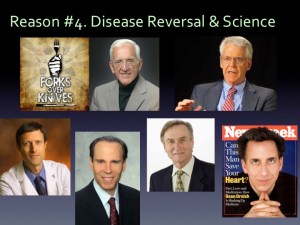
Confusion over clarity is the name of the game in our extended food/healthcare complex despite some powerful clues from nature and a mountain of evidence gathered by a handful of pioneering medical doctors and one world-changing nutritional scientist, Dr. T. Colin Campbell.

16 UAB DebateBut the problem is that there are far more nutritional scientists and medical doctors who believe that meat and dairy are best for the health of humans. So who is the public going to believe?

Answer: They will believe the scientist or MD that recommends the diet that they like eating—the standard American diet.

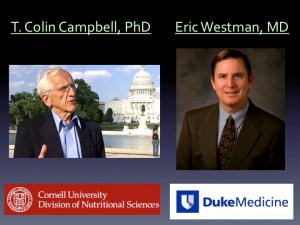
30 Is Paleo right?In the spring of 2013, Dr. Campbell debated Dr. Westman in Birmingham, AL (shown here) on the topic of the best diet for humans. Both brilliant men, with sterling credentials from the best institutions—they were 180 degrees apart when it came to what we should be eating.

Dr. Campbell promotes the whole food, plant-based diet while Dr. Westman promotes the meat/dairy-rich Paleo, 55 Asteroid ExampleMediterranean and Atkins diets.

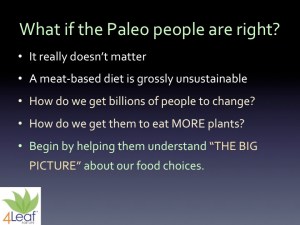
So what if Dr. Westman and the Paleo folks are right. What if meat and dairy really is the most healthful food  for humans? See the slide at right for my answer.

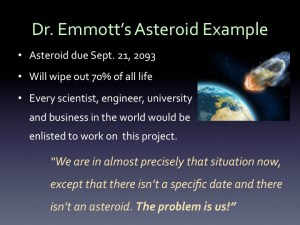
What can we do? In his book, Dr. Emmott talked about an “Asteroid” project that would take place if we knew that an asteroid were going to collide with Earth 58 PLAN Sequenceand wipe out 70% of all forms of life on a specific date in 2093.

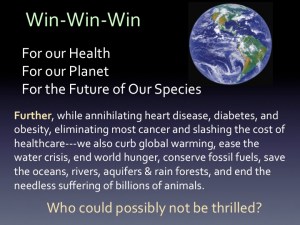
As he said, “Every scientist, engineer, university and business in the world would be enlisted to work on  that project.” And that’s exactly what we need now. We need to pull together a small group of thoughtful, committed, citizens (Margaret Mead quote) who have the knowledge, leadership qualities and funding required to 62 Win Win WInquickly change how the world thinks about food.

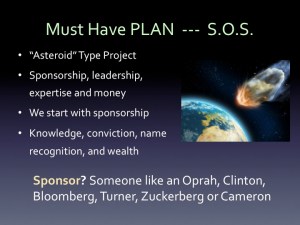
That project must begin with a knowledgeable “sponsor” who totally understands the power of plant-based nutrition and has the combination of fame and wealth needed to bring the the right mix of individuals to the table. In my presentation, I refer to our initial meeting as the SOS Summit and we’re targeting 63 System OppositionNovember of 2013 for it to take place.

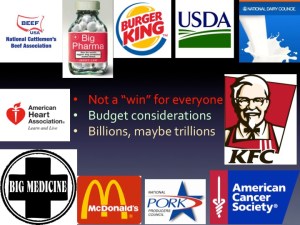
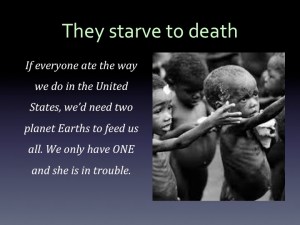
What about budget? As you may have guessed, many HUGE organizations throughout the world will be VIOLENTLY opposed to our efforts to get people to stop eating the toxic western diet. It will take billions, if not trillions of dollars to make this thing work. The legal fees alone will be enormous.33 Starving 4B

At the initial summit, we expect to have people in the room who know Bill Gates, Michael Bloomberg, Warren Buffett, Oprah Winfrey and Bill Clinton personally.

Once these brightest and wealthiest people in the world fully appreciate the gravity of our situation, we expect that the resulting budget will be multiple billions of dollars per year.65 Easter and Dubai

After all, what could be more important than preventing the collapse of our civilization? The world’s super-wealthy philanthropists are known for throwing outrageous sums of money at problems with no overall PLAN of action in mind.

28 Details of 4LeafThey spend too much time  applying social service Band-Aids when what is needed is comprehensive, global, systemic change. We must begin in earnest addressing the causes of our problems and we must stop spending so much time and money dealing with the repercussions of our misguided ways.

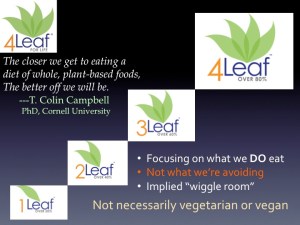
Attractive package with some flexibility. We all know that there is huge resistance to the words vegan and vegetarian. Hence, we don’t plan to use them.

This slide is the one that I will use to explain our 4Leaf approach to healthy eating—maximizing the percent of your calories from whole, plant-based foods. Not necessarily becoming vegan or vegetarian. We’ll attract at least ten times as many people if we propose something that they consider less extreme and more reasonable.

We’d rather get one billion people to switch to the 2 or 3Leaf level than get 100 million people to become 100% vegan. It will free up over seven times as much land and save seven times as much water in the long run.

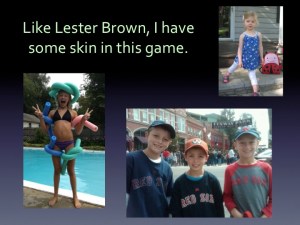
My final slide featuring my five grandchildren with one on the way in February. In the year 2100, their ages will range from 86 to 100.

My final slide featuring my five grandchildren with one on the way in February. In the year 2100, their ages will range from 86 to 100.

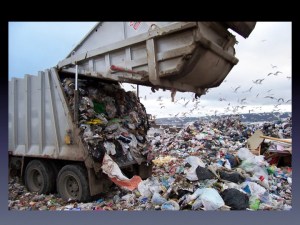
How much land? An area over half the size of the United States. And it will prevent the starvation of billions of people. The main problem with most of our destructive human activity is that the unwanted repercussions are out of sight and out of mind. What would you choose to eat if you could see the morbid repercussions of those choices in your own neighborhood?

S.O.S. Status. On August 2, I placed my first phone call to the office of the overall sponsor that we feel would be best suited. Since then, I have met with that person and we are now working on a plan of action. Stay tuned.

Here is where I will be speaking in Tucson. The fabulous Fox Theater.

Here is where I will be speaking in Tucson.

Seeking speaking engagements. As the “big picture” guy, this is now my primary focus. My topic is unique, it is critically important and my fees are reasonable. I can travel anywhere as long as expenses are covered. In October I am speaking at a health congress in Italy. For my fee schedule and other details, Click here. Scroll down to see a 4-minute video of me telling the 4Leaf Story.

A few of my earlier links related to this topic.

Handy 5-piece take-charge-of-your-health kit—from Amazon.com

Why should we be eating mostly plants? The “big picture” in 4 minutes.

Want to find out how healthy your family is eating? Take our free 4Leaf Survey. It takes less than five minutes and you can score it yourself. After taking the survey, please give me your feedback as it will be helpful in the development of our future 4Leaf app for smartphones. Send feedback to jmorrishicks@me.com

International. We’re now reaching people in over 100 countries. Follow us on Facebook and Twitter or get daily blog notices by “following” us in the top of the right-hand column. For occasional updates, join our periodic mailing list.

J. Morris Hicks, working daily to promote health, hope and harmony on planet Earth.

To order more of my favorite books—visit our online BookStore now For help in your own quest to take charge of your health, visit our 4Leaf page and also enjoy some great recipes from Lisa’s 4Leaf Kitchen.

Got a question? Let me hear from you at jmorrishicks@me.com. Or give me a call on my cell at 917-399-9700.

SHARE and rate this post below.

—J. Morris Hicks, board member, T. Colin Campbell Foundation
Posted in Activism & Leadership, Big Picture, Harmony Project, SOS (Saving Our Species) | 6 Comments