Recipe version of my Sailors Daily 4Leaf Oatmeal

Although now listed on Lisa’s page; this was originally from my kitchen

Early in 2011, I included a detailed description of my two favorite go-to meals in this blog. Those pages have been seen thousands of times and hopefully have been helping people achieve success on our 4Leaf Program. Over the weekend, I decided that it was time to develop a recipe version of those two meals. Scroll down for a printer-friendly version. Here’s the first one:
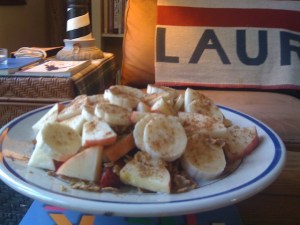
Sailors Daily 4Leaf Oatmeal -- best if eaten next to a lighthouse

Sailors Daily 4Leaf Oatmeal

The ultimate in taste, nutrition and convenience. Nothing could be easier than this great meal that will keep you going for hours. And eating it cold makes it that much better.

Ingredients:

  • 1 cup of whole grain oatmeal
  • Unsweetened soy, almond or rice milk (I use Pacific Brand unsweetened, vanilla flavored almond milk)
  • Handful of raisins
  • 1 small apple or pear
  • Handful of blueberries and/or strawberries
  • A sprinkling of Uncle Sam’s brand wheat berry flakes with flaxseeds.
  • 1 medium banana
  • Ground cinnamon

Directions

  1. Put the dry oatmeal in a large bowl.
  2. Add a handful of raisins on top.
  3. Add cold water; then about the same amount of the nut or soy milk to cover the oats & raisins.
  4. While the oats are soaking (and expanding), take a few minutes to slice your fruit.
  5. Add the berries first on top of the oatmeal.
  6. Slice the apple or pear into bite-size pieces and spread over the top of the oatmeal and berries.
  7. Add the sprinkling of Uncle Sam’s flakes on top for crunch. Being on top of the berries and apple, the flakes will not get soggy.
  8. Slice the banana and add on the very top.
  9. Sprinkle with cinnamon and this delicious meal is ready to eat in less than five minutes.

Leveraging the simple concept of maximizing the percent of your calories that are derived from whole, plant-based foods

My favorite meal of the day. I absolutely love this meal, and like it more than ever since I learned how to eat it cold (from Dr. Caldwell Esselstyn). It’s actually quite refreshing; more like a crunchy cereal than the mushy and sticky cooked oatmeal. But, by all means, choose what works best for you.

Just choose your favorite fruits and experiment with unsweetened crunchy whole grain cereals to sprinkle on top. Depending on your caloric needs, this meal can deliver 500 calories or more – with everything being whole plants except for the few ounces of soy or almond milk.

My routine is to have this great meal a few hours after my early morning bowl of fresh fruit. Simply adjust your schedule to something that works for you. For example, you may want to have the big bowl of oatmeal at home before you leave for work, then bring along some fruit for a snack in case your get hungry before lunch.

The combination of the fruit and the oatmeal will yield a 4Leaf score over 90% — before you have lunch. By starting out your day with the healthiest of foods, it helps to motivate you to maintain the 4Leaf score for the entire day.

For a “printer-friendly” one-pager, ideal on your fridge with a magnet—Just click here for a PDF.

J. Morris Hicks -- eating, exercising and living for health; making a difference and having fun

One more thing, in case you’re interested, here is the original posting of this great meal — posted on 2-17-11. Eating healthy in the A.M. — “Sailors Oatmeal” at mid-morning

Click here for the page containing all of Lisa’s recipes.

If you’d like to order our book on Amazon,  visit our BookStore now.

Be sure to tell your friends about our easy-to-remember website at www.4leafprogram.com and if you like what you see here, you may wish to join our periodic mailing list.

If you like what 4Leaf eating is doing for you and your family, you might enjoy visiting our new “4Leaf Gear” store. From the New England village of Holden, Massachusetts — Be well and have a great day.

SHARE and rate this post below…One more thing, occasionally an unauthorized ad may appear beneath a blog post. It is controlled by WordPress (a totally free hosting service). I do not approve or personally benefit whatsoever from any ad that might ever appear on this site. I apologize and urge you to please disregard.
Posted in 4Leaf for Life, Recipes & meals | 2 Comments

Omega-3, sodium & potassium—Think ratios

We’re eating too much of the bad stuff and not enough of the good.

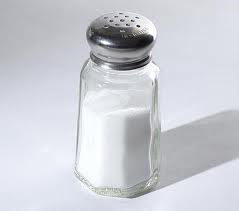
Most of our salt intake doesn’t come from this little guy — but from the highly processed and restaurant foods.

Happy New Year! A recent study reported in the New York Times (see link below this post) focused on the dangerously high sodium to potassium ratios in the USA. In the 12-26-11 article by Jane E. Brody, there was a great deal of information about the dangers of too much sodium and the health benefits of consuming more potassium. Good information, but lacking in clarity. As for our salt consumption, the article reported:

Ninety percent of the sodium in the American diet comes from salt, three-fourths of which is consumed in processed and restaurant foods. Salt added in home cooking and at the table accounts for only a minor proportion of sodium intake.

The article also reported that the body’s actual requirement for sodium is quite low, only 220 mg. per day, yet the average American consumes 3400 mg. That’s almost 50% more than the 2300 mg. maximum in our latest dietary guidelines. What about that ratio? The article continues.

A major study, based on data from more than 12,000 American adults, took into account all those risk factors for death from heart disease. The researchers found that while a diet high in sodium — salt is the main source — increases your risk, even more important is the ratio of sodium (harmful) to potassium (protective) in one’s diet.

Potassium rich foods; the same foods that provide us with the protein and all the other vitamins and nutrients that we need. Whole, plant-based foods.

Omega-6 to Omega-3 ratio. So, it’s kind of like the healthy omega-3s that we hear so much about. It turns out that the ratio of the omega-6s to the omega-3s is more important. Dr. Fuhrman was quoted in our book: “Optimal health depends on the proper balance of fatty acids in the diet . . . Our modern diet, full of vegetable oils and animal products, is very high in omega-6 fat and very low in omega-3 fat; the higher the omega-6 to omega-3 ratio, the higher the risk of heart disease, diabetes, and inflammatory illnesses.” So if we cut down on the harmful omega-6s in our diet, the less omega-3’s we’ll need in order to achieve the right ratio.

Regarding the sodium to potassium ratio; the article continues: “When people whose meals contained little sodium relative to potassium were compared with those whose diets had a high sodium-to-potassium ratio, the latter were nearly 50 percent more likely to die from any cause and more than twice as likely to die from ischemic heart disease during a follow-up period averaging 14.8 years.”

The good news. If we simply eat a plant-based diet rich in grains, legumes, fresh fruits and vegetables, we’ll get all the sodium we need, but not too much. More importantly, we’ll get the protective potassium from those whole, plant-based foods. That same diet will also improve our omega ratio as well — increasing our ratio of the healthy omega-3s to the not-so-healthy omega-6s. But the article came up way short with regards to this obvious solution.

The obvious problem is our rich Western diet of meat, dairy, eggs and highly processed foods three meals a day — the very diet that delivers way too much sodium and omega-6s but not nearly enough potassium and omega-3s. More information on salt from the article:

The body’s requirement for sodium is very low — only 220 milligrams a day — but the average American consumes more than 3,400 milligrams daily. The current Dietary Guidelines for Americans recommend a maximum of 2,300 milligrams (about a teaspoon of salt) for people over age 2.

Despite widespread efforts to get people to consume less sodium, intake of this nutrient has increased significantly since the early 1970s as consumption has risen of processed and restaurant foods, which rely heavily on salt as a cheap way to enhance flavor and texture and preserve food.

To make matters worse, not only does the amount of sodium rise precipitously when foods like tomatoes and potatoes are processed, but the natural potassium in these foods declines significantly, worsening the sodium-potassium ratio.

It seems that the official “system” information is sometimes helpful, sometimes harmful, but always confusing.

The bottom line. This salt issue is just one of hundreds of health problems that are driven by our rich Western diet. Although the solution is so refreshingly simple, the sources quoted in the New York Times article come up way short when it comes to telling the public exactly what they should be eating. From near the end of the article:

Dr. Kuklina (of the CDC) recommends eating fewer processed foods, especially processed meats, and more fresh fruits and vegetables and dairy products that are low in sodium, like yogurt and milk.

Increase your potassium intake not by taking supplements, but by eating more cantaloupe, bananas, oranges, grapes, grapefruit, blackberries, yogurt, dried beans, leafy greens, potatoes and sweet potatoes.

Obviously, Dr. Kulina hasn’t read The China Study and/or doesn’t believe the overwhelming scientific and clinical evidence supporting our adoption of a whole foods, plant-based diet. She’s still talking about eating less processed meats and she includes dairy and yogurt right in there with her list of healthy sources of potassium. The reader, of course, will just continue to be confused. (See link to article at end of this post).

To wrap up this discussion of salt; let’s turn to someone that you can always trust to tell you the truth — someone who favors clarity over confusion. From his great website at nutritionfacts.org, take a look at Dr. Michael Greger’s two-minute video from 10-21-11.

While you’re making your resolutions, you should also think about how you can become a better citizen of the planet. Conveniently, as Dr. Campbell says, “If the we eat the way that promotes the best health for ourselves, we also promote the best health for the planet.”

And our planet needs your help; take a look at the following movies and you’ll understand why. Just in case you haven’t seem them yet, get yourself some popcorn (or celery), and watch these great world-changing documentaries with your family (free). They are about 1.5 hours each and are likely to leave you feeling differently about the role of the human race on our precious planet.

HOME — a great 2009 film; a powerful eye-opener

“Earthlings” — A documentary that we all NEED to see

J. Morris Hicks, author and activist. Working daily to promote health, hope and harmony on planet Earth.

If you like what you see here, you may wish to join our periodic mailing list. Also, for help in your own quest to take charge of your health, you might find some useful information at our 4-Leaf page.

And if you like what 4-Leaf eating is doing for you and your family, you might enjoy visiting our new “4-Leaf Gear” store. From the seaside village of Stonington, Connecticut – Be well and have a great day.

If you’d like to order our book on Amazon,  visit our BookStore now.

The Jane Brody NY Times article: High Sodium-to-Potassium Ratio in Diet Is a Major Heart Risk – NYTimes.com.

—J. Morris Hicks…blogging daily at HealthyEatingHealthyWorld.com

SHARE and rate this post below…One more thing, occasionally an unauthorized ad may appear beneath a blog post. It is controlled by WordPress (a totally free hosting service). I do not approve or personally benefit whatsoever from any ad that might ever appear on this site. I apologize and urge you to please disregard.
Posted in Video Included, Vitamins & Supplements | Tagged | Leave a comment

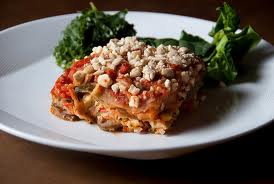
From Lisa’s Kitchen — Almost 4Leaf Vegetable Lasagna

Lisa's 3Leaf Vegetable Lasagna -- a great meal that everyone loves

Our first 3Leaf meal from Lisa

But that doesn’t mean that it is not healthy. It is 100% plant-based and derives less than 2o% of its calories from fat. The only reason it is not 4Leaf is because we don’t consider the whole-grain lasagna noodles to be whole plants — in nature’s package. But we do eat pasta from time to time and this recipe is one of our favorites.

This delicious recipe was inspired by Rip Esselstyn’s Raise the Roof Lasagna in the Engine 2 Diet book. His recipe scored at 2Leaf on our 4Leaf scale; Lisa tweaked it a bit, removed the tofu, and transformed it into a healthy 3Leaf entree.

Think of 4Leaf as a lifestyle -- one of maximizing the percent of your calories from whole, plant-based foods -- still in nature's package.

Bear in mind that with a daily 4Leaf goal, there is plenty of room for a special 2Leaf or 3Leaf entree from time to time. Also, by adding a salad and more veggies on the side, you could make this great meal a bit closer to 4Leaf. For more on our 4Leaf philosophy, visit 4leafprogram.com

Filled with a variety of wonderful vegetables, this lasagna is an ideal casserole with hints of garlic, onion and rosemary. This recipe actually makes enough for two casseroles; one large and one small. You could keep one for yourself and take one to a dinner party!

Ingredients:

  • 1 onion, chopped
  • 1 small head of garlic, chopped or minced (about 10 cloves)
  • 12 ounces of mushrooms, any variety, sliced
  • 1 head broccoli, chopped (about 4 cups)
  • 2 large carrots, chopped
  • 2 peppers, any color, chopped
  • 1  15 oz. can low sodium corn, drained
  • 1/2 teaspoon cayenne pepper
  • 1 teaspoon dried oregano
  • 1 teaspoon dried basil
  • 1 teaspoon dried rosemary
  • 2 24-oz jars of low sodium pasta sauce
  • One 14-oz. box whole grain lasagna noodles
  • 16 ounces frozen spinach
  • 3 sweet potatoes, cooked and mashed with 1/2 cup soy, hemp or almond milk and 1 teaspoon soy butter; salt to taste (optional)
  • 3 tomatoes, sliced thin
  • 1 cup roasted, unsalted cashews, ground
  • 2 Tablespoons nutritional yeast (optional)

Directions: (filling)

  1. Preheat oven to 400 degrees. In a large sprayed pot, sauté  the onion and garlic on medium heat for about 5 minutes.
  2. Add the mushrooms and cook until they give up their liquid, and remove to a large mixing bowl.
  3. Sauté  the broccoli and carrots for about 5 minutes and add to the mushrooms.
  4. Sauté  the peppers and corn for about 5 minutes and add them to the bowl.
  5. Add the spices to the bowl and mix.

Directions: (to assemble)

  1. Cover the bottom of a 9-by-13-inch casserole dish with a layer of sauce and add about 2 1/2 pieces of the lasagna, covering them with another layer of sauce (The lasagna will cook in the oven).
  2. Spread half of the vegetables over the noodles.
  3. Cover the vegetables with 2 1/2 more pieces of the lasagna and another layer of sauce.
  4. Add half of the bag of spinach and then cover them with half of the mashed sweet potatoes.
  5. Add more sauce, another 2 1/2 pieces of the lasagna noodles and another layer of sauce.
  6. Cover the lasagna with the tomatoes, the ground cashews and the nutritional yeast (if using). Repeat using a 8-by-8-inch casserole dish.
  7. Cover with foil and bake in the oven for about 45 minutes. Remove the foil and bake for another 15 minutes.
  8. Enjoy!

With love from Lisa...

For a “printer-friendly” one-pager, ideal on your fridge with a magnet—Just click here for a PDF.

Would love to hear from you at lisa@4leafprogram.com

Be sure to tell your friends about our easy-to-remember website at www.4leafprogram.com and if you like what you see here, you may wish to join our periodic mailing list.

If you like what 4Leaf eating is doing for you and your family, you might enjoy visiting our new “4Leaf Gear” store. From the New England village of Holden, Massachusetts — Be well and have a great day.

If you’d like to order our book on Amazon,  visit our BookStore now.

—Lisa Hicks…blogging occasionally at 4leafprogram.com

SHARE and rate this post below…One more thing, occasionally an unauthorized ad may appear beneath a blog post. It is controlled by WordPress (a totally free hosting service). I do not approve or personally benefit whatsoever from any ad that might ever appear on this site. I apologize and urge you to please disregard.

Posted in Recipes & meals | 3 Comments