Bill Gates & Eric Schmidt—both big fans of Khan Academy

Changing the way the world thinks about education…

Maybe we can use their story to help us come up with a way to change the way the world thinks about food.

Take a few minutes and learn about the amazing Khan Academy—I first heard about it on Sunday night. On 3-11-12, 60 Minutes aired a segment about a most remarkable teacher (35-year old Sal Khan) who is revolutionizing the way we learn.

Originally working out of a closet in his home, he is now reaching millions of students with an audacious mission: providing a free world-class education to anyone, anywhere. With 3 degrees from M.I.T. and a Harvard MBA, Sal began by tutoring some cousins and then got the idea to offer his lessons to anyone, anywhere.
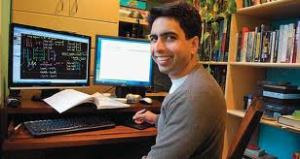
Sal Khan behind his desk, from which he reaches millions of students around the world.

So he quit his job as a hedge fund manager in 2009 and went to work full-time above a tea shop in the silicon valley. Now Khan Academy is going global.

Backed by Google, Gates, and other Internet powerhouses (to the tune of about $15 million), Sal Khan now has over 3,000 lectures with more than 4 million students every month. Through yesterday, he had delivered almost 130 million lessons.

You should get to know this remarkable young man. (two minutes)

He says he’s an “education entrepreneur” because he can’t think of any better way to impact the world.

Bill Gates says he’s started a revolution. (two minutes)

So, how do we teach the world about food? Well, it would help if we Bill Gates and Eric Schmidt (former Google CEO) were on board. Once they realized the staggering global impact of dispelling the “protein myth,” we could simply leverage technology like the Khan Academy to spread the word.

Mr. Gates and Mr. Schmidt both seem to appreciate the concepts of “thinking outside the box” or “pushing the envelope.”
Promoting health, hope and harmony on planet Earth

What’s good for our health, is also good for the planet.

Once they learn what a shift to plant-based eating could do for global issues like health care, climate change, environment, the energy crisis and world hunger—they would be able to generate a lot of energy around the concept of teaching these simple truths to the world.

I am certain that Dr. Campbell, Esselstyn, Ornish and many other prominent experts would be interested in collaborating with the likes of Gates, Schmidt, and Khan on a plan to help people everywhere take charge of their health—while at the same time, doing some wonderful things the entire world.
Watch the entire 60 Minutes segment that features Google CEO Eric Schmidt talking about how Sal Khan, the entrepreneur and educator, influences programs like Dell technology in education and inspiring everyone from Bill Gates & Eric Schmidt to students and teachers everywhere. Khan has figured out a way to leverage the power of IT in the classroom—and he’s done it in a way that has gone far beyond what traditional educators have done.

Click here to watch this 13-minute segment with CNN’s Dr. Sanjay Gupta. (This video also includes a little advertising.)

Finally, take a look at the Khan Academy website itself. www.KhanAcademy.org

Maybe, like Sal Khan, we can all become “food entrepreneurs” and work together to change the way the world thinks about food. Like him, I can’t think of any better way to impact the world.

Follow us on Facebook and Twitter. Want to receive some occasional special news from us? You may wish to Join our periodic mailing listFor daily updates you can choose to “FOLLOW” at the top of the right column>>>>>>>>>>>>

Also, for help in your own quest to take charge of your health, you might find some useful information at our 4Leaf page or some great recipes at Lisa’s 4Leaf Kitchen. Got a question? Let me hear from you at jmorrishicks@me.com.

If you’d like to order our book on Amazon,  visit our BookStore now.

J. Morris Hicks, working daily to promote health, hope and harmony on planet Earth.

From the seaside village of Stonington, Connecticut – Be well and have a great day.

—J. Morris Hicks…blogging daily at HealthyEatingHealthyWorld.com

SHARE and rate this post below…One more thing, occasionally an unauthorized ad may appear beneath a blog post. It is controlled by WordPress (a totally free hosting service). I do not approve or personally benefit whatsoever from any ad that might ever appear on this site. I apologize and urge you to please disregard.

J. Morris Hicks — Member of the Board of Directors — Click image to visit the foundation website.
Posted in Uncategorized | 8 Comments

Ongoing plight of pigs and chickens—NYTimes.com

Mark Bittman -- New York Times

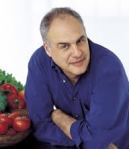
After 401 days of blogging about “the big picture” of what we eat and the impact that it has on our world, one of my most-referenced journalists is Mark Bittman of the New York Times. Like me, Mark fully understands the big picture. Unlike me, he’s chosen not to become an activist to bring about rapid change. But, his routine articles are making a difference.

In the past week, Mark has published one article about pigs and their gestation crates and one about chicken and their best hope for ending the suffering of over 8 billion a year in just the United States. The answer, according to Mark, is fake chicken. They’re doing such a great job of making “chicken” out of soy these days, that they fooled Mark almost every time in a series of taste-tests.

Of course, I have my concerns about fake chickens, fake eggs, fake hamburgers or anything fake for that matter. Two concerns:

This is how we raise the real thing---over 8 billion "broilers" in just the USA each year.

  1. Not as healthy as whole plants. Fake meats and cheeses are highly processed and typically contain way too much sodium.
  2. Just get over it, already. How can you possibly free yourself to fully enjoy the tasteful bounty of flavors and textures of the natural foods for our species—if we continue to try to make “cheesy” imitations of the animal-based foods for which we weren’t designed?

On the other hand, Mark is showing people how they can have their chicken and eat it too. They can free themselves of the guilt of complicity involving the horrid treatment of roughly 50 billion “broilers” worldwide AND they can still have their chicken wraps, nuggets and the essential “chicken soup” for when they get sick.

So how are these fake chickens made? Ever seen an extrusion process in an aluminum factory? While there is a 5-minute video of Mark in the New York Times article, here is a one-minute version of essentially the same process. I will have to admit that it’s a HUGE improvement over the hormones, antibiotics, torture and feces associated with the traditional chicken “manufacturing” process.

Back to Mr. Bittman. I like the way he wrapped up the article—touching on the big picture impact of raising all those billions of factory animals. From the article:

I don’t believe chickens have souls, but it’s obvious they have real lives, consciousness and feeling, and they’re capable of suffering, so any reduction in the number killed each year would be good. If that’s too touchy-feely for you, how’s this? Producers have difficulty efficiently dealing with the manure, wastewater and post-slaughter residue that result from raising animals industrially; chickens, for example, produce about as much waste as their intake of feed.

Then there’s the antibiotic issue: roughly 80 percent of the antibiotics sold in this country are given to animals, which has increased the number of antibiotic-resistant diseases as well as the presence of arsenic in the soil and our food.

The health issues: Nearly every test of supermarket chicken finds high percentages — sometimes as high as two out of three samples — of staph, salmonella, campylobacter, listeria or the disease-causing antibiotic-resistant bacteria called MRSA.

The USDA on the bandwagon? Even the Department of Agriculture is now on the side of plant-based diets. Its “Dietary Guidelines” say “vegetarian-style eating patterns have been associated with improved health outcomes.”

And almost all unbiased people agree that less meat is better than more: for our health, for the environment and certainly for the animals treated as widgets.

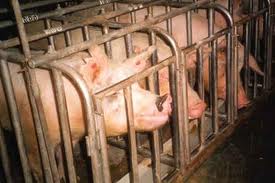
Pregnant sows may say goodbye to these gestation crates within the next five years.

Then, there’s the pigs. Since that Chipotle Grill video, there’s been quite a bit of news lately about the huge food companies’  actions to force food producers to eliminate the use of “gestation crates” for sows within the next three to five years.

As if that is going to reduce the overall suffering in factory farms by more than a fraction—sounds a lot like lip service to me. The article led off with news about Compass Group, USA:

The Charlotte-based U.S. branch of the company runs roughly 10,000 dining facilities at hospitals, senior living centers, schools, colleges and universities, corporate offices and entertainment and sports venues around the country, and purchases around 38 million pounds of pork every year.

How about that? Compass buys 38 million pounds of pork every year and much of it is served to patients in hospitals across the land. The serving of disease-promoting foods in hospitals is pretty clever marketing—raising the odds of keeping all those “disease care” facilities full of people. Now everyone’s jumping on the bandwagon; from the article:

Last month, McDonald’s announced that it is requiring all of its pork suppliers to submit plans for phasing out gestation crates by May, at which point the company will likely set a timeline for eliminating the crates from its U.S supply chain (2017 would be a reasonable guess).  Compass-owned Bon Appétit Management Company also committed last month to eliminate gestation crates(and hen battery cages) by 2015, while Smithfield, Cargill and Hormel are all making efforts to reduce their use of the crates as well.

So do you think these actions are going to do any good? Take a look at this short (less than 3 minutes) video and get a first-hand look at what continues to happen to pigs who never see the inside of gestation crate.

When do we end the madness, give the poor suffering animals a break and start taking charge of our own health by making an ultra-simple lifestyle switch to eating whole plants? For your convenience, the two articles:

Finally, Fake Chicken Worth Eating – NYTimes.com.

Article about the Gestation Crates – NYTimes.com.

Thanks Mark, for helping to move us in the right direction.

Follow us on Facebook and Twitter. Want to receive some occasional special news from us? You may wish to Join our periodic mailing listFor daily updates you can choose to “FOLLOW” at the top of the right column>>>>>>>>>>>>

Also, for help in your own quest to take charge of your health, you might find some useful information at our 4Leaf page or some great recipes at Lisa’s 4Leaf Kitchen. Got a question? Let me hear from you at jmorrishicks@me.com.

If you’d like to order our book on Amazon,  visit our BookStore now.

J. Morris Hicks, working daily to promote health, hope and harmony on planet Earth.

From the seaside village of Stonington, Connecticut – Be well and have a great day.

—J. Morris Hicks…blogging daily at HealthyEatingHealthyWorld.com

SHARE and rate this post below…One more thing, occasionally an unauthorized ad may appear beneath a blog post. It is controlled by WordPress (a totally free hosting service). I do not approve or personally benefit whatsoever from any ad that might ever appear on this site. I apologize and urge you to please disregard.

J. Morris Hicks -- Member of the Board of Directors -- Click image to visit the foundation website.
Posted in Suffering of Animals, Video Included | 9 Comments

400 Consecutive Days of Blogging—A Reflection

Sal, this one’s for you.

A candid shot of Sal Liggieri, as he ponders the extensive and exceptionally healthy menu at the Candle Cafe

After studying all about food since 2002, I published my first blog on this WordPress site on February 10, 2011 and have posted one every day since. Today is #400—and it is dedicated to one of my first readers and the one who has posted more comments than anyone else—Mr. Salvatore Liggieri of New York City.

I had the pleasure of meeting Sal back in November—we had a great (tasty and nutritious) vegan lunch at the Candle Cafe at 75th and Third on the upper East side. And to make it even more special, Bart (the founder) stopped by our table for a visit.

As most of you know, Sal tends to be slightly less optimistic than I when it comes to confidence that we Americans will EVER walk away from our exceedingly harmful, wasteful, cruel and unsustainable typical Western diet. He frequently describes his visits to the gym where he chronicles some of his observations and interactions:

A recent discussion I had at my gym. I talked with an 82 year old man from Germany who had a heart attack and was now exercising. I asked what he ate? His response: “I eat healthy, plenty of meat and dairy, prepared in my German tradition.” I asked what about vegetables? “Some creamed spinach and sometimes pickled red cabbage.” And that’s it. I started to talk plant based food and he says: “If you don’t eat meat and drink milk, you are going to get sick.” This from a man who had a heart attack. He walked away holding hands with his fat wife.

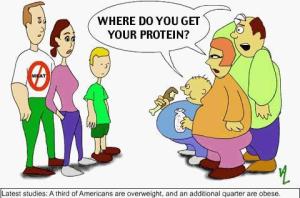
Like Sal's German friend, these people are puzzled about where we get our protein.

The scene that Sal describes is all too familiar. We have all seen it and I’m sure that I will see a lot of it during the next ten days while visiting parts of Georgia and Alabama.

But, as I have said many times in this blog and in our book, the people that Sal describes and that we all see in our daily lives are simply doing what they have been taught. Our sad situation of ill health, along with the other consequences of our deadly diet, is not their fault. They have been told the wrong information by institutions that we trust. And that has simply got to change. How?

The Big Picture. For those of us who understand how all the pieces fit together; it is our responsibility to spread the word—even if we have to go up against the uninformed schools of nutrition, mainstream medicine, the food & pharmaceutical industries and our own government agencies like the USDA and the FDA. The good news is that we have some brave pioneers from the elite science and medical communities on our side. And we have some powerful citizens like Bill Clinton and others who have taken charge of their own health—by simply heeding the advice of those brave pioneers.

Incomparable! Thank God for T. Colin Campbell and this great book.

But like Sal, every once in a while, I feel a bit of depression about our situation. Whenever that happens, I like to pause and remind myself of all the positive things that are happening. Here are a few that come to mind this morning:

  1. The T. Colin Campbell Foundation and eCornell have trained and certified over 1600 people in Plant-Based Nutrition since January of 2009 and about 400 of those have been medical doctors.
  2. Medical doctors and registered dietitians receive continuing education credits for taking this course and we’re now training about 400 doctors per year. I say “we” because of my great privilege/honor to now be serving on the board of this superb organization.
  3. Since doctors and dietitians don’t learn a great deal about truly promoting health in their formal training, many of them are energized and motivated after taking Dr. Campbell’s course.
  4. One of the graduates is my new friend Dr. John McDonough, who holds a doctorate in public health and is on the faculty of the Harvard School of Medicine. A former state legislator in MA, he was a close colleague of the late Ted Kennedy and worked with the U.S. Senate committee as a consultant on health care reform. He now blogs twice a week for the Boston Globe. (Google “Health Stew.”)
  5. The China Study (with the same publisher as our book) is now approaching the one million mark in sales around the world. Even more impressively, since being released in 2005, its sales have risen steadily every single year—all through word-of-mouth; with zero marketing. It’s now selling more books each week than it’s entire first print run back in 2004.
  6. Our book is also beginning to make a difference in people’s lives. As with The China Study, people who like our book are giving it to their close friends and families. And they’re using it in their own efforts to take charge of their health.
  7. A local friend of mine had triple by-pass last week. With no knowledge of his heart disease, I had given him our book last month. Yesterday, when I visited him in his hospital room in Hartford, our book was on his tray and he’d already read the first two chapters that featured Dr. Esselstyn’s amazing success with heart patients.
  8. My visits last month to the University of Kentucky and Holy Cross College reinforced my earlier conviction that the future success of our quest depends on the young—and gratefully, they are accepting that challenge.
  9. With a new tracking feature, I have just learned that in the past two weeks, this blog has been viewed in 77 countries—on every continent.
  10. With a degree in Industrial Engineering, it is great personal thrill for me to be able to get my arms around the single greatest process improvement in the history of the world—what we eat. The positive impacts on our health, cost of health care, the energy crisis, climate change, water pollution/shortage, land degradation, loss of forests & species and world hunger are STAGGERING.

Published by BenBella -- October 2011

In summary, as my son Jason and I often say to each other, “It just feels really good to be making a difference. Want to help us do more of that?

Then kindly tell your friends and family about this blog and our book. Also invite me to speak in your area or, finally, introduce me to an organization that might like to have some assistance in lowering their cost of health care.

Finally, I want to end this blog today with a few more words from my friend in New York. With the help of all my new friends in those 77 countries, maybe we can measure our progress in years and decades instead of the centuries that Sal suggests in this comment:

Jim, It excites me that you are making progress, though slowly. We will have to accept that change will be slow. But also accept that for many people there will never be change. For some smokers, they will continue to smoke until they die from it. Some obese people will opt to stay fat. They will all get what they deserve: A life of health misery!

I admit that it’s frustrating to talk to people about “plant foods.” When you question what they eat, you are questioning their religion. They all eat “healthy.” Why are we who eat the plant food diet (PFD) always asking the questions? In my thirty years of eating this way, no one…and I mean no one has ever asked me what I eat. Not even in my obese family.

Yes Jim, we will make progress but measured in centuries. Long live the Broccoli! Sal

********************

Follow us on Facebook and Twitter. Want to receive some occasional special news from us? You may wish to Join our periodic mailing listFor daily updates you can choose to “FOLLOW” at the top of the right column>>>>>>>>>>>>

Also, for help in your own quest to take charge of your health, you might find some useful information at our 4Leaf page or some great recipes at Lisa’s 4Leaf Kitchen. Got a question? Let me hear from you at jmorrishicks@me.com.

If you’d like to order our book on Amazon,  visit our BookStore now.

J. Morris Hicks, working daily to promote health, hope and harmony on planet Earth.

From the seaside village of Stonington, Connecticut – Be well and have a great day.

—J. Morris Hicks…blogging daily at HealthyEatingHealthyWorld.com

SHARE and rate this post below…One more thing, occasionally an unauthorized ad may appear beneath a blog post. It is controlled by WordPress (a totally free hosting service). I do not approve or personally benefit whatsoever from any ad that might ever appear on this site. I apologize and urge you to please disregard.

J. Morris Hicks -- Member of the Board of Directors -- Click image to visit the foundation website.

Posted in Activism & Leadership | 3 Comments