Dr. Ornish. Turning off cancer genes, reversing heart disease.

Just two of the benefits of a whole foods, plant-based diet
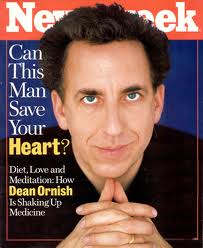
Dean Ornish, M.D.

This past weekend, Dr. Dean Ornish, prominent medical school professor and founder of the Preventive Medicine Research Institute, published a powerful Op-Ed in the New York Times. It was entitled, Eating for Health, Not Weight, and as we stress in our 4Leaf Program and throughout our book, Dr. Ornish emphasizes that what you DO eat is far more important than what you’re avoiding. Like he says in the article:

In 35 years of medical research, conducted at the nonprofit Preventive Medicine Research Institute, which I founded, we have seen that patients who ate mostly plant-based meals, with dishes like black bean vegetarian chili and whole wheat penne pasta with roasted vegetables, achieved reversal of even severe coronary artery disease.

One of the giants in the field of promoting a whole foods, plant-based diet for optimal health, Dr. Ornish is one of my most admired physicians. A few of the highlights of his remarkable career:

    • Recognized as the first physician to reverse heart disease by with lifestyle changes only.
    • Consulted with the Clinton White House and Air Force One to improve the health-promoting qualities of the foods being served.
    • Appeared on cover of Newsweek in 1999; recognized for his work in reversing heart disease.
    • His program for reversing heart disease is one of only two lifestyle programs now eligible for Medicare reimbursement.
    • Along with T. Colin Campbell, PhD, and Dr. Caldwell Esselstyn, Jr.; was one of the three who influenced President Bill Clinton to adopt a near-optimal vegan diet–and reverse his heart disease–in 2010.

No longer eating burgers and fries, Mr. Clinton learned how to reverse his heart disease from his consulting physician, Dr. Dean Ornish.

So what about those cancer genes? That’s something you don’t see in print very often, yet it something that catches our attention. And while most people like to think that the human genome project is going to lead to the cure for cancer, I prefer to listen to the much better news from people like Dr. Ornish. Here’s what he had to say in his article:

Also, we found that it changed gene expression in over 500 genes in just three months, “turning on” genes that protect against disease and “turning off” genes that promote breast cancer, prostate cancer, inflammation and oxidative stress.

We found that this program may also slow, stop or reverse the progression of early stage prostate cancer, as well as reverse the progression of Type 2 diabetes.

How about that! Turning ON the good genes and turning OFF the bad genes—simply by changing your diet. He goes on to say, “WHAT you eat is as important as what you exclude — your diet needs to be high in healthful carbs like fruits, vegetables, whole grains, legumes, soy products in natural, unrefined forms and some fish, like salmon. There are hundreds of thousands of health-enhancing substances in these foods. And what’s good for you is good for the planet.”
Fish? Yes, Dr. Ornish believes it’s okay to have a little fish in your diet. But overall, his recommendations sound identical to our 4Leaf Program which is: “Derive the vast majority of your calories from whole, plant-based foods—not necessarily becoming a vegetarian or a vegan.” In fact, Dr. Ornish provided part of the foundation of our 4Leaf Program; he is part of the “common ground” of knowledge of five pioneering medical doctors featured in Chapter One of our book.
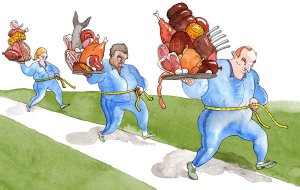
The featured photo in the Op-Ed by Dr. Ornish (See link below to complete article)

Eating for Health, Not Weight. Throughout out book and our 4Leaf Program, we stress the goal as the pursuit of vibrant health. By striving for vibrant health, you simply eat all you want of the right foods and the weight will take care of itself. Effortlessly and permanently. Dr. Ornish reinforces this simple logic in his article as he tells the gory truth about the Atkins-type diets that seem to never go away. He writes:

People are drawn to Atkins-type diets in part because, as the study showed, they produce a higher metabolic rate. But a low-carb diet increases metabolic rate because it’s stressful to your body. Just because something increases your metabolic rate doesn’t mean it’s good for you. Amphetamines will also increase your metabolism and burn calories faster, which is why they are used to help people lose weight, at least temporarily. But they stress your body and may mortgage your health in the progress.

A major research article published recently in the British Medical Journal studied 43,396 Swedish women over 16 years. It concluded that “low carbohydrate-high protein diets … are associated with increased risk of cardiovascular diseases.” An important article in The New England Journal of Medicine examined data from a study showing that high-protein, low-carb diets promote coronary artery disease even if they don’t increase traditional cardiac risk factors like blood pressure or cholesterol levels. A diet low in fat and high in unrefined carbohydrates caused the least amount of coronary artery blockages, whereas an Atkins-type diet caused the most.
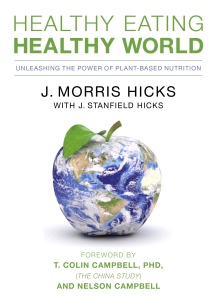
Dr. Dean Ornish wrote the cover endorsement.

The Bottom Line. Forget dieting to lose weight. People who diet to lose weight regain the weight 97% of the time. Much better to follow the advice of people like Dr. Dean Ornish—eat the right food, turn off cancer genes, reverse heart disease and as a fringe benefit, achieve that trim body that you’ve always wanted.

As he summarizes in his article, ” About 75 percent of the $2.8 trillion in annual health care costs in the United States is from chronic diseases that can often be reversed or prevented altogether by a healthy lifestyle. If we put money and effort into helping people make better food and exercise choices, we could improve our health and reduce the cost of health care.”

Finally, I cannot end this article without sharing the fine endorsement that Dr. Ornish wrote for our book. And since we liked it so much, we decided to include it on the front cover. On Healthy Eating, Healthy World, he writes:

“What’s good for you is also good for our planet. Although heart disease and diabetes kill more people each year worldwide than all other diseases combined, these are completely preventable and even reversible for at least 95% of people today by changing our diet and lifestyle. This book shows you how.”

—DEAN ORNISH, MD, Founder, Preventive Medicine Research Institute; Clinical Professor of Medicine, University of California, San Francisco; and author of The Spectrum and Dr. Dean Ornish’s Program for Reversing Heart Disease

Consecutive daily blogs (Numerals from a bottle of Ohio whiskey)

You will want to read Dr. Ornish’s complete article below. Also, I have provided links to several of my earlier blogs that have featured this great American:

Handy 4-piece take-charge-of-your-health kit—from Amazon.com

Want to find out how healthy your family is eating? Take our free 4Leaf Diagnostic Survey. It takes less than five minutes and you can score it yourself. After taking the survey, please give me your feedback as it will be helpful in the development of our future 4Leaf app for smartphones. Send feedback to jmorrishicks@me.com

International. We’re now reaching people in over 100 countries. Follow us on Facebook and Twitter or get daily blog notices by “following” us in the top of the right-hand column. For occasional updates, join our periodic mailing list.

To order more of my favorite books—visit our online BookStore now

J. Morris Hicks, working daily to promote health, hope and harmony on planet Earth.

For help in your own quest to take charge of your health, you might find some useful information at our 4Leaf page or some great recipes at Lisa’s 4Leaf Kitchen.

Got a question? Let me hear from you at jmorrishicks@me.com. Or give me a call on my cell at 917-399-9700.

SHARE and rate this post below.

Blogging daily at hpjmh.com…from the seaside village of Stonington, Connecticut – Be well and have a great day.

—J. Morris Hicks, board member, T. Colin Campbell Foundation
Posted in Activism & Leadership, Cancer, M.D.s---Health-Promoting | Tagged , | 1 Comment

Our Food. A “big picture” view of what’s not working

And a call for HELP from those who can make a difference

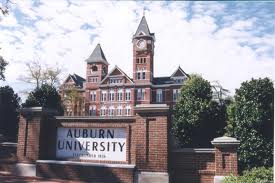
Keeping things simple is a big part of industrial engineering—my field of study at Auburn University. I later earned an MBA from The University of Hawaii. The CEO of the world’s most valuable company is also an Auburn I.E. grad.

Addressed to nutritional scientists everywhere, today’s blog contains a letter that I plan to send to hundreds of professors of nutritional science around the United States. The idea to write such a letter evolved while I was composing my last three blogs:

My primary purpose in this letter is to ask our nation’s nutritional scientists for their help. Through no fault of their own, our feeding model in the western world has sprung a few serious leaks. While preparing my thoughts for my letter and considering the desired tone, I took a look at what I said about our overall “system” in Chapter 8 of our book:

This is not a story of conspiracy or of suspected misconduct on the part of any individual, company, institution, or branch of the government. This is a story of confusion that develops when an enormously complicated and interconnected group of organizations in a free market environment has zero financial incentive to promote the highest possible level of health.

Dr. Nancy Rodriguez, University of Connecticut

My first letter is addressed to Dr. Nancy Rodriguez, Professor in the Department of Nutritional Science at the University of Connecticut. I chose her primarily because of her recent notoriety in the news and also because we reside in the same state.

I first saw Dr. Rodriguez on Larry King Live a few years ago and just last week, saw that she was featured in the Wall Street Journal article about the pros and cons of a vegan diet

In addition to this online version of my letter, I will send a hard copy today via USPS Priority Mail, along with a copy of our book to her office in the UConn Department of Nutritional Sciences in Storrs, CT.

September 25, 2012

Dear Dr. Rodriguez,

As a fellow resident of the great state of Connecticut and one who shares your interest of promoting health around the world, I am writing today to ask you for your help. I am writing to share with you my understanding of a global dilemma that I truly feel is the most important topic in the history of the human race.

I used to say that it was the most important topic in the history of the world, but then I realized that the world has been around for 4 billion years and we humans only 200,000 years. The planet has survived mass extinctions before and will continue to survive—even if we don’t. The question is whether she will be able to provide for the long-term sustainability of the human race. 

First as an industrial engineer, and later as a senior business executive for over thirty years, it was always important to consider the “big picture” impact of any system that we might wish to change or improve. The overall topic for this letter is a critical look at the flawed feeding model that we have embraced in the western world.

How is it flawed? For starters, the way we’re currently eating is not working when it comes to our health. Consider that just 22 years ago, the U.S. obesity average was 12%. By 2005, it almost doubled to 23%. Today it stands at about 36% and is now projected by the Robert Woods Johnson Foundation to hit 44% by 2030. Concurrently, our cost of health care has risen sharply from 5.2% of GDP in 1960 to the 18% that we have today and is forecast to hit 31% by 2035.

In addition to our own health, we must also consider the other global consequences of what we choose to eat. The four most crucial issues to consider are world hunger, the shortage of clean water, the conservation of fossil fuels and the impact that raising of livestock has on global warming. From an engineering perspective, there is no way we could have developed a more inefficient, more harmful and more unsustainable way to feed ourselves. To sum it up, Philip Wollen stated in his powerfully moving video from down under recently,

“If everyone ate the way that we do here in the western world, we’d need two planet Earths to feed us all; we only have one, and she is dying.” 

Please understand that I am not writing to criticize, but rather as an appeal for a collaborative effort to address some serious world issues while there is still time. Today, I write to request three things—that you read our 2011 book (enclosed), that you agree to meet with me in your office, and that you would consider having me as a guest lecturer in some of your classes at UConn.

I began my study of our global feeding model in 2002 and believe that I have now reached a totally unbiased conclusion of what has transpired—as only an outsider can do. As Dr. T. Colin Campbell stated in the foreword of our book regarding my “big picture” view of the world, 

“Too often in a field of study, we rely solely on those people who have established themselves as the inside “experts.” Yet, sometimes the most interesting perspectives are those that come from outside the field. And this is the case here—Jim’s unique perspective has enabled him to tell a story in Healthy Eating, Healthy World that is informative, engaging, and compelling.”

In addition to reading the enclosed book, I encourage you to take a look around my blog-site at hpjmh.com. Since early 2011, I have posted 598 consecutive daily blogs—and all have something to do with my unique “big picture” view. Please call me at your convenience to discuss. You can reach me on my cell phone at 917-399-9700. I look forward to hearing from you soon.

Best regards, J. Morris (Jim) Hicks, PO Box 823, Stonington, CT 

Consecutive daily blogs (numerals today from a British auto tag)

PS: You should know by now that I have become a strong proponent of a whole foods, plant-based diet. Not because I am a scientist or a physician, but because from a comprehensive “big picture” perspective, it just makes sense.

Our proprietary 4Leaf Program was designed as a simple tool to help people maximize the percentage of their calories from whole plants; not necessarily becoming vegetarian or vegan. I am also on the board of directors of the T. Colin Campbell Foundation. For a preview of our book, click on the second link below. 

Handy 4-piece take-charge-of-your-health kit—from Amazon.com

Want to find out how healthy your family is eating? Take our free 4Leaf Diagnostic Survey. It takes less than five minutes and you can score it yourself. After taking the survey, please give me your feedback as it will be helpful in the development of our future 4Leaf app for smartphones. Send feedback to jmorrishicks@me.com

International. We’re now reaching people in over 100 countries. Follow us on Facebook and Twitter or get daily blog notices by “following” us in the top of the right-hand column. For occasional updates, join our periodic mailing list.

To order more of my favorite books—visit our online BookStore now

J. Morris Hicks, working daily to promote health, hope and harmony on planet Earth.

For help in your own quest to take charge of your health, you might find some useful information at our 4Leaf page or some great recipes at Lisa’s 4Leaf Kitchen.

Got a question? Let me hear from you at jmorrishicks@me.com. Or give me a call on my cell at 917-399-9700.

SHARE and rate this post below.

Blogging daily at hpjmh.com…from the seaside village of Stonington, Connecticut – Be well and have a great day.

—J. Morris Hicks, board member, T. Colin Campbell Foundation
Posted in Activism & Leadership | 5 Comments

Money, integrity, science—and the search for the truth about food

Two days ago, I posted a blog entitled, “How many PhDs does it take to figure out what we should eat?” Then yesterday, I published one featuring the fact that President Bill Clinton has chosen to ignore the collective conventional wisdom of the entire world of nutritional science. (See links below)

With industry now controlling our schools of nutrition, is academic freedom dead?

Instead, he chose the simple wisdom of one lone renegade nutritional scientist from Cornell University. Why do I say renegade? Because of the way that he is now treated by the university where he earned his PhD and spent almost his entire career.

As of today, you can hardly find any information about this great man on the Cornell website despite this extremely rare, glowing endorsement from a legendary president of Cornell. As recalled by Dr. Campbell himself:

When the legendary long-term Cornell president Frank Rhodes retired in 1995, he cited Campbell’s China Project in his farewell address to 8,000 people as “one of the greatest embodiments of Cornell excellence to take place during my twenty-two years at the helm of this great institution.”

Cornell excellence? Nowadays, this example of one of the “greatest embodiments of Cornell excellence” seems to have become almost an embarrassment to this great university. Like so many of our elite schools of nutrition, much of their financial support comes from the producers of meat, dairy, eggs and other unhealthy products. So aligning themselves with a scientist who is now recommending the avoidance of ALL of those products is not good for the health of their revenue stream.

For the same reason, a few years ago, this great university suddenly canceled Dr. Campbell’s plant-based nutrition course that he’d been teaching for seven years. They didn’t even give him the courtesy of a phone call to let him know of their decision in advance. This is no way to treat a future Nobel prize winner.

You can study nutritional science in Malibu, CA.

Before it was canceled, it was the only such course offered for credit toward graduation from any accredited school of nutrition in the United States (to his knowledge). Like Cornell, all those other schools are feeding at the trough of the USDA and their misguided food guidelines driven by the special interests of the food producers.

Now, even though the United Nations has formally endorsed a vegan diet for a host of reasons, this travesty continues in our elite schools of nutrition. The U.N. put it this way on their website in a 2010 paper (See link below):

“A global shift towards a vegan diet is vital to save the world from hunger, fuel poverty and the worst impacts of climate change…As the global population surges towards a predicted 9.1 billion people by 2050, western tastes for diets rich in meat and dairy products are unsustainable.”

Academic freedom? To me, this is a sad state of affairs in our overall education system. Because of pressure from our food producers, who provide the funding for our schools of nutrition, “academic freedom” is a thing of the past when it comes to providing our brightest young minds with the information they need to reverse chronic disease, tame our health care monster and preserve the planet’s ability to provide for the longterm sustainability of the human race.

To my knowledge—the ONLY nutrition school in the nation that offers a course in plant-based nutrition. Bravo for Dr. Roman Pawlak for making that happen.

I found one exception. Actually, there is at least one public university that has not succumbed to the financial muscle of the food industry—East Carolina University in Greenville, North Carolina.

One of my readers told me about an associate professor there, Dr. Roman Pawlak (See link below). While speaking with Dr. Pawlak a few weeks ago, I learned that, after consulting with Dr. Campbell several years ago, he developed his own plant-based nutrition course and has been teaching it since. To my knowledge—and his, that is the only such course offered for credit toward graduation in the United States. Let me know if you know of others.

1-9-13 update. Dr. Pawlak has just published a new book, In Defense of Vegetarianism, which you can order by sending an email to him at indefenseofvegetarianism@gmail.com

So the United Nations talks about what we must do to survive, yet our schools of nutrition completely ignore it. What about all of those other nutritional science faculty members across the United States? How can we help them come to understand the harm that has been inflicted on the world because of their failure to consider the “big picture” when making their dietary recommendations.

How can we implore them to consider these four questions as part of their “big picture?”

    • Has heart disease or type 2 diabetes ever been reversed by recommending more consumption of meat and dairy?
    • What do the strongest animals in the world eat, and what do the chimps and the gorillas eat? (the animals whose DNA is closest to ours)
    • How do meat and dairy foods stack up to plant-based when it comes to water consumption/pollution, climate change and energy consumption?
    • Is the American diet (heavy in meat and dairy) sustainable in a world that will soon have 9 billion people? Is there enough land? 

The Bottom Line. Although this is a very difficult mountain to climb, I am going to give it a shot. I am going to start by writing a few letters to some of the nation’s most prominent nutrition professors. In those letters, I am going to try to convey my genuine understanding of the frustrations that they must be feeling—given the overall state of poor health in the United States.

In my home state of Connecticut, my first letter will be addressed to Dr. Nancy Rodriguez, professor.

My first letter will be addressed to Dr. Nancy Rodriguez, professor in the Department of Nutritional Science at the University of Connecticut, just an hour’s drive from my home. I chose her for three reasons: She debated Dr. Campbell on Larry King Live about two years ago, she wrote the opposing view to the vegan diet in the recent Wall Street Journal article, and we both reside in Connecticut.

In that letter, I will mention that I have recently lectured in three university settings, including one in the state system in nearby New Haven, CT. The other two are Holy Cross and the University of Kentucky. None of those lectures were in a department of nutritional science, but rather in other areas related to my favorite topic: the promotion of health, hope and harmony on planet Earth.

Toward the end of my letter, I am going to offer my services as a guest lecturer. Not being a PhD myself, I would label my topic “An industrial engineer’s “big picture” view of a global feeding model that is not working.” The primary point in my letters will be that their “best and brightest” students who have managed to be accepted there—deserve to hear all sides of this crucial subject. (Watch for that letter in tomorrow’s future blog)

Consecutive daily blogs (numerals from the windy city)

A little research. According to the Campus Explorer website (See link below), there are 264 schools of nutrition in the United States and probably well over 10,000 faculty members.

One of those schools is Cornell, which charges undergraduates a tidy $37,750 per year in tuition. You’d think that a good measure of scientific integrity would be included for that kind of money. If I were a parent paying the bill, I would insist on it.

Here are links to U.N. source document, to Dr. Pawlak’s page at ECU and a few of my earlier blogs on this topic.

Handy 4-piece take-charge-of-your-health kit—from Amazon.com

Want to find out how healthy your family is eating? Take our free 4Leaf Diagnostic Survey. It takes less than five minutes and you can score it yourself. After taking the survey, please give me your feedback as it will be helpful in the development of our future 4Leaf app for smartphones. Send feedback to jmorrishicks@me.com

International. We’re now reaching people in over 100 countries. Follow us on Facebook and Twitter or get daily blog notices by “following” us in the top of the right-hand column. For occasional updates, join our periodic mailing list.

To order more of my favorite books—visit our online BookStore now

J. Morris Hicks, working daily to promote health, hope and harmony on planet Earth.

For help in your own quest to take charge of your health, you might find some useful information at our 4Leaf page or some great recipes at Lisa’s 4Leaf Kitchen.

Got a question? Let me hear from you at jmorrishicks@me.com. Or give me a call on my cell at 917-399-9700.

SHARE and rate this post below.

Blogging daily at hpjmh.com…from the seaside village of Stonington, Connecticut – Be well and have a great day.

—J. Morris Hicks, board member, T. Colin Campbell Foundation
Posted in Activism & Leadership, Scientific Integrity | 6 Comments