Especially, if you expect them to prevent the common cold.
 With flu and cold season fast approaching, an article in the San Francisco Chronicle caught my eye and inspired this post.
For the first 58 years of my life, I had my fair share of bouts with the “common cold.” Unfortunately, they were much more common (frequent) than I would have liked. As a young child, I remember the agonizing trips to the doctor to have what seemed like gallons of mucus being sucked from my nostrils by some kind of noisy vacuum apparatus.
During my childhood in Mississippi—colds, fevers, sore throats, and coughs were about as routine as the bacon and eggs we had every morning for breakfast. The only good part of the “common cold” routine was getting to stay home from school.
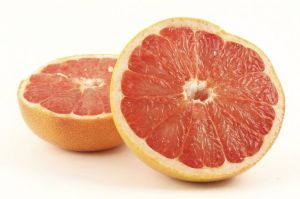
Juicy grapefruit, one of many whole plant sources of Vitamin C—every day, not just when you feel a cold coming on.
Things didn’t get much better as an adult. From ages 19 through 58, I probably averaged 3 or 4 colds or bouts with flu every year—even though I was religious about taking my daily Vitamin C supplements and taking megadoses at the first sign of a cold. I probably wasted a thousand dollars on all those tablets.
Now we have some not-so-great news about Vitamin C. Reported on 10-4-12 in the San Francisco Chronicle (See link below):
After decades and dozens of studies, it appears the idea that vitamin C prevents colds is just an old wives’ tale. But there is some evidence that high doses of the vitamin, which is found in citrus fruit and other produce, may slightly shorten the length of a cold.
So what is a person to do? Well, I can tell you what I did and I can also provide you with some anecdotal information from other members of my family. It’s all about giving your body what it needs to build the strongest possible immune system—to fight flu, viruses, cancers and anything else that might invade your body.
It all begins with what your body needs to optimize your immune system; beginning with the right food for our species. You might say that a strong immune system is a component of vibrant health. In addition to the right food, you also need clean water, fresh air, sunshine (Vitamin D), regular exercise, adequate rest and a positive state of mind. Even with all of the above, some of us still get sick from time to time but not nearly as often—and with much less severity. Here are my personal anecdotes:

Jason and me with Mount Washington. The 4Leaf lifestyle is our best protection against the common cold. (Ages 35 and 63 in this picture)
Myself (67). Since adopting a near optimal diet in 2003, my frequency of colds and flus has gone from about 3 or 4 per year to less than one per year on average.
And, oftentimes, when I feel the early symptoms of a cold, it disappears in less than two days. In the past, whenever I felt those early symptoms, it almost always developed into a horrible 2-week ordeal. FYI, I haven’t had a flu shot in over ten years, and I no longer take any Vitamin C supplements.
My son and co-writer, Jason Hicks (39). He reports that his frequency of colds has dropped 90 percent since adopting the near-optimal 4Leaf lifestyle. His main problem is probably not enough rest as he leads an extremely busy lifestyle.

Dr. Shawn Lankton, my nephew and fellow 4Leaf health enthusiast
My PhD nephew in New York (28). Shawn (shown was mentioned by name in our book. Now, a strategy consultant in New York for a premier international consulting firm, here’s what he reported for our book: “If I get sick, it lasts for about twelve hours (instead of days or weeks). Maybe the most interesting effect is that I feel ‘lighter’—sort of like having a clear sinus as opposed to being stuffed up, but for the whole body. It’s very refreshing.”
Two of my grandsons (Age 10 & 11). These guys live in different homes in the Boston area. The ten-year old eats 4Leaf all the time and is one of the healthiest children in all of New England. The 11-year old eats the Standard American Diet (SAD) most of the time and suffers often (colds, fevers, ear aches, etc.) from its effects–about ten times more frequently than the ten-year old (shown here with me).
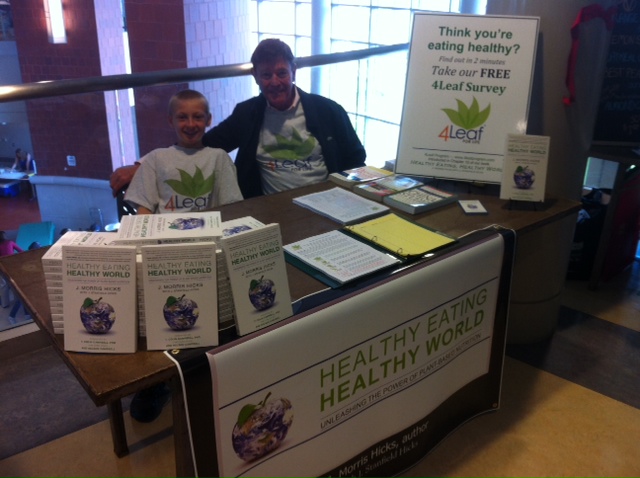
Andrew, my 4Leaf grandson (wearing a 4Leaf shirt) with me at a VegFest in Worcester, MA earlier this year. FYI, he can now outrun his older brother.
I might add that none of us 4Leaf-ers take Vitamin C on a regular basis. But we’re all constantly getting a great quantity of that vital nutrient at almost every meal. My 7 or 8 servings of fruits and green vegetables each day provides me with more Vitamin C in nature’s package every day—than the average American gets in a full month.
Back to the Vitamin C piece in the Chronicle; they really got it right in the last paragraph after emphasizing getting more of this nutrient from foods rather than from pills:
Citrus fruits, dark green vegetables, peppers, strawberries and cantaloupe are all good natural sources of vitamin C, but storage and cooking can take their toll. The longer a food is stored, the more vitamin C it loses, and cooking and steaming dissolves some of the nutrient.
To maximize the vitamin C you get from food, the National Institutes of Health recommend eating fruits and vegetables fresh and raw
- Source document. Vitamin C may shorten cold, not stop it – SFGate.
- Earlier blog. Playing it “safe” with vitamin supplements? Think again!
- Earlier blog. Multivitamins? Harmful, harmless or helpful? Dr. Greger
- Earlier blog. Vitamins…a 27 billion dollar folly?
The Bottom Line. It’s all about your immune system—and your lifestyle choices have a lot to do with how well it functions. Do yourself and your family a favor and make 4Leaf eating a routine habit in your home. And do it now—before your children get too set in their bad habits. While your children are young, you hold the key to the future health of all of your family members who follow you. Do them all a favor and use that key.
Handy 4-piece take-charge-of-your-health kit—from Amazon.com
- The movie that’s changing the lives of millions: Forks Over Knives DVD
- Healthy Eating, Healthy World, The “big picture” about food (our book)
- An essential scientific resource: The China Study by Dr. T. Colin Campbell
- Dr. McDougall’s new book, The Starch Solution, with lots of great recipes.
Want to find out how healthy your family is eating? Take our free 4Leaf Diagnostic Survey. It takes less than five minutes and you can score it yourself. After taking the survey, please give me your feedback as it will be helpful in the development of our future 4Leaf app for smartphones. Send feedback to jmorrishicks@me.com

 International. We’re now reaching people in over 100 countries. Follow us on Facebook and Twitter or get daily blog notices by “following” us in the top of the right-hand column. For occasional updates, join our periodic mailing list.
To order more of my favorite books—visit our online BookStore now

J. Morris Hicks, working daily to promote health, hope and harmony on planet Earth.
For help in your own quest to take charge of your health, you might find some useful information at our 4Leaf page or some great recipes at Lisa’s 4Leaf Kitchen.
Got a question? Let me hear from you at jmorrishicks@me.com. Or give me a call on my cell at 917-399-9700.
SHARE and rate this post below.
Blogging daily at hpjmh.com…from the seaside village of Stonington, Connecticut – Be well and have a great day.
—J. Morris Hicks, board member, T. Colin Campbell Foundation
 We hear news about cancer every day—often many stories on any given day…and not just during October, which is breast cancer month. We’ve become obsessed with cancer and most of us have some kind of personal experience with the disease. We’re either a victim, a survivor, have a loved one with cancer, have friends who are oncologists and/or we’re involved with efforts to raise awareness or funds aimed at finding the cure.
 For this blog, I selected a few recent headlines that tell much of the story themselves. Listed below, each was delivered by a different major news organization (all names that you trust). From the frequency of the news that we see, each of those news companies must have dedicated staff who write nothing but cancer stories. (See links to all below)
 So what does all this mean? To me, it means MONEY. And with cancer, it almost seems like there is no end in sight. From The Economist article: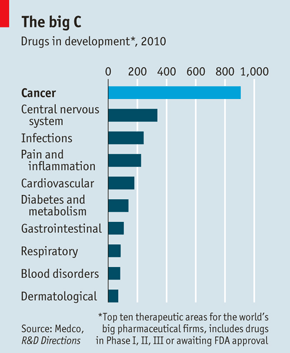
 The Bottom Line. The chart above tells the story. CANCER has almost as many drugs in development as ALL of the nine other leading categories—COMBINED.
 According to the 9-30-12 article, they can help reduce the cost of health care by replacing “fee for service” with “fixed budgets” that reward doctors for delivering less service.


 J. Morris Hicks, engineer. writer. big picture guy.