Too many people, wasting resources, eating the wrong food…

And running out of land as billions go hungry

Last week, while traveling in New York, I bought a Kindle copy of Lester Brown’s new book, Full Planet, Empty Plates and have mentioned it a few times since. Like me, John Robbins, Howard Lyman and a few others—Mr. Brown is trying to alert the world to an impending calamity, the likes of which we have never seen. As the title implies, he is writing about a rapidly approaching catastrophe—when the world runs out of food.
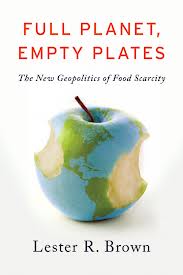
Like ours, Mr. Brown’s book features a single apple on the cover. And like our apple, his tells a story.

But, unlike me, Robbins & Lyman, Mr. Brown focuses primarily on population control as the obvious solution; although he does mention that we affluent members of the human race should try to cut down on our consumption of meat. He also talks about the need for us to wipe out poverty and to discontinue our ill-advised practice of diverting over half of our current corn crop to biofuels—which inadvertently has triggered an increase in the cost of food.

Make no mistake. Mr. Brown has identified many good initiatives that we all should embrace. But his unconvincing argument about us consuming too much meat—weakens the likelihood that he will influence people to take the single most important step that we can make to correct so many things in this world.

And that move is returning to the natural plant-based diet for our species before it’s too late. To be sure, Mr. Brown and I agree on many things—including the urgent focus on sustaining our civilization versus previous emphasis on “saving the planet.” From his bio in the book:

Lester R. Brown is President of Earth Policy Institute, a nonprofit, interdisciplinary research organization based in Washington, D.C., which he founded in May 2001. The purpose of the Earth Policy Institute is to provide a plan for sustaining civilization and a roadmap of how to get from here to there.

Big changes are taking place in terms of the world’s food supply. In the USA, we’re now using over half of our corn crop for biofuels while China is now eating more than twice as much meat as the United States. And most of that meat is pork, which he points out is now the world’s leading meat.
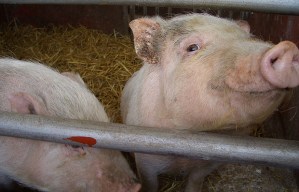
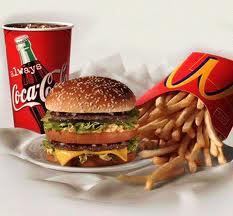
Pigs in China; eating grain imported from Brazil — part of a grossly unsustainable process of feeding humans the wrong food for our species.

In an earlier blog (7-19-11), Burning trees in the Amazon — to feed pigs in China, I described the incredibly wasteful and harmful process of how China is able to consume so much pork.

They don’t have enough land to grow the feed and, since they don’t want to rely on the U.S. and other nations for their pork, they’re now destroying forests in the Amazon—to grow soybeans, which are then shipped to China to feed the pigs.

While sourcing pig feed from around the world, they have increased their annual consumption 600 percent from 9 million tons to 52 million tons in the past 34 years. Can you imagine anything more wasteful and unsustainable? Meanwhile, back to Mr. Brown’s 4-part solution:

On the demand side of the food equation, there are four pressing needs— to stabilize world population, eradicate poverty, reduce excessive meat consumption, and reverse biofuels policies that encourage the use of food, land, or water that could otherwise be used to feed people. We need to press forward on all four fronts at the same time.

The challenge now is to move our early twenty-first-century civilization onto a sustainable path. Every one of us needs to be involved. Environmentalists have talked for decades about saving the planet, but now the challenge is to save civilization itself. We all have a stake in the future of civilization. Many of us have children. Some of us have grandchildren. We know what we have to do. It is up to you and me to do it. Saving civilization is not a spectator sport.

Consecutive Daily Blogs

The Bottom Line. Mr. Brown does a great job of describing a serious global dilemma. And every elected official in the world should be required to read his book. They should also devour the contents of our 4-part package shown below. After doing so, they may all realize that the single most powerful step we can take—to correct many of the most crucial issues our civilization faces—is to work toward a global diet-style of whole, plant-based foods.

That single move would take care of our bankrupting cost of health care, would put a serious dent in our energy consumption and would free up enough land and water to easily feed the world’s 8 or 9 billion people—buying us some time while we all work to stabilize the world’s population.  Click here to purchase Mr. Brown’s new book on Amazon.

Handy 4-piece take-charge-of-your-health kit—from Amazon.com

Want to find out how healthy your family is eating? Take our free 4Leaf Diagnostic Survey. It takes less than five minutes and you can score it yourself. After taking the survey, please give me your feedback as it will be helpful in the development of our future 4Leaf app for smartphones. Send feedback to jmorrishicks@me.com

International. We’re now reaching people in over 100 countries. Follow us on Facebook and Twitter or get daily blog notices by “following” us in the top of the right-hand column. For occasional updates, join our periodic mailing list.

To order more of my favorite books—visit our online BookStore now

J. Morris Hicks, working daily to promote health, hope and harmony on planet Earth.

For help in your own quest to take charge of your health, you might find some useful information at our 4Leaf page or some great recipes at Lisa’s 4Leaf Kitchen.

Got a question? Let me hear from you at jmorrishicks@me.com. Or give me a call on my cell at 917-399-9700.

SHARE and rate this post below.

Blogging daily at hpjmh.com…from the seaside village of Stonington, Connecticut – Be well and have a great day.

—J. Morris Hicks, board member, T. Colin Campbell Foundation
Posted in Activism & Leadership, Sustainability | 5 Comments

Walking for hunger—helping victims; not fixing the problem

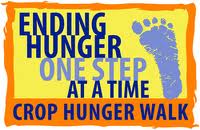
Covering the entire front page of my local newspaper last week was the hunger walk image shown here. It was advertising a local Crop Hunger Walk scheduled to take place in Mystic, CT, on October 14. The article went on to say that over $300,000 had been raised since their first local WALK in 1976. So where does the money go?

It goes to Church World Service (founded 1946) a cooperative ministry of 37 Christian communions working together to eradicate hunger and poverty and promote peace and justice among the world’s most vulnerable people.

The good news here is that people everywhere want to help. They give their time, they donate their money and they organize events like this one to encourage others to do the same. The problem is that there is a much larger picture that few people anywhere truly understand—including our world leaders.

In a nutshell, that big picture is that we are rapidly approaching the physical capacity of our planet to sustain a steadily growing population who are consuming the highly inefficient meat & dairy-based western diet in ever increasing numbers. The first big problem is population growth. And the second big problem is that the way we are living & eating is simply unsustainable.

But the people who are “walking for hunger” don’t understand that “big picture” — and the money they raise is primarily spent on helping the victims of our excessive population growth and unsustainable lifestyle. Their walking is doing nothing to fix the underlying problem.

Like ours, Mr. Brown’s book features a single apple on the cover. And like our apple, his tells a story.

As I said, the first piece of our problem is population growth—growing from one billion in 1804 to the seven billion that we have today. An excerpt from Lester Brown’s new book, Full Planet, Empty Plates.

One of the consequences of this explosive growth in human numbers is that human demands have outrun the carrying capacity of the economy’s natural support systems— its forests, fisheries, grasslands, aquifers, and soils.

Once demand exceeds the sustainable yield of these natural systems, additional demand can only be satisfied by consuming the resource base itself. We call this overcutting, overfishing, overgrazing, overpumping, and overplowing. It is these overages that are undermining our global civilization.

Our wasteful lifestyles. The other part of our “big picture” global problem is the way we live and eat in the western world. Our large homes, with big lots and requiring lots of driving for basic needs is a problem that can not be easily solved anytime soon. But an even bigger problem is one that could be resolved in a much shorter time-frame. That problem is our incredibly wasteful way of eating.

The typical western diet; a disaster for your health, your environment and the long-term sustainability of the human race.

Our typical western diet that over 90% of Americans are eating is not only undermining our health, it is wasting our precious natural resources at an incredible pace. Compared to a powerful health-promoting diet of mostly whole plant foods, our meat & dairy-based western diet (on a per calorie basis) requires over ten times as much water, ten times as much energy and ten times as much land.

That coupled with the fact that the world has an additional 219,000 people at the dinner table each night, spells disaster like we have never seen. Meanwhile, those kind and generous people who’re out walking for hunger—are unaware of these facts as they innocently continue eating that same wasteful & unsustainable diet themselves while raising money to help the victims of all of the above in some faraway land.

Consecutive Daily Blogs (numerals from Israel)

As Gandhi said, “we must be the change we want to see in this world.” And this begins with education. Our world leaders must come go grips with the reality of what is happening on this planet. Click here to purchase Lester Brown’s powerful new book on Amazon.

Handy 4-piece take-charge-of-your-health kit—from Amazon.com

Want to find out how healthy your family is eating? Take our free 4Leaf Diagnostic Survey. It takes less than five minutes and you can score it yourself. After taking the survey, please give me your feedback as it will be helpful in the development of our future 4Leaf app for smartphones. Send feedback to jmorrishicks@me.com

International. We’re now reaching people in over 100 countries. Follow us on Facebook and Twitter or get daily blog notices by “following” us in the top of the right-hand column. For occasional updates, join our periodic mailing list.

To order more of my favorite books—visit our online BookStore now

J. Morris Hicks, working daily to promote health, hope and harmony on planet Earth.

For help in your own quest to take charge of your health, you might find some useful information at our 4Leaf page or some great recipes at Lisa’s 4Leaf Kitchen.

Got a question? Let me hear from you at jmorrishicks@me.com. Or give me a call on my cell at 917-399-9700.

SHARE and rate this post below.

Blogging daily at hpjmh.com…from the seaside village of Stonington, Connecticut – Be well and have a great day.

—J. Morris Hicks, board member, T. Colin Campbell Foundation
Posted in Sustainability, World Hunger | 4 Comments

“Carnivores Next Door”—as the world runs out of space

With a caption of “Coming soon to your neighborhood, mountain lions,” this article reports on the wild animals that are already living in our urban space.

Have you heard about the animals that have been taking up residence in our human space? First raccoons, then coyotes, and more to follow.

But, they didn’t begin their invasion until we had commandeered their spaces for our homes, shopping centers, schools, freeways, farms, ballparks, factories and cities. A 10-5-12 article in National Geographic reported:

First it was the raccoons. Next came the coyotes. And then? Bigger carnivores. Urban and suburban areas in North America are home to a lot of small, wild predators, and now scientists believe that the coyote’s success in adapting to an urban lifestyle could pave the way for larger carnivores to move in.

“The funny thing is that now we have more people on Earth and bigger cities than ever, we also now have carnivores moving into cities. It’s a two-way street: We’re expanding cities into their territories and they’re also coming in,” said Gehrt, who also holds appointments with the Ohio Agricultural Research and Development Center and Ohio State University Extension.

Like ours, Mr. Brown’s book features a single apple on the cover. And like ours, his apple tells a story.

Yes we do have a lot more people on Earth. After taking 200,000 years to reach 1 billion humans, we’ve been adding another billion every 13 years most recently; adding a new six billion humans in just a little over 200 years. But, having coyotes taking up residence in our backyards is the least of our problems. As Lester Brown explains in his new book, Full Planet, Empty Plates:

One of the consequences of this explosive growth in human numbers is that human demands have outrun the carrying capacity of the economy’s natural support systems— its forests, fisheries, grasslands, aquifers, and soils.

Once demand exceeds the sustainable yield of these natural systems, additional demand can only be satisfied by consuming the resource base itself. We call this overcutting, overfishing, overgrazing, overpumping, and overplowing. It is these overages that are undermining our global civilization.

Our precious planet is like this lily pond—it is just about full.

Mr. Brown paints a pretty grim picture in his book, noting that just a 3% annual growth rate will produce a 20-fold in just 100 years. In Chapter 2, he explains how the French use a riddle to teach this exponential growth concept to schoolchildren and the grim reality that it bodes for our future on this planet:

A lily pond, so the riddle goes, contains a single leaf. Each day the number of leaves doubles— two leaves the second day, four the third, eight the fourth, and so on. Question: “If the pond is full on the thirtieth day, at what point is it half full?” Answer: “On the twenty-ninth day.” Our global lily pond may already be in the thirtieth day.

Lester Brown has been trying to warn all of us for most of his career. We had better start listening soon.

In other words, our planet is currently housing about all of the humans that she can handle; particularly when you consider how inefficiently we live and eat. Lester Brown has been writing about the environment and our food supply for many years and I have featured him in my blogs from time to time. A portion of his bio summary from his new book:

Lester R. Brown is President of Earth Policy Institute, a nonprofit, interdisciplinary research organization based in Washington, D.C., which he founded in May 2001. The purpose of the Earth Policy Institute is to provide a plan for sustaining civilization and a roadmap of how to get from here to there.

He has been described as “one of the world’s most influential thinkers” by the Washington Post. He was the Founder and President of the Worldwatch Institute during its first 26 years. During a career that started with tomato farming, Brown has authored or coauthored many books and been awarded 25 honorary degrees. With books in more than 40 languages, he is one of the world’s most widely published authors.

After reading his work for the past few years, I have become even more convinced that our only feasible solution to our overcapacity dilemma is a well-planned, aggressive move in the direction of a plant-based diet for humans. But, he comes up short when it comes to what I call that urgent, “blinding flash of the obvious” plant-based solution—although he does a fabulous job of explaining the problem that all of us Earthlings face.

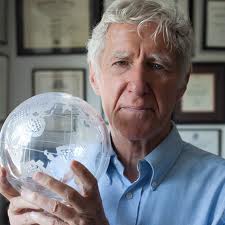
Meet Lester Brown in this short video.

The Bottom Line. Although I haven’t finished reading his book, I am recommending that you buy it—for less than $10 in the Kindle format. His book reinforces what I have been writing about for 612 consecutive days. Because of our own selfish behavior in the past 100 years, we may have compromised our planet’s ability to sustain our species longterm. Click here to purchase this powerful book on Amazon.

Consecutive Daily Blogs (numerals from New Jersey, where there is not much land left for wildlife.

Handy 4-piece take-charge-of-your-health kit—from Amazon.com

Want to find out how healthy your family is eating? Take our free 4Leaf Diagnostic Survey. It takes less than five minutes and you can score it yourself. After taking the survey, please give me your feedback as it will be helpful in the development of our future 4Leaf app for smartphones. Send feedback to jmorrishicks@me.com

International. We’re now reaching people in over 100 countries. Follow us on Facebook and Twitter or get daily blog notices by “following” us in the top of the right-hand column. For occasional updates, join our periodic mailing list.

To order more of my favorite books—visit our online BookStore now

J. Morris Hicks, working daily to promote health, hope and harmony on planet Earth.

For help in your own quest to take charge of your health, you might find some useful information at our 4Leaf page or some great recipes at Lisa’s 4Leaf Kitchen.

Got a question? Let me hear from you at jmorrishicks@me.com. Or give me a call on my cell at 917-399-9700.

SHARE and rate this post below.

Blogging daily at hpjmh.com…from the seaside village of Stonington, Connecticut – Be well and have a great day.

—J. Morris Hicks, board member, T. Colin Campbell Foundation

Posted in Sustainability, World Hunger | Tagged | Leave a comment