Beginning with Alzheimer’s; a new alphabetical listing

Welcome to the first PAGE of my new Diseases section of this site.
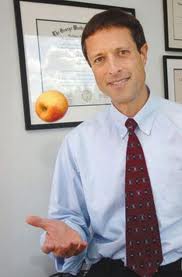
Dr. Neal Barnard, one of the brave medical pioneers featured in our book.

Dr. Neal Barnard, one of the five enlightened medical doctors feature in our book.

After following the fine work of Dr. Neal Barnard for almost ten years, I finally met him for the first time in November of 2012. Toward the end of that meeting, he told us that while he is still trying to spread the word about reversing diabetes, his new passion is better understanding Alzheimer’s and teaching people how to prevent it with a near-optimal diet.

Apparently, there is a relationship between diabetes and Alzheimer’s. This explains why several of the blogs listed below also deal with diabetes.The following blogposts are listed in reverse chronological order (most recent first).

I will point out that #4 and #5 deal exclusively with Alzheimer’s. In particular, #5 was the first blog where I featured one of Dr. Michael Greger’s videos. That blog begins with a summary of Dr. Greger’s background and includes this statement from his blog:

We’ve known for almost 20 years that compared to long-time vegetarians, those eating meat (including poultry and fish) appear to have three times the risk of developing dementia. Since studies show “even moderately elevated cholesterol increased dementia risk,” the cognitive impairment more often seen in those eating meat may be due to atherosclerotic plaque building in the brain’s blood vessels, which can cause micro-infarctions or “ministrokes” that can kill off little parts of the brain the way clogged coronary arteries can kill off parts of the heart during a heart attack.

Here are my five previous blogposts dealing at least in part with Alzheimer’s. Each of them have links to other related blogs.

  1. Reversing diabetes. Mainstream medicine still not listening (11-28-12)
  2. Connecting the dots: FOOD . obesity . diabetes . Alzheimer’s! (9-27-2012)
  3. For your friends and family with type 2 diabetes (6-22-12, inspired by a New York Times article about the link between diabetes and memory problems)
  4. Alzheimer’s Prevention (with drugs)—the big story this week (5-17-12)
  5. Alzheimer’s, like heart disease, may need never exist. (9-7-11)

Click here to view the list of other “diseases” that will posted soon.

About AlzheimersThis content of this blogpost also appears on this site as a page—and is the first one on the drop-down list under my new Diseases tab just under the banner. This new page was established to help my readers quickly find information on the most common diseases—that can be prevented or eliminated with a whole foods, plant-based diet. As I add more information, these pages will be updated.

Consecutive daily blogs

Consecutive daily blogs

Please forward this blog to anyone you know that may be interested in learning more about the causes and prevention of Alzheimer’s Disease. As for Dr. Barnard, he is the Founder and the President of the Physicians Committee for Responsible Medicine. He has authored many books and he also wrote the following endorsement for our book:

Healthy Eating, Healthy World is more than an eye-opening, fact-filled book about the causes of poor health. It is a map leading directly to the cure. In the process, it points the way toward solving the seemingly unrelated problems of environmental destruction and world hunger. It is sensible, direct, and right.”

—NEAL D. BARNARD, MD,President, Physicians Committee for Responsible Medicine

Handy 4-piece take-charge-of-your-health kit—from Amazon.com

Want to find out how healthy your family is eating? Take our free 4Leaf Diagnostic Survey. It takes less than five minutes and you can score it yourself. After taking the survey, please give me your feedback as it will be helpful in the development of our future 4Leaf app for smartphones. Send feedback to jmorrishicks@me.com

International. We’re now reaching people in over 100 countries. Follow us on Facebook and Twitter or get daily blog notices by “following” us in the top of the right-hand column. For occasional updates, join our periodic mailing list.

To order more of my favorite books—visit our online BookStore now

J. Morris Hicks, working daily to promote health, hope and harmony on planet Earth.

For help in your own quest to take charge of your health, you might find some useful information at our 4Leaf page or some great recipes at Lisa’s 4Leaf Kitchen.

Got a question? Let me hear from you at jmorrishicks@me.com. Or give me a call on my cell at 917-399-9700.

SHARE and rate this post below.

Blogging daily at hpjmh.com…from the seaside village of Stonington, Connecticut – Be well and have a great day.

—J. Morris Hicks, board member, T. Colin Campbell Foundation
Posted in Alzheimer's Disease | Leave a comment

Does being fat make you live longer? (Blog # 700)

That’s the question the average consumer is now confused about.

700

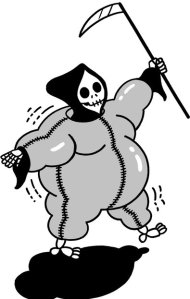
The gist of the article is our "fear of fat." This was the image in the New York Times.

The gist of the article is our “fear of fat.” This was the image in the New York Times.

—My 700th consecutive daily blog— No doubt you’ve heard the news story about obesity not being as deadly as we thought. With uncanny timing at the beginning of “diet and weight-loss season,” they’re now telling us this— from a recent study:

All adults categorized as overweight and most of those categorized as obese have a lower mortality risk than so-called normal-weight individuals.

This news was based on the release of a meta study published in the Journal of American Medical Association (JAMA). The study reviewed data from nearly 100 large epidemiological studies from around the world.

And the news has caught everyone’s attention. It’s been on the morning news, the evening news and now on the opinion page of the New York Times. The newscasters have all been grinning when they reported this news and overweight people everywhere have been breathing a sigh of relief.

Another example of confusion over clarity. People everywhere are now hearing that there’s nothing wrong with being a little overweight or even obese. This study is simply adding more confusion to the mix at a time when obesity levels are reaching epidemic levels. And people everywhere will have the same reaction:

“Good news! They’re now saying that being a little overweight is good for you—actually lowering your risk of death.”

Here’s the problem. We have created the perception in this country that the main driver of all of our health problems is obesity. And if we could just lower our weight—by whatever means—that all of our health problems will disappear.

Eat the right food (whole plants) and your weight will take care of itself.

Eat the right food (whole plants) and your weight will take care of itself.

But, obesity has never been the main problem. The blinding flash of the obvious problem has always been that we’re eating the wrong food. Focusing on weight-loss has never worked when trying to solve health issues. We all know the stats for weight-loss diets—they fail about 97% of the time.

It’s the food, stupid. That’s why we hardly even mentioned weight-loss when we created the 4Leaf for Life approach to the promotion of health. At the top of our 4Leaf chart, we have always stressed that effortless weight-loss is just a bonus—your body naturally seeks its ideal weight if you just eat the right foods. From our 4Leaf chart:

In Pursuit of Vibrant Health!

Effortless weight-­loss is just a bonus. All is based on leveraging the simple, yet powerful, concept of maximizing the percent of your calories from whole, plant-based foods—still in nature’s package.

NY Times LogoThe author of the New York Times article, Paul Campos, a professor of law at the University of Colorado—got it right when he made this statement later in the article:

In reality, of course, it would be nonsensical to tell so-called normal-weight people to try to become heavier to lower their mortality risk. Such advice would ignore the fact that tiny variations in relative risk in observational studies provide no scientific basis for concluding either that those variations are causally related to the variable in question or that this risk would change if the variable were altered.

But the damage has already been done, people everywhere are thinking what they always think—that the news and the rules are constantly changing. For over forty years, we’ve been warning people about obesity, now we’re telling them it may help them live longer. We’re reinforcing their likelihood to just keep on eating what they’re eating.

My son Jason lost 20 pounds he didn't know he had to lose---when he got serious about 4Leaf eating.

My son Jason lost 20 pounds he didn’t know he had to lose—when he got serious about 4Leaf eating.

The Bottom Line. We’re emphasizing the wrong things when it comes to health. While we should be telling the public EXACTLY what they should be eating to be healthy, we’re not even scratching the surface.

The beautiful simplicity is that people can eat all they want of the most nutritious of foods (whole plants) and their bodies will seek their ideal weight—effortlessly and permanently. And I seriously doubt that the ideal weight for anyone is one that would be classified as obese.

Want to finish up with a hefty dose of clarity on this topic? Take a look at my related blogs listed below:

Handy 4-piece take-charge-of-your-health kit—from Amazon.com

Want to find out how healthy your family is eating? Take our free 4Leaf Diagnostic Survey. It takes less than five minutes and you can score it yourself. After taking the survey, please give me your feedback as it will be helpful in the development of our future 4Leaf app for smartphones. Send feedback to jmorrishicks@me.com

International. We’re now reaching people in over 100 countries. Follow us on Facebook and Twitter or get daily blog notices by “following” us in the top of the right-hand column. For occasional updates, join our periodic mailing list.

To order more of my favorite books—visit our online BookStore now

J. Morris Hicks, working daily to promote health, hope and harmony on planet Earth.

For help in your own quest to take charge of your health, you might find some useful information at our 4Leaf page or some great recipes at Lisa’s 4Leaf Kitchen.

Got a question? Let me hear from you at jmorrishicks@me.com. Or give me a call on my cell at 917-399-9700.

SHARE and rate this post below.

Blogging daily at hpjmh.com…from the seaside village of Stonington, Connecticut – Be well and have a great day.

—J. Morris Hicks, board member, T. Colin Campbell Foundation

Posted in Uncategorized | 6 Comments

Home-Made Hummus, Smoothies and More

Joanne Irwin

Joanne Irwin

After ten years of eating a near optimal, whole foods, plant-based 4Leaf kind of diet, I have made some significant improvements for 2013. It all began when I saw Joanne Irwin conduct a “PCRM Cancer Project class and cooking demo” on Cape Cod back in October.

I saw how easy it was for Joanne to prepare that fresh home-made hummus; she also inspired me to start including smoothies as a routine in my life. Up until then, I had been consuming store-bought hummus that contains way too much olive oil, tahini and fat—and with enough preservatives to make it last as long as a Twinkie.

So when I got back home, I dug around in my basement for a “mini food processor” someone had given me a few years ago. After discovering that it was missing the top, I ordered a new mini-Cuisinart for less than $50.

My unit came with two containers and two sets of blades.

My unit came with two containers and two sets of blades.

Then, during a visit to my daughter’s house in Georgia in early December, she showed me her brand new Ninja processor. She said that it had great consumer reviews (about the same as Vitamix) but at a fraction of the cost. So I ordered one and have started making hummus and smoothies on a regular basis.

This is the unit that I bought. Just checked and it can be purchased on Amazon for $45 delivered (if you have Prime). Click here if you’d like to purchase this unit on Amazon.

Fresh Hummus. Not being a big recipe guy, I just play around with the ingredients that I like until I settle on what works for me. For hummus, I start with fresh chickpeas in a bag. After soaking them overnight, I simmer them for about 45 minutes the next day. I then put half the batch in the freezer and make fresh hummus with the other half.

My Ninja on the kitchen counter with the hummus all ready to process.

My Ninja on the kitchen counter with the hummus all ready to process. Notice the motor sits on top so the food goes easily to the bottom without having to push it.

Yesterday, I put my chickpeas and about a half cup of water in the bottom of the pitcher. Then I added five collard leaves followed by some Braggs Liquid Aminos, lime juice, one plum tomato, and five olives. Less than one-half minute later, I had enough fresh hummus for two days. I find that it tastes better when fresh, so I keep my batches small.

Healthy Smoothies. When I first started eating a superior diet in 2003, I bought a Jack LaLanne Juicer and used it for several years. Ultimately, I got tired of wasting all that fiber and cleaning the juicer—so I retired it to my basement. Now, with my new Ninja, I find that I don’t waste the fiber, I can combine fruits and veggies and the clean-up is nothing but a quick rinse with warm water.

Yesterday, my smoothie of the day included one cup of frozen blueberries, one frozen banana, four large collard leaves, and one pear—mixed in one half cup of water and one half cup of unsweetened vanilla flavored almond milk. Very tasty, very easy and super healthy anytime of day. Both my hummus and my smoothies are high in the 4Leaf range with well over 90% of the calories from whole, raw plants.

Consecutive daily blogs

Consecutive daily blogs

The Bottom Line. Great value, great nutrition, lots of fiber and hassle-free. But it’s not a Vitamix. My son said that my hummus and smoothies were not quite as “smooth” as the ones he makes on his Vitamix—but he said that my little Ninja did a very nice job—at a fraction of the price of his processor.

Still using canned beans and chickpeas in your recipes? You will probably shift to the much “greener,” cheaper and healthier dry bags of beans after reading this first blog.

Handy 4-piece take-charge-of-your-health kit—from Amazon.com

Want to find out how healthy your family is eating? Take our free 4Leaf Diagnostic Survey. It takes less than five minutes and you can score it yourself. After taking the survey, please give me your feedback as it will be helpful in the development of our future 4Leaf app for smartphones. Send feedback to jmorrishicks@me.com

International. We’re now reaching people in over 100 countries. Follow us on Facebook and Twitter or get daily blog notices by “following” us in the top of the right-hand column. For occasional updates, join our periodic mailing list.

To order more of my favorite books—visit our online BookStore now

J. Morris Hicks, working daily to promote health, hope and harmony on planet Earth.

For help in your own quest to take charge of your health, you might find some useful information at our 4Leaf page or some great recipes at Lisa’s 4Leaf Kitchen.

Got a question? Let me hear from you at jmorrishicks@me.com. Or give me a call on my cell at 917-399-9700.

SHARE and rate this post below.

Blogging daily at hpjmh.com…from the seaside village of Stonington, Connecticut – Be well and have a great day.

—J. Morris Hicks, board member, T. Colin Campbell Foundation
Posted in Recipes & meals | 5 Comments