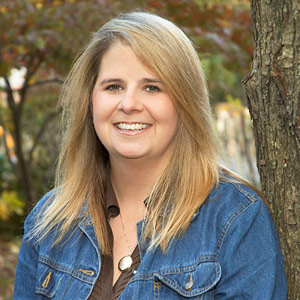
Speaking to 220 sixth-graders in New London, Connecticut

Food Math 101, a course that’s never been taught anywhere
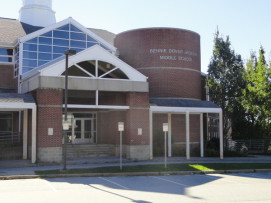
Bennie Dover Jackson Middle School of New London, CT

Bennie Dover Jackson Middle School of New London, CT

On Tuesday, April 2, I delivered the first of four presentations to the sixth grade class at Bennie Dover Jackson Middle School in New London, CT. We invited various elected officials as well as the local and state media. My presentation was entitled:

Food Math 101, The numbers behind what we’re eating are not adding up. What can we do about it?

The presentation began with “The Big Picture” of how we humans fit into the ancient (4.6 billion year) history of planet Earth. Although our species has only been around for less than 1/100th  of one percent of the time that the Earth has been supporting life, we have inflicted more damage on the fragile harmony of nature in just the last fifty years—than all previous generations of humans combined—for the last 200,000 years.

The 75-minute time slot was filled with lots of audience participation as the entire class learned about how our food choices affect crucial issues like world hunger, global warming, and the skyrocketing cost of health care. They all learned how a simple improvement of their diet can have profound effects on many global issues that threaten the longterm sustainability of our species.
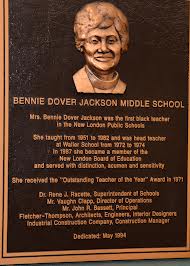
As you can see from this plaque, this special woman was the first African American to teach in the New London School system---in the 1950s.

As you can see from this plaque, this special woman was the first African American to teach in the New London School system—in the 1950s.

Maybe this series of presentations will be the first of many. As I mentioned in my presentation notes for the first slide:

This second day of April, 2013, could be the start of something big. You may very well be the first 6th grade class in the history of the United States to receive this kind of training. Something big can start right here at the Bennie Dover Jackson Middle School. Something that could spread first to the 7th and 8th grades here, then to the other schools in the county, then the state. Who knows? Maybe some of you will go on TV with Oprah someday and tell your story to the entire world.

At the end of the presentation, my CALENDAR QUIZ was conducted as a team effort. There were twelve questions and all students whose birthday falls in January shared their answer to the first question with the rest of the class. The February group handled the second question and so forth. At the completion of the “Calendar Quiz,” the students were told that by completing the Food Math 101 mini-seminar:

  • You have learned the simple truth about promoting health…
  • And how our food choices impact their requisite resources: land, water and energy.
  • You have also learned how those same food choices impact HUGE issues like world hunger, global warming, the cost of health care and much more.

Media coverage. Julienne Hanckel of the New London Day wrote a nice article after entering some of the kids following the presentation. It was published on April 8 and can be seen here. Reprint of New London Day article re Bennie Dover Jackson Middle School April 2-5, 2013. Click here for link to the actual article in The Day.

Click here to view a PDF of my entire 75-slide PowerPoint Presentation. Comprised of mostly pictures, it is a large file and may take a minute or so to download.

Two minutes of video from my Bennie Dover Jackson presentations of Food Math 101 in April of 2013, New London, CT.

School lunches. Sadly, our school lunch programs seem to be “owned” by the dairy industry. I posted this blog after reading about the new “vegetarian” lunch program at PS 244 in Queens, NY. In New London and in Queens, you will see photos of the ubiquitous “dairy” ingredients in an otherwise healthy dish. School Lunches. Not Great—but more good news than bad.

Handy 4-piece take-charge-of-your-health kit—from Amazon.com

Want to find out how healthy your family is eating? Take our free 4Leaf Survey. It takes less than five minutes and you can score it yourself. After taking the survey, please give me your feedback as it will be helpful in the development of our future 4Leaf app for smartphones. Send feedback to jmorrishicks@me.com

International. We’re now reaching people in over 100 countries. Follow us on Facebook and Twitter or get daily blog notices by “following” us in the top of the right-hand column. For occasional updates, join our periodic mailing list.

To order more of my favorite books—visit our online BookStore now

J. Morris Hicks, working daily to promote health, hope and harmony on planet Earth.

For help in your own quest to take charge of your health, you might find some useful information at our 4Leaf page or some great recipes at Lisa’s 4Leaf Kitchen.

Got a question? Let me hear from you at jmorrishicks@me.com. Or give me a call on my cell at 917-399-9700.

SHARE and rate this post below.

—J. Morris Hicks, board member, T. Colin Campbell Foundation
Posted in Big Picture, Children, Sustainability | 7 Comments

Weight-loss and the deadly world of personal health journalism

“Survival of the wrongest”

CJR ColumbiaThat was the title of an article that appeared in the Columbia Journalism Review earlier this year (January 2013, see link below). It was written by David H. Freedman, a contributing editor at The Atlantic, and a consulting editor at Johns Hopkins Medicine International and at the McGill University Desautels Faculty of Management.

He begins by citing a well-written, well-research 6,000-word article by Taylor Parker-Pope that was published in the New York Times in late 2011. After acknowledging the excellence of the article in a multitude of ways, he adds the following paragraph:

There’s really just one problem with Parker-Pope’s piece: Many, if not most, researchers and experts who work closely with the overweight and obese would pronounce its main thesis—that sustaining weight loss is nearly impossible—dead wrong, and misleading in a way that could seriously, if indirectly, damage the health of millions of people.

Tara Parker-Pope is the editor of the Well blog at The  New York Times

Tara Parker-Pope is the editor of the Well blog at The New York Times—earning a nice living doing exactly what her editors expect her to do.

In her article (See link below), Parker-Pope had laid out the scientific evidence that maintaining weight loss is a nearly impossible task—something that hardly anyone can accomplish. Freedman elaborates:

The article is crammed with detailed scientific evidence and quotes from highly credentialed researchers. It’s also a compelling read, thanks to anecdotal accounts of the endless travails of would-be weight-losers, including Parker-Pope’s own frustrating failures to remove and keep off the extra 60 pounds or so she says she carries.

In short, it’s a well-reported, well-written, highly readable, and convincing piece of personal-health-science journalism that is careful to pin its claims to published research.

Aha, notice the highlighted phrase above about Parker-Pope’s problems with her own weight. I just read her entire article and totally understand why she came to the conclusions that she did.

She’s been a victim of the same weight-loss hoax that I have written about in our book and numerous times on this blog. Diets to lose weight do not work. The weight comes back over 95% of the time, yet Americans continue to spend some $50 billion a year on a process that hardly ever works.

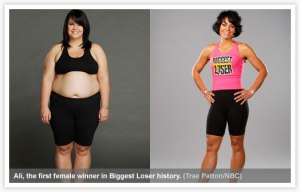
First female winner on the Biggest Loser. Wonder how she is doing today?

First female winner on the Biggest Loser. Wonder how she is doing today?

Why is that? It’s because we continue to glamorize the process in prime-time shows like The Biggest Loser. And there’s a new magic weight-loss book coming out every week.

Parker-Pope describes one ridiculous weight-loss example in her article:

Beginning in 2009, he and his team recruited 50 obese men and women. The men weighed an average of 233 pounds; the women weighed about 200 pounds.

Although some people dropped out of the study, most of the patients stuck with the extreme low-calorie diet, which consisted of special shakes called Optifast and two cups of low-starch vegetables, totaling just 500 to 550 calories a day for eight weeks. Ten weeks in, the dieters lost an average of 30 pounds. —- Then, most of them gained it all back.

Leveraging the simple, yet powerful concept of maximizing the percent of your calories from whole plant foods -- still in nature's package

Apparently Tara hasn’t heard about the 4Leaf approach to vibrant health, focusing on 2 words: WHOLE PLANTS

It’s not Tara’s fault. So what does that prove? Absolutely nothing. Tara Parker-Pope is just doing her job, trying to earn a living and keep her bosses at the New York Times happy. She is one of thousands of people out there writing about health and, through no fault of her own, she is preventing many people from learning the truth about nutrition.

Maybe out of her own ignorance, she fails to explain how effortless and permanent weight-loss typically follows a lifestyle shift that focuses on whole, plant-based foods as the primary fuel that nature intended for us to burn.

Freedman summarizes the personal health journalism problem thusly:

Health journalists are taking advantage of the wrongness problem. Presented with a range of conflicting findings for almost any interesting question, reporters are free to pick those that back up their preferred thesis—typically the exciting, controversial idea that their editors are counting on.

When a reporter, for whatever reasons, wants to demonstrate that a particular type of diet works better than others—or that diets never work—there is a wealth of studies that will back him or her up, never mind all those other studies that have found exactly the opposite (or the studies can be mentioned, then explained away as “flawed”). For “balance,” just throw in a quote or two from a scientist whose opinion strays a bit from the thesis, then drown those quotes out with supportive quotes and more study findings.

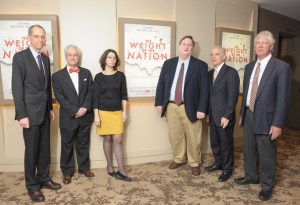
Guess which one is the nation's foremost authority on obesity---from Yale University?

Guess which one is the nation’s foremost authority on obesity—from Yale University? Think khaki pants.

The Bottom Line. We cannot depend on any part of our extended healthcare system to steer us on the right path to vibrant health. Reading these articles today reminded me of a blog I wrote last year following the HBO special entitled, “The Weight of the Nation.”

I later wrote a blog about the “three generals” in charge of our army that is fighting obesity. Links to both of those blogs are provided below. As for my use of the word “deadly” in the title, Mr. Freedman implies that many people are dying in our country because of the “confusing” messages about their health that they get from well-intentioned journalists.

While 70 to 80% of our cost of health care is driven by our toxic western diet—rare is the journalist that provides the clarity that we so desperately need to avoid or reverse the chronic diseases that account for most deaths. Mark Bittman and Jane Brody (of The New York Times) provide occasional clarity, but then usually contradict themselves a few days later.

If you’re looking for “clarity” on a regular basis, check out the other 800 blogposts and pages on this site. And give me a call if you’d like for me to speak at your venue. Next week, I am scheduled to speak to 220 sixth grade students at a middle school in New London, CT (over a period of four days). Click here for a look at my PowerPoint slides for those presentations. Credit for this blog idea goes to my friend Bernadine in Stonington, CT.

Handy 4-piece take-charge-of-your-health kit—from Amazon.com

Want to find out how healthy your family is eating? Take our free 4Leaf Survey. It takes less than five minutes and you can score it yourself. After taking the survey, please give me your feedback as it will be helpful in the development of our future 4Leaf app for smartphones. Send feedback to jmorrishicks@me.com

International. We’re now reaching people in over 100 countries. Follow us on Facebook and Twitter or get daily blog notices by “following” us in the top of the right-hand column. For occasional updates, join our periodic mailing list.

To order more of my favorite books—visit our online BookStore now

J. Morris Hicks, working daily to promote health, hope and harmony on planet Earth.

For help in your own quest to take charge of your health, you might find some useful information at our 4Leaf page or some great recipes at Lisa’s 4Leaf Kitchen.

Got a question? Let me hear from you at jmorrishicks@me.com. Or give me a call on my cell at 917-399-9700.

SHARE and rate this post below.

—J. Morris Hicks, board member, T. Colin Campbell Foundation
Posted in Weight-Loss | 2 Comments

“My space is small. My life is big.”—Graham Hill

That was the closing line in Mr. Hill’s recent Op-Ed piece.

Graham Hill

Graham Hill, founder of TreeHugger.com

And the entire article (see link below) resonated with me. After accumulating a ridiculous amount of STUFF by the time I was fifty, I have spent the last eighteen years simplifying my life. When I was fifty, I had just left a senior executive position with Ralph Lauren making a hefty sum of money—which I had managed to spend in the accumulation of all that stuff.

Like Mr. Hill says in his article, stuff doesn’t bring happiness. But it does bring stress. I thought of that article yesterday when the cashier at the Big Y asked me to put my email address on my receipt and enter the raffle for a chance to win a free iPad. I thought about it for a second and realized that I don’t need an iPad. I have enough electronic devices (iPhone 5 and MacBook Pro) that work perfectly well. A third would just complicate things.

I am reminded of the old adage, “If you have only one pair of glasses, you always know where they are. If you have four pair, you never know where any of them are.” So what about Mr. Hill, the founder of TreeHugger.com and a few other highly successful ventures? He seems to have discovered the secret. Although a multimillionaire, his article began:

I LIVE in a 420-square-foot studio. I sleep in a bed that folds down from the wall. I have six dress shirts. I have 10 shallow bowls that I use for salads and main dishes. When people come over for dinner, I pull out my extendable dining room table. I don’t have a single CD or DVD and I have 10 percent of the books I once did.

I have come a long way from the life I had in the late ’90s, when, flush with cash from an Internet start-up sale, I had a giant house crammed with stuff — electronics and cars and appliances and gadgets.

Somehow this stuff ended up running my life, or a lot of it; the things I consumed ended up consuming me. My circumstances are unusual (not everyone gets an Internet windfall before turning 30), but my relationship with material things isn’t.

Stopping by my warm and cozy little home on a winter evening

One of the smallest homes in my Borough, it is over twice as large as Mr. Hill’s studio. But I continue to simplify my life. Like Hill, I have zero CDs or DVDs.

I know exactly what he is talking about, and I always think of the famous quote by Henry David Thoreau, “Our life is frittered away by detail. Simplify. Simplify.” Not only does all that stuff take over your life and cause you stress, it greatly reduces the amount of time and energy that you could be devoting to something meaningful—with Earth shattering results.

In my case, if I had continued the multiple homes, globe trotting lifestyle of my past, I would never have found time to discover my life’s major definite purpose, invest 10,000 learning about it, writing a book and publishing almost 800 blogs in the past two years. I would’ve spent my senior years seeking leisure, trying to extend my health and figuring out ways to save taxes on the money that I would leave to my heirs.

In short, I would’ve taken care of myself but would have done absolutely nothing when it comes to helping to ensure the long-term sustainability of the human species. As I have written before, there are three things about us humans that threaten our future as a species:

  1. Our numbers. In a mere blink of history, we’ve gone from one billion humans in 1804 to seven billion today and continue to add 200,000 to our population every 24 hours—about 8,000 per hour. Well on our way to ten billion.
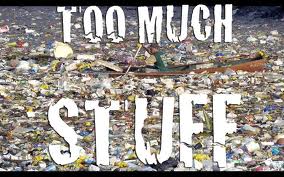
  2. The way we live. Big houses, large lots, spread out subdivisions in the boonies, too much pavement, importing food and “stuff” from thousands of miles away, too much stuff and too much waste.
  3. The way we eat. Our western diet requires at least ten times as much land, water and energy to support the same number of people—as compared to a whole foods, plant-based diet. It’s also killing us and the resultant cost of “disease care” is bankrupting our nations.

Stuff 2The Bottom Line. All three of the above are a huge problems standing between our species and living in harmony with nature and our fellow Earthlings. And all three will take a long time to correct.
But I would argue that #3 would be the easiest and the quickest change of the three. The first two will take multiple decades, if not centuries to correct; whereas the third one could change dramatically in less than a decade. All we need is powerful leadership and a few billion dollars to spread the word.

Graham Hill’s article focused on #2—the way we live and all the “stuff” that goes along with it. And even though we all seem to want more stuff, it really is not what gives us joy. As Hill mentioned:

Intuitively, we know that the best stuff in life isn’t stuff at all, and that relationships, experiences and meaningful work are the staples of a happy life.

My focus is on #3, The Way We Eat, and that focus is bringing me great satisfaction that comes with making a difference. That meaningful work has already led to rare experiences and relationships that have also added to my overall quality of life. Like Mr. Hill, My space is small. My life is big.

11-19-14 Update. Six months after posting this article in early 2013, I further simplified my life, got rid of more stuff and moved to a super efficient (and enjoyable) high density, planned re-development community just outside New York City in Stamford, CT. Now I hardly even need a car as I can walk to almost everything, including frequent express trains to NYC or Boston. You can see my fifth floor patio in this photo—with the finest supermarket in North America in the foreground.

Dense living with public transportation will be integral parts of the "green" economy of the future.

Dense living with public transportation will be integral parts of the “green” economy of the future.

The following five books and one DVD can be purchased on Amazon for a grand total of less than $60—and will enable you to understand the overwhelming challenges we face—along with the single most-powerful solution of all.

Six-Pack from Hicks—for health, hope & harmony on planet Earth

  1. Healthy Eating, Healthy WorldThe “big picture” about food (our book)
  2. A life changer for millions, including James Cameron. Forks Over Knives DVD 
  3. An essential scientific resource: The China Study by Dr. T. Colin Campbell; the primary book that influenced Bill Clinton to adopt a whole food, plant-based diet.
  4. What have we done to our planet? Full Planet, Empty Plates by Lester Brown
  5. A horrifying wake-up call for leaders. TEN BILLION by Dr. Stephen Emmott
  6. Food choices are the primary cause of our environmental problems, yet our world leaders, scientists & experts are Comfortably Unawareby Richard Oppenlander.

Why should we be eating mostly plants? The “big picture” in 4 minutes.

Want to find out how healthy your family is eating? Take our free 4Leaf Survey. It takes 2 or 3 minutes. eCornell is now using our survey in their plant-based nutrition course. Check it out on your smartphone at eCornell.com/4Leaf-Survey.

International. We’re now reaching people in over 100 countries. Follow us on Facebook and Twitter or get daily blog notices by “following” us in the top of the right-hand column. For occasional updates, join our periodic mailing list.

J. Morris Hicks, working daily to promote health, hope and harmony on planet Earth.

To order more of my favorite books—visit our online BookStore now For help in your own quest to take charge of your health, visit our 4Leaf page and also enjoy some great recipes from Lisa’s 4Leaf Kitchen.

Got a question? Let me hear from you at jmorrishicks@me.com. Or give me a call on my cell at 917-399-9700.

—J. Morris Hicks, board member since 2012; click banner for more info:

Nutrition Certificate

Posted in Activism & Leadership | 5 Comments