A Fresh 4Leaf Cooked Meal in less than 5 minutes—My secret

The key is cooking in batches and freezing one-meal portions.

Adirondack Dining at it's Best.

Adirondack Dining at it’s Best. Here’s what my fruit bowl and my Sailors Daily Oatmeal look like when I eat them outdoors.

After being married for almost thirty years, I have now been a single man for fifteen. And during that time, I have learned the most valuable lesson of my life—what we should be eating to promote our health and sustain our planet.

Concurrently, as an Industrial Engineer, I have learned how to efficiently prepare over 75% of the calories that I consume. And all of those meals that I prepare at home are 4Leaf, with over 80% of their calories from whole, plant-based foods.

The key to maintaining a diet-style at the 4Leaf level is to work on perfecting all of your “routine” meals. Those are the meals that you have at least once a week—every week. For me, that’s pretty easy, because I don’t prepare very many different meals at home. I figure if the Tarahumara in Mexico can thrive on corn, squash and beans—then I can thrive on my go-to breakfast, lunch and dinner meals—with some five to ten highly nutritious ingredients in each of them. Here is my schedule:
Leveraging the simple, yet powerful concept of maximizing the percent of your calories from whole plant foods -- still in nature's package

A 4Leaf meal derives over 80% of its calories from whole plants; 3Leaf is over 60% and so forth.

0730 First meal of the day. A bowl of fresh fruit. Depending on season, a combination of orange, pear, berries, banana, mango, melon, kiwi, and/or apples

1100 My Sailors Daily Oatmeal. While my whole grain oats are soaking in a mixture of cold water and unsweetened soy, almond, coconut or rice milk—I cut my fruit to load on top. The fruit varies by season, but the most frequent is blueberries, apple and banana. I never get tired of this meal. As a bonus, the “milks” that I use are often fortified with Vitamin D and B12.

2 p.m. My Sailors Super 4Leaf Lunch. Here’s where I do the batch cooking in advance. About once a week, I cook a batch of wild rice/brown rice and a batch of black beans/red beans. I usually soak both batches overnight before cooking my rice in a rice cooker and my beans in a standard saucepan. The cooking takes about an hour for each. After cooling for a few hours, I load seven single-serve portions of beans and rice in little plastic containers that I can freeze. Here’s how I do it—scroll down through these pictures (Notice the captions below the pics):

Here's where I do the soaking and the cooking. Notice the lighthouse for the "Sailors Super 4Leaf Lunch"

Here’s where I do the soaking and the cooking. Notice the lighthouse for the “Sailors Super 4Leaf Lunch”
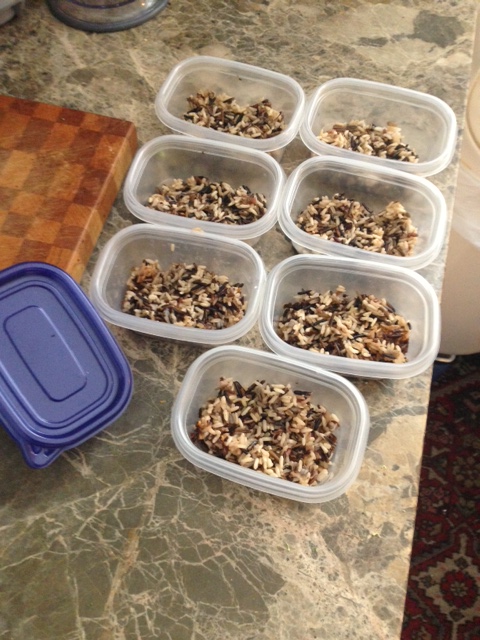
I load the rice mixture into the bottom of the little containers.

I load the rice mixture into the bottom of the little containers.

Then I load the bean mixture on top.
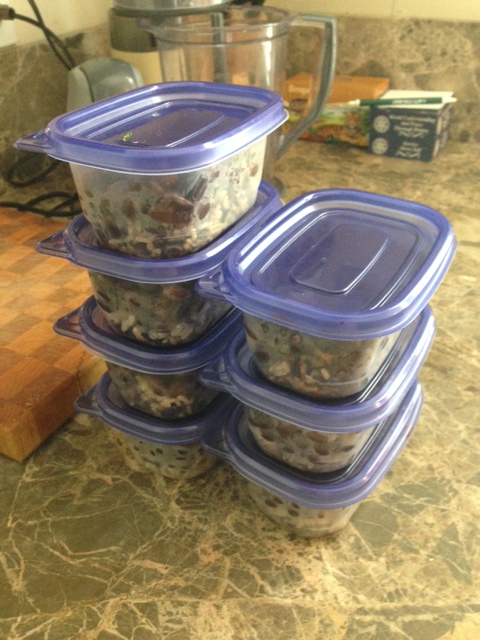
Then I load the bean mixture on top.

Here are my seven little containers with lids on top---ready to freeze.

Here are my seven little containers with lids on top—ready to freeze. As for cost, I figure that each container has about 200 calories and costs about 29 cents each.
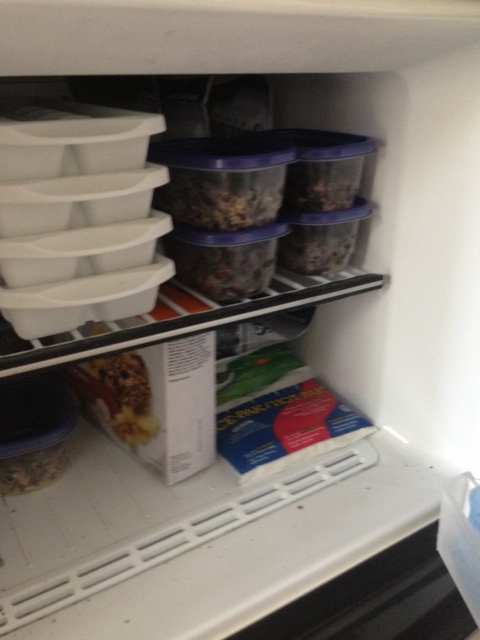
Here they are in the freezer.
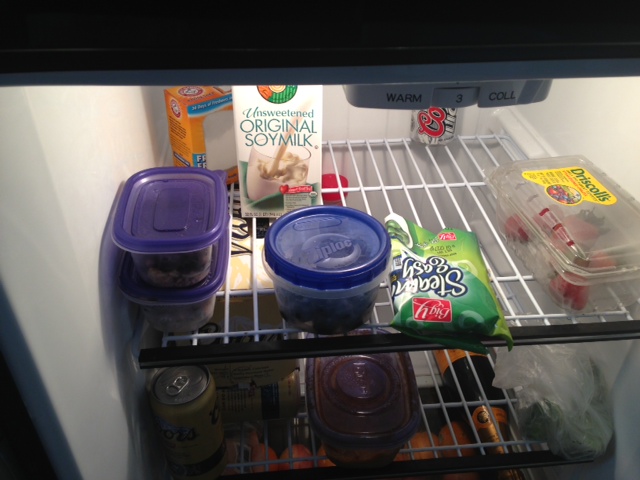
Here they are in the freezer.

I usually keep two in the refrigerator section so that they're ready to cook without having to defrost.

I usually keep two in the refrigerator section so that they’re ready to cook without having to defrost.

Preparing the lunch or dinner. I empty the contents of one of my single serve containers of rice & beans onto the plate—upside down. So now, my rice is on the top and my beans are on the bottom. I then slice up whatever vegetables I want to cook slightly while I warm up the meal—things like broccoli, mushrooms, celery, squash, eggplant, kale, spinach, cauliflower and/or shelled edamame. I then add my Kirkland non-salt seasoning and Braggs Liquid Aminos (spray) along with lime juice—for great flavor every time.

I generally cook for about two minutes in the microwave (I like my veggies raw or just barely cooked). During those two minutes, I slice up things like avocado, tomato, celery and/or carrots (all raw) that I  load on top of my meal before serving.

As for timing, the batch cooking method doesn’t take much of my time at all.The total amount of my own time for cooking is about two minutes and the loading of containers and clean-up is about five minutes. That is just once a week—adding up to seven minutes for an average of one minute per meal. Then the actual slicing, heating and serving takes me about five minutes from the time that decide that I am ready to eat.

Final product–a 4Leaf meal with well over 80% of calories from whole plants
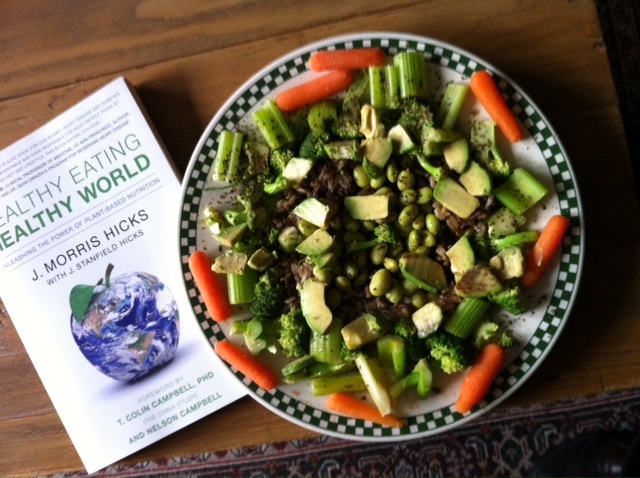
Check out the bright green edamame on top.

Check out the bright green edamame on top.

A few more handy links to some of my previous blogs on this topic:

Handy 4-piece take-charge-of-your-health kit—from Amazon.com

Want to find out how healthy your family is eating? Take our free 4Leaf Survey. It takes less than five minutes and you can score it yourself. After taking the survey, please give me your feedback as it will be helpful in the development of our future 4Leaf app for smartphones. Send feedback to jmorrishicks@me.com

International. We’re now reaching people in over 100 countries. Follow us on Facebook and Twitter or get daily blog notices by “following” us in the top of the right-hand column. For occasional updates, join our periodic mailing list.

To order more of my favorite books—visit our online BookStore now

J. Morris Hicks, working daily to promote health, hope and harmony on planet Earth.

For help in your own quest to take charge of your health, you might find some useful information at our 4Leaf page or some great recipes at Lisa’s 4Leaf Kitchen.

Got a question? Let me hear from you at jmorrishicks@me.com. Or give me a call on my cell at 917-399-9700.

SHARE and rate this post below.

—J. Morris Hicks, board member, T. Colin Campbell Foundation
Posted in 4Leaf for Life, Healthy Eating 101, Recipes & meals | 4 Comments

Real Bad News for Big PHARMA & Big FOOD

The Plant-Based paper from Kaiser Permanente is a HUGE breakthrough.

Yesterday’s blogpost about Kaiser Permanente’s breakthrough paper on plant-based nutrition is likely to put the fear of God in the leadership teams at the Big Pharma and Big Food industries. It appears to be the first chink in the armor of our vast, interconnected “system” of healthcare, pharmaceuticals, food producers, health-insurors, media, nutritional science, medical schools and government.

The only "green" thing about Cargill is the leaf in their logo.

The only “green” thing about Cargill is the leaf in their logo.

Up until now, all of the pieces of this deadly “system” appeared to be in lockstep with the lame and ineffective dietary advice as created by our USDA. You’re very familiar with the phrase about the “lean cuts of meat, wild fish and low fat dairy.”

That phrase is ubiquitous. It’s on every major “disease specific” website like the American Cancer Society, the American Heart Association and the American Diabetes Association.

Up until now, that vast “system” has thrived by keeping the American public sick and fat. Trillions of dollars have been made as we became the sickest nation on Earth while paying far more than any other nation for our healthcare. But things are now about to start changing. How about this closing statement in the article?

The future of health care will involve an evolution toward a paradigm where the prevention and treatment of disease is centered, not on a pill or surgical procedure, but on another serving of fruits and vegetables.

Kaiser Permanente logoThe dominoes begin to fall. Now that the nation’s largest managed care and hospital company has publicly recognized the disease prevention and reversal power of plant-based nutrition, others will follow suit—eventually.

Things will start moving much more quickly if KP gets serious in terms of measuring and acting on the following metrics mentioned in the article’s Conclusion:

Finally, we should encourage performance-driven measurable outcomes, which may include:

  1. the percentage of physicians who have completed a course on nutrition that includes a discussion of the benefits of a plant-based diet and exercise;
  2. the percentage of our hospitals, cafeterias, and physicians’ meeting facilities that serve meals that are consistent with a plant-based diet;
  3. the percentage of patients on a physician panel who are obese and who have completed a course on weight management and nutrition that emphasizes a plant-based diet; and
  4. the percentage of patients in a physician panel with high blood pressure, diabetes, high cholesterol, or cardio- vascular disease who completed a course on nutrition that emphasizes a plant-based diet.
Does your doctor know how to reverse heart disease? Then, find a new doctor?

Maybe someday they can trade the iconic stethoscope for a recipe book of delicious, health-promoting meals.

What gets measured, get’s done. I know this from my training and career as an industrial engineer and process improvement consultant. Now if KP starts measuring all of these things AND starts tying physicians’ compensation to health-promotion, then we’re about to enter a whole new ballgame in the world of healthcare.

To be sure, the future of healthcare will ultimately mean a much smaller overall system. But it’s going to take a long time. With our food choices driving up to 80% of our cost of healthcare, we’re talking about a dramatic reduction in the overall size of our total “system” over the next fifty years.

Just as we went from 5% of our GDP for healthcare to the 18% that we have today in the past fifty years, we should start trending back in the other direction before long—but only after the population starts demanding the kind of health-promotion that KP is talking about. From the paper’s “Conclusion:”

The major benefits for patients who decide to start a plant-based diet are the possibility of reducing the number of medications they take to treat a variety of chronic conditions, lower body weight, decreased risk of cancer, and a reduction in their risk of death from ischemic heart disease.

Now let’s see if our mainstream media provides any help in spreading this Earth-shattering information. So far, I have heard absolutely NOTHING from them. Just imagine what would happen if this news just captured one percent of the combined time devoted to the Boston Bombers, the IRS scandal, storm disasters and the Benghazi talking points.

Do you think the CEO will be happy to learn that men will soon learn how to manage their E.D. with broccoli instead of his little blue pills.

Do you think the CEO will be happy to learn that men will soon be learning how to manage their E.D. with broccoli instead of his little blue pills.

Morality vs. Profits. What if you were the CEO of one of the world’s largest pharmaceutical companies? What goes through your mind when you read the above statement about plant-based diet reducing the number of prescriptions people take? A few things to ponder:

  • What is going to happen to all those $100,000-a-year-per-patient cancer drugs that you have in development?
  • What if people stop getting cancer and the news media starts talking about finding the plant-based cure that has eluded the entire army “fighting” cancer since 1971?
  • What will happen to your business if cancer, heart disease, diabetes and E.D. start trending sharply downward?
  • As the CEO of your giant pill-making corporation, how do you plan to spin this news for your workforce?
  • Finally, as a human being, would you be happy if cancer, heart disease, E.D. and diabetes all completely disappeared tomorrow?
Cancer---now one of the biggest businesses in the USA

This has been the driver of our healthcare “system” for the past fifty years. It’s about time morality begins to trump profits when it comes to the health of our citizens.

The Bottom Line. Since writing yesterday’s blog, I have been thinking a great deal about the KP paper and the ripple of beneficial effects that it will have all over the world. The health effects, the economic effects and the environmental effects will all be tremendous once the human species begins moving steadily in the direction of a whole foods, plant-based diet.

Just this morning, I told a friend that this is the best news I have heard since President Clinton announced that he had chosen a plant-based diet to reverse his heart disease. Both of these events add tons of legitimacy and credibility to the most important process in the history of the world—beginning to choose the food that nature intended for us to eat. By doing so, we promote our own health while helping to ensure Mother Nature’s longterm ability to sustain our species.

Once again I have provided a link below to the entire KP Paper but have decided to provide the entire powerful “Conclusion” for your convenience. Please send this blog to everyone you know that is employed in the healthcare, food production or pharmaceutical industry. Change is coming—and it will be the best change we have ever seen.

Why is all of this such a big deal? Kaiser Permanente is the largest HMO in the United States with 182,000 employees, including 14,600 physicians.

The KP Plant-Based Paper Conclusion

A healthy, plant-based diet requires planning, reading labels, and discipline. The recommendations for patients who want to follow a plant-based diet may include eating a variety of fruits and vegetables that may include beans, legumes, seeds, nuts, and whole grains and avoiding or limiting animal products, added fats, oils, and refined, processed carbohydrates. The major benefits for patients who decide to start a plant-based diet are the possibility of reducing the number of medications they take to treat a variety of chronic conditions, lower body weight, decreased risk of cancer, and a reduction in their risk of death from ischemic heart disease.

A plant-based diet is not an all-or-nothing program, but a way of life that is tailored to each individual. It may be especially beneficial for those with obesity, Type 2 diabetes, high blood pressure, lipid disorders, or cardiovascular disease. The benefits realized will be relative to the level of adherence and the amount of animal products consumed. Strict forms of plant-based diets with little or no animal products may be needed for individuals with inoperable or severe coronary artery disease. Low-sodium, plant-based diets may be prescribed for individuals with high blood pressure or a family history of coronary artery disease or stroke. A patient with obesity and diabetes will benefit from a plant-based diet that includes a moderate amount of fruits and vegetables and minimal low-fat animal products. Severe obesity may require counseling and initial management with a low-calorie diet or very-low-calorie diet and the supervision of a physician’s team. Patients with kidney disease may need a plant-based diet with special restrictions, for example fruits and vegetables that are high in potassium and phosphorus. Finally, patients with thyroid disease will need to be careful when consuming plants that are mild goitrogens, like soy, raw cruciferous vegetables, sweet potatoes, and corn. These patients should be informed that cooking these vegetables inactivates the goitrogens.

Physicians should advocate that it is time to get away from terms like vegan and vegetarian and start talking about eating healthy, whole, plant-based foods (primarily fruits and vegetables) and minimizing consumption of meat, eggs, and dairy products. Physicians should be informed about these concepts so they can teach them to staff and patients.

A registered dietitian should be part of the health care team that designs a plant-based diet for patients with chronic disease, especially if multiple medications are involved. Depending on the underlying conditions, patients with chronic disease who take multiple medications need close monitoring of low blood sugar levels, low blood pressure, or rapid weight loss. If these occur, the physician may need to adjust medications. In some cases, such as the one presented here, the need for certain medications can be eliminated altogether. Although the risk of deficiencies may be low, health care teams need to be aware that a motivated patient on a strict plant-based diet may need monitoring for deficiencies of certain nutrients, as outlined above.

The purpose of this article is to help physicians understand the potential benefits of a plant-based diet, to the end of working together to create a societal shift toward plant-based nutrition. There is at least moderate-quality evidence from the literature that plant-based diets are associated with significant weight loss and a reduced risk of cardiovascular disease and mortality compared with diets that are not plant based. These data suggest that plant-based diets may be a practical solution to prevent and treat chronic diseases.

Further research is needed to find ways to make plant-based diets the new normal for our patients and employees. We cannot cure chronic diseases, but we may be able to prevent and control them by changing how we eat. With education and monitoring for adherence, we can improve health outcomes. Patterns of families and other colleagues who may be reluctant to support the efforts of individuals who are trying to change are a challenge to be overcome.

We should invite our colleagues, patients, and their families to a shared decision-making process with the goal of adopting a plant-based diet and a regular exercise program. We should invite health care teams to complete a course on healthy eating and active living. We should encourage staff to be knowledgeable about plant-based nutrition. Finally, we should encourage performance-driven measurable outcomes, which may include:

  1. the percentage of physicians who have completed a course on nutrition that includes a discussion of the benefits of a plant-based diet and exercise;
  2. the percentage of our hospitals, cafete- rias, and physicians’ meeting facilities that serve meals that are consistent with a plant-based diet;
  3. the percentage of patients on a physi- cian panel who are obese and who have completed a course on weight management and nutrition that empha- sizes a plant-based diet; and 
  4. the percentage of patients in a physician panel with high blood pressure, diabetes, high cholesterol, or cardio- vascular disease who completed a course on nutrition that emphasizes a plant-based diet.

Too often, physicians ignore the potential benefits of good nutrition and quickly prescribe medications instead of giving patients a chance to correct their disease through healthy eating and active living. If we are to slow down the obesity epidemic and reduce the complications of chronic disease, we must consider changing our culture’s mind-set from “live to eat” to “eat to live.” The future of health care will involve an evolution toward a paradigm where the prevention and treatment of disease is centered, not on a pill or surgical procedure, but on another serving of fruits and vegetables. 

The second link below is a PDF of the entire KP Paper.

Handy 4-piece take-charge-of-your-health kit—from Amazon.com

Want to find out how healthy your family is eating? Take our free 4Leaf Survey. It takes less than five minutes and you can score it yourself. After taking the survey, please give me your feedback as it will be helpful in the development of our future 4Leaf app for smartphones. Send feedback to jmorrishicks@me.com

International. We’re now reaching people in over 100 countries. Follow us on Facebook and Twitter or get daily blog notices by “following” us in the top of the right-hand column. For occasional updates, join our periodic mailing list.

To order more of my favorite books—visit our online BookStore now

J. Morris Hicks, working daily to promote health, hope and harmony on planet Earth.

For help in your own quest to take charge of your health, you might find some useful information at our 4Leaf page or some great recipes at Lisa’s 4Leaf Kitchen.

Got a question? Let me hear from you at jmorrishicks@me.com. Or give me a call on my cell at 917-399-9700.

SHARE and rate this post below.

—J. Morris Hicks, board member, T. Colin Campbell Foundation

Posted in M.D.s---Health-Promoting | Tagged | 6 Comments

Plant-Based for ALL Patients! Says Kaiser Permanente.

Finally some much needed CLARITY from the “system”

Kaiser Permanente logo

In their Spring 2013 Journal, America’s largest managed care company and hospital system has taken a bold stand on the superiority of plant-based nutrition to promote health. This is big news and deserves widespread distribution. Please share this blog with your doctor.

“Physicians should consider recommending a plant-based diet to all their patients…encouraging whole, plant-based foods and discouraging meats, dairy products, and eggs as well as all refined and processed foods.”

BSB Word 2 pdf Ad

Background. Although our medical doctors receive little if any nutritional training in med school, they are the primary gatekeepers when it comes to advising patients about what they should be eating. And since most of the doctors eat the Standard American Diet (the S.A.D.) themselves, naturally that is what they advise their patients to eat. That practice has resulted in the sickest nation on Earth with by far the highest cost of healthcare. But things are finally beginning to change.

From the Spring 2013 Kaiser Permanente Journal

The objective of this article is to present to physicians an update on plant-based diets. Concerns about the rising cost of health care are being voiced nationwide, even as unhealthy lifestyles are contributing to the spread of obesity, diabetes, and cardiovascular disease. For these reasons, physicians looking for cost-effective interventions to improve health outcomes are becoming more involved in helping their patients adopt healthier lifestyles.

Healthy eating may be best achieved with a plant-based diet, which we define as a regimen that encourages whole, plant-based foods and discourages meats, dairy products, and eggs as well as all refined and processed foods.

Research shows that plant-based diets are cost-effective, low-risk interventions that may lower body mass index, blood pressure, HbA1C, and cholesterol levels. They may also reduce the number of medications needed to treat chronic diseases and lower ischemic heart disease mortality rates. Physicians should consider recommending a plant-based diet to all their patients, especially those with high blood pressure, diabetes, cardiovascular disease, or obesity.

Of all the diets recommended over the last few decades to turn the tide of these chronic illnesses, the best but perhaps least common may be those that are plant based…Despite the strong body of evidence favoring plant-based diets, including studies showing a willingness of the general public to embrace them, many physicians are not stressing the importance of plant- based diets as a first-line treatment for chronic illnesses. This could be because of a lack of awareness of these diets or a lack of patient education resources. (See link below to view the complete Kaiser Pemanente Journal source document.)

The world's FIRST ever such conference

The world’s FIRST ever such conference. See link below for details on this conference—Oct. 24-26, 2013 in Naples, FL

Hooray for Kaiser Permanente. This is exactly what has been needed to promote health and reduce disease, obesity and the outrageous cost of healthcare in the United States.

Now begins the process of helping the doctors learn about the awesome power of plant-based nutrition and how to best convey that knowledge to their patients.

Please share this blog with your doctor—while there is still time for her/him to sign up for this conference. We’ve come a long way since last year’s HBO obesity special, “The Weight of the Nation,” when plant-based nutrition was not even mentioned. See earlier blog link below. Now let’s see if we EVER hear this story from our mainstream news sources.

Why is all of this such a big deal? Kaiser Permanente is the largest HMO in the United States with 182,000 employees, including 17,000 physicians.

Handy 5-piece take-charge-of-your-health kit—from Amazon.com

Why should we be eating mostly plants? The “big picture” in 4 minutes.

Want to find out how healthy your family is eating? Take our free 4Leaf Survey. It takes less than five minutes and you can score it yourself. After taking the survey, please give me your feedback as it will be helpful in the development of our future 4Leaf app for smartphones. Send feedback to jmorrishicks@me.com

International. We’re now reaching people in over 100 countries. Follow us on Facebook and Twitter or get daily blog notices by “following” us in the top of the right-hand column. For occasional updates, join our periodic mailing list.

J. Morris Hicks, working daily to promote health, hope and harmony on planet Earth.

To order more of my favorite books—visit our online BookStore now

For help in your own quest to take charge of your health, visit our 4Leaf page and also enjoy some great recipes from Lisa’s 4Leaf Kitchen.

Got a question? Let me hear from you at jmorrishicks@me.com. Or give me a call on my cell at 917-399-9700.

SHARE and rate this post below.

—J. Morris Hicks, board member, T. Colin Campbell Foundation

Posted in M.D.s---Health-Promoting | Tagged | 10 Comments