Re-inventing Nutritional Science. First step is “Un-Learning.”

Even the best and brightest still think there’s a “need” for animal protein.
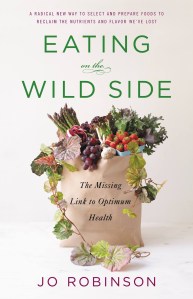
Jo Robinson's new book

Jo Robinson’s new book

This blog was inspired by a New York Times article entitled, “Breeding the nutrition out of our food.” (Jo Robinson, 5-25-13, see link below). Her article got me to thinking about the enormous challenge we face—in getting our field of nutritional science and medicine back on the right track.

It’s a daunting task and will take decades. And who’s going to lead it? The nutritional scientists will be in the lead someday—but not anytime soon. I believe that it begins with consumer acceptance of the overwhelming preponderance of evidence supporting the “whole foods, plant-based” diet for humans.

The benefits are enormous. It prevents cancer. It reverses heart disease and type 2 diabetes. It consumes 90% less land, water and energy for the same number of calories. I mean, really, what more do we need? We need our experts to start getting it right, and Ms. Robinson got a lot of things right in her article, beginning with:

WE like the idea that food can be the answer to our ills, that if we eat nutritious foods we won’t need medicine or supplements. We have valued this notion for a long, long time. The Greek physician Hippocrates proclaimed nearly 2,500 years ago: “Let food be thy medicine and medicine be thy food.” Today, medical experts concur. If we heap our plates with fresh fruits and vegetables, they tell us, we will come closer to optimum health.

usdaShe went on to explain what has been happening to the nutrients in our food since humans began to farm over 10,000 years ago. She points out how the first GMOs hit our grocery shelves in 1961 and then shared this very troubling information:

The United States Department of Agriculture exerts far more effort developing disease-resistant fruits and vegetables than creating new varieties to enhance the disease resistance of consumers. In fact, I’ve interviewed U.S.D.A. plant breeders who have spent a decade or more developing a new variety of pear or carrot without once measuring its nutritional content.
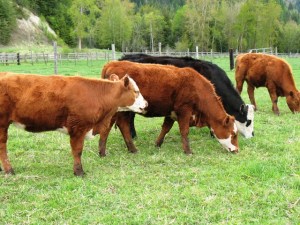
Grass fed beef---NOT a health food.

Grass fed beef—NOT a health food.

But no sense of urgency. While Ms. Robinson’s excellent article revealed much of what is wrong with our system, it did little to change it. In fact, even she seems to believe the old “protein myth” that we “need” to eat animal protein to be healthy. She states:

Experiment with using large quantities of mild-tasting fresh herbs. Add one cup of mixed chopped Italian parsley and basil to a pound of ground grass-fed beef or poultry to make “herb-burgers.” Herbs bring back missing phytonutrients and a touch of wild flavor as well.

The Bottom Line.  No doubt Ms. Robinson is right about the way we’ve bred most of the nutrients out of our food. Even so, the whole foods, plant-based diet that is still available today is capable of promoting health, reducing obesity and reversing heart disease. The good news is that we can all take charge of our health TODAY—even with the food choices that are out there NOW. Here’s an example on Amtrak:
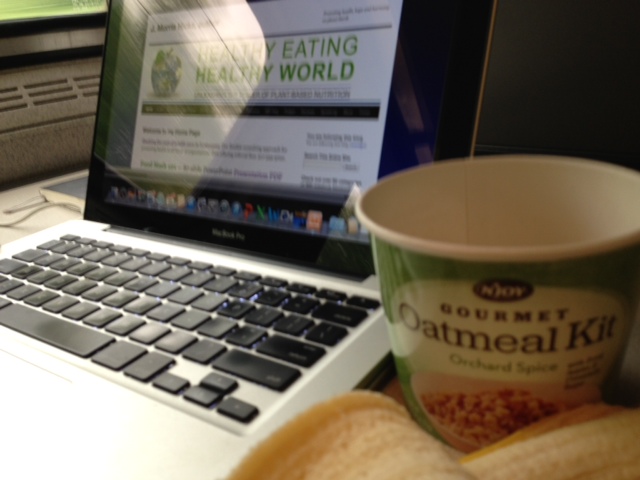
Hot oatmeal, nuts and fresh banana on Amtrak

Hot oatmeal, nuts and fresh banana on Amtrak — $3.50

As I draft this blog from Amtrak 183 to Baltimore, I am sitting in the Cafe Car and just enjoyed a hot bowl of oatmeal with nuts and fresh banana for $3.50. And, over the weekend, four of us dined at the Salt Creek Grille in Rumson, NJ. We had a few drinks and kept ordering sides of things like roasted asparagus and sweet potato fries until we were full. Not quite a 4Leaf meal, but a great deal healthier than ALL of the entrees on the menu.
Definitely NOT one of Mr. Buffett's favorite foods.

Healthy eating in mainstream restaurants is possible. I always go immediately to the sides.

So, as more of us begin to demand a greater variety of WFPB on the menu, the food industry will respond, animals will be saved by the billions and eventually our special interests-controlled Congress will be forced to put our dietary guidelines under an agency whose number one priority is the health of our citizens.

Only then will our descendants be able to bring our human species back to living in harmony with our planet. As Dr. Campbell states in his new book, Whole, “No less than our future as a species hangs in the balance.”

What about the un-learning? Changing the “system” is going to take decades. And it will be driven by a brand new kind of thinking about nutrition—the kind of thinking that Dr. Campbell described in his new book. Sadly, Colin is among a tiny handful of nutritional scientists whose brain is not imprisoned by the narrow, reductionist thinking that dominates the field today. As the “un-learning” of the old begins and the “whole” thinking begins, it could take fifty years before our government, schools of nutrition & medicine, and food companies get it right.
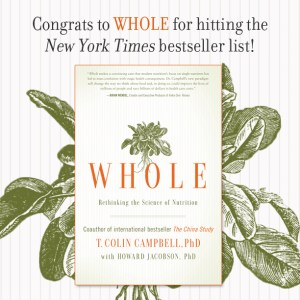
I am thrilled that Dr. Campbell endorsed our book on page 167 and that our mutual publisher, BenBella, placed a full page ad for Healthy Eating, Healthy World in one of the last few pages of the book.

I am thrilled that Dr. Campbell endorsed our book on page 167 and that our mutual publisher, BenBella, placed a full page ad for “Healthy Eating, Healthy World” in one of the last few pages of the book. To purchase, see link at left.

Meanwhile, we need to do our best to tell people exactly what they should be eating NOW—and it doesn’t include the grass fed beef and free-range chickens referred to in the article. Other than that bit of confusion, it’s an excellent article.

Handy 4-piece take-charge-of-your-health kit—from Amazon.com

Want to find out how healthy your family is eating? Take our free 4Leaf Survey. It takes less than five minutes and you can score it yourself. After taking the survey, please give me your feedback as it will be helpful in the development of our future 4Leaf app for smartphones. Send feedback to jmorrishicks@me.com

International. We’re now reaching people in over 100 countries. Follow us on Facebook and Twitter or get daily blog notices by “following” us in the top of the right-hand column. For occasional updates, join our periodic mailing list.

To order more of my favorite books—visit our online BookStore now

J. Morris Hicks, working daily to promote health, hope and harmony on planet Earth.

For help in your own quest to take charge of your health, you might find some useful information at our 4Leaf page or some great recipes at Lisa’s 4Leaf Kitchen.

Got a question? Let me hear from you at jmorrishicks@me.com. Or give me a call on my cell at 917-399-9700.

SHARE and rate this post below.

—J. Morris Hicks, board member, T. Colin Campbell Foundation
Posted in Academic Freedom, Scientific Integrity | 5 Comments

“Why I’m Not a Vegan” — Title of latest Mark Bittman piece

Then he proceeds to tell us all the reasons he should be.

Mark Bittman, New York Times

Mark Bittman, New York Times

Confusing, to say the least. As a big fan of Mark Bittman, I continue to be mystified by his refusal to take a stand and tell us with abundant clarity exactly why we should be eating a whole foods, plant-based diet. He probably knows more about the consequences of our food choices than all the other prominent journalists combined—yet he still has a tendency to “beat around the bush.”

As for not using the “vegan” moniker to describe himself, I agree with him on that decision but for different reasons. Mark seems to think that we may actually “need” to eat some animal protein so he never really closes the deal with his readers. In an article that clearly describes a plethora of health, social and environmental issues of eating animal foods, Mark also throws in this confusing paragraph:

Animal products have a special place in this discussion, because unlike hyperprocessed foods they have been a part of the diet of most humans since humans existed, and because their concentration of nutrients makes consuming at least some of them convenient and perhaps even smart.

I think BEEF Magazine is pleased that Mark is helping to keep the public confused.

I think BEEF Magazine is pleased that Mark is helping to keep the public confused.

Mark goes on to say that he follows his own VB6 plan—vegan before 6 p.m. That probably means that he eats animal protein almost every night and he also admits to cheating. That probably means that he eats animal protein frequently before 6 p.m. I just did a search for “vb6.” Nothing else. The first thing I saw was an article in BEEF Magazine—saying that Mark Bittman wasn’t pleasing anyone with that formula for eating.

My problem with Mark’s latest article is that it does nothing to help the reader understand the extreme gravity of our current trend in feeding the human population. When we’re talking about the most destructive, harmful, inefficient and unsustainable diet-style imaginable (his words) — when are we going to get real serious about helping citizens everywhere understand exactly what is at stake?

In my opinion, what is at stake is the longterm sustainability of the human species. After studying this topic for ten years (and investing over 10,000 hours), I concluded in 2012 that it’s not about “saving the planet.” The planet is going to be just fine. She has seen mass extinctions before and will see them in the future. It’s our future as a species that’s in jeopardy.

Dr. T. Colin Campbell agrees. In his new book, Whole, he writes about the need to get serious about fixing our human feeding model:

“No less than our future as a species hangs in the balance.”

I am thrilled that Dr. Campbell endorsed our book on page 167 and that our mutual publisher, BenBella, placed a full page ad for Healthy Eating, Healthy World in one of the last few pages of the book.

I am thrilled that Dr. Campbell endorsed our book on page 167 and that our mutual publisher, BenBella, placed a full page ad for Healthy Eating, Healthy World in one of the last few pages of the book.

As for my reasons for not using the “vegan” moniker. Like Mark, I don’t describe myself as a vegan—although I am much closer to being one than he is. Since beginning my journey towards whole foods, plant-based eating in 2002, I have never liked the “V” words, vegan and vegetarian. Primarily for three reasons:

  1. They’re more focused on what you’re avoiding—not what you ARE eating.
  2. Vegan and vegetarian diets are not necessarily healthy—and can be very unhealthy.
  3. They both carry a negative stigma that means different things to different people.

When I speak to vegan or vegetarian groups, they often seemed surprised to hear me say that I am not a vegan. But I quickly add that I would wager that I eat more broccoli than any man in the state of Connecticut. I also mention that I never plan to have any animal products and I never buy any. I even opted for cloth seats in my new car. I like the way the recent Kaiser Permanente Plant-Based paper treated the terms:Kaiser Permanente logo

Physicians should advocate that it is time to get away from terms like vegan and vegetarian and start talking about eating healthy, whole, plant-based foods (primarily fruits and vegetables) and minimizing consumption of meat, eggs, and dairy products. Physicians should be informed about these concepts so they can teach them to staff and patients.

So, Mark Bittman, the authors of the Kaiser Permanente piece and J. Morris Hicks are all in agreement. We’re all saying that we should be eating more whole plants and less animal and processed foods.

The 4Leaf level is reached at over 80% of your calories from whole plants.

The 4Leaf level is reached at over 80% of your calories from whole plants.

In my case, our 4Leaf for Life concept was built on this oft-quoted statement by Dr. T. Colin Campbell, “The closer we get to eating a diet of whole, plant-based foods, the better off we will be.” So we set the top bar at 80%.

That means that the 4Leaf level is reached when you’re consuming at least 80% of your calories from whole plants. I’d be willing to bet that the average vegetarian (most of whom eat lots of dairy, eggs & fish and refined carbs) are getting less than 20% of their daily calories from whole plants.

Back to Mark’s article. As usual, he demonstrated his broad knowledge on the subject of food and the far-reaching consequences of the choices we make. And he acknowledges that most Americans are making the wrong choices most of the time. They’re eating way too much animal and refined carb calories and not nearly enough whole plants. He also touched on the many non-dietary reasons for choosing more whole plants:

[T]here are non-dietary reasons to eat fewer animal products. Even if their nutritional profile were unambivalently beneficial, they use too many resources: land, water, energy and — not the least important — food that could nourish people. (To the often-asked question, “How will we feed the 9 billion?” — used to defend a host of objectionable agricultural practices — many of us say, “Focus more on feeding people plants and less on feeding them animals.

NY Times LogoI always enjoy reading Mark Bittman’s work in the New York Times and find that I am usually inspired to blog about what he says. He makes me think. Over the past two years, I have probably featured Mark in at least fifty of my nearly 800 blogposts.

I encourage you to read his latest article at the link provided below. For your convenience, I’ve also provided links to  few of my other blogs that were inspired by Mr. Bittman.

Handy 4-piece take-charge-of-your-health kit—from Amazon.com

Want to find out how healthy your family is eating? Take our free 4Leaf Survey. It takes less than five minutes and you can score it yourself. After taking the survey, please give me your feedback as it will be helpful in the development of our future 4Leaf app for smartphones. Send feedback to jmorrishicks@me.com

International. We’re now reaching people in over 100 countries. Follow us on Facebook and Twitter or get daily blog notices by “following” us in the top of the right-hand column. For occasional updates, join our periodic mailing list.

To order more of my favorite books—visit our online BookStore now

J. Morris Hicks, working daily to promote health, hope and harmony on planet Earth.

For help in your own quest to take charge of your health, you might find some useful information at our 4Leaf page or some great recipes at Lisa’s 4Leaf Kitchen. Got a question? Let me hear from you at jmorrishicks@me.com. Or give me a call on my cell at 917-399-9700.

SHARE and rate this post below.

—J. Morris Hicks, board member, T. Colin Campbell Foundation
Posted in Big Picture, Environment, Sustainability | 10 Comments

Elon Musk. Mission-motivated leadership in action…

Quite possibly the most amazing person alive today

Elon Musk as he appeared in Business Week

Elon Musk as he appeared in Business Week

I was first introduced to Elon Musk about a year ago on a 60 Minutes segment entitled, SpaceX–Entrepreneur’s Race to Space. At the time, I didn’t connect the dots regarding the staggering potential of this amazing man.

But now I have—thanks to my friend, Leo Schwaiger, who brought him to my attention a few days ago. Then, just a few hours later, I discovered the passion of Elon Musk—He is a mission-motivated leader who likes to tackle projects that will make a HUGE difference in this world. A few of his quotes:

[He likes] “to solve important problems that will most benefit the future of humanity”

“We need to figure out how to have the things we love and not destroy the world.”

“Unless we solve the sustainable energy problem in this century, we will face massive economic collapse.”

Link to "60 Minutes" video at end of this article.

Link to “60 Minutes” video at end of this article.

Background. A native of South Africa, Elon will turn 42 on June 28, 2013. And what a career he’s already had. After earning multiple undergraduate degrees in Economics and Physics from the University of Pennsylvania, here’s what he did next (from Wikipedia)

Musk then considered three areas he wanted to get into that were “important problems that would most affect the future of humanity“, as he said later, “One was the Internet, one was clean energy, and one was space.”

Then he got busy making money. His first commercial success was the sale of Zip2 (provided online content publishing software) to Compaq in 1999 for $307 million. He then co-founded PayPal which he sold to eBay for $1.5 billion. Since then, he has launched SpaceX, Solar City and Tesla Motors. Not only is Tesla now turning a profit after ten years, they just recently repaid a Federal loan of $465 million—22 years early. From Wikpedia:

Tesla Motors designs, manufactures and sells electric cars and electric vehicle powertrain components. Tesla Motors is a public company that trades on the NASDAQ stock exchange under the symbol TSLA. After 10 years, Tesla posted profits for the first time during the first quarter of 2013.

One of the nation's most successful clean energy providers.

One of the nation’s most successful clean energy providers.

After pouring hundreds of millions of his own money into both SpaceX and Tesla, Elon was able to lead them back from the brink of financial collapse—and now both businesses are enjoying commercial success.

As the first civilian participant in outer space, his company now has a $1.6 billion contract to service the International Space Station for NASA.

What about food? Mr. Musk likes to work on important problems that most affect the future of humanity. What could possibly be more important than food? This is the question that I kept thinking about as I watched several of his videos. The first one is 52-minutes long and does a great job of chronicling his remarkable career—SO FAR. If you don’t have time to watch it now, then make sure you do watch it soon.

In my case, I spent the better part of May 23 watching videos and reading information about Elon. Then I wrote him a letter—and have provided a copy of it just after the video.

Meet the amazing Mr. Elon Musk

My letter to Elon (requesting a meeting)

Subject: Working on things that really matter

Dear Elon,

Like yourself, I am concerned about the long-term sustainability of our species. Knowing of your interest in “important problems that would most affect the future of humanity,” I have spent the better part of the morning studying your background, watching your videos and drafting this letter of introduction.

You are clearly concerned about global warming, our dependence on fossil fuels and many other issues that might affect the future viability of our species. Like you, I share those concerns but, unlike you, I am primarily concerned with the most-powerful and most feasible Earth-based solutions.

Based on my 10,000 hours of study in my new field since 2002, I have concluded that our most urgent problems are driven by the food choices that we make. For example, in the USA, our “Standard American Diet” requires over ten times as much land, water and energy—on a per calorie basis—as does a health-promoting, Earth-friendly, whole foods, plant-based diet. The collective impacts of these numbers are staggering.

You must agree that nothing is more important than having food to eat for all humans. And if everyone (all 7 billion of us) ate the way we do in the USA, we’d need two planet Earths to feed us all—yet we only have one—so far. As you know, the production of our food requires a never-ending supply of land, water and energy—and we’re squandering all three at a record pace.

Since our money-controlled healthcare system and U.S. Government are not addressing this food problem, I have decided to tackle it myself. Kind of like you and your experience with NASA. After publishing my book in 2011 (Healthy Eating, Healthy World), I have published almost 800 blogs on my website at hpjmh.com and am now focusing my efforts on two projects that could best leverage my knowledge and talent for the greater good:

  • Food/Education venture. A highly innovative, direct-to-consumer food distribution & education model that could revolutionize the food business while promoting improved eating habits among millions of people. This venture is in the early, pre-funding stage.
  • Cost of healthcare reduction consulting. The only leaders in our nation who have a financial incentive to promote health are the CEOs of the large corporations who are paying the lion’s share of our $2.8 trillion annual healthcare bill. We’ve developed a powerful consulting package aimed at saving hundreds of millions of dollars a year with a single corporation, but are still searching for that first CEO client. You can read all the details by clicking on the following link, located at the top of my website at hpjmh.com: “Slashing the cost of healthcare in businesses”

Elon, I am writing to request a meeting with you. As you say, “We need to figure out how to have the things we love and not destroy the world.” Right now, we’re destroying the world by the way we eat. And the problem is getting worse every day.

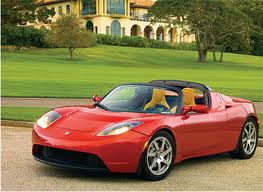
The first car was a flashy roadster---primarily to promote awareness and interest. The affordable family sedan is on the way.

His first Tesla Motors car was a flashy roadster—primarily to promote awareness and interest. The affordable family sedan is on the way.

Please give me a call at 917-399-9700. Thank you for taking the time to read this letter and consider meeting with me. I would be thrilled to work with you—someone who is so committed to working on things that are “really going to matter.”

Sincerely, J. Morris Hicks (Jim)

PS: I am sending this letter to your office at SpaceX in Hawthorne and to your Tesla office in Palo Alto. Hopefully one of them will make it into your hands soon. I look forward to hearing from you.

Ten Minutes for Tesla. Elon’s vision for a transportation system that generates more energy than it uses. A ten-minute video that will make you want to buy your first electric vehicle. In this video, he addresses the primary concerns about electric vehicles—and his vision has a solution for all three.

The Bottom Line. The world desperately needs mission-motivated leaders like Elon Musk. He has the brains, the knowledge, the leadership skills, the track record and the money to tackle just about any problem he chooses. Let’s hope he chooses to join us in tackling the most important problem (for humanity) in the history of the world.

Handy 4-piece take-charge-of-your-health kit—from Amazon.com

Want to find out how healthy your family is eating? Take our free 4Leaf Survey. It takes less than five minutes and you can score it yourself. After taking the survey, please give me your feedback as it will be helpful in the development of our future 4Leaf app for smartphones. Send feedback to jmorrishicks@me.com

International. We’re now reaching people in over 100 countries. Follow us on Facebook and Twitter or get daily blog notices by “following” us in the top of the right-hand column. For occasional updates, join our periodic mailing list.

To order more of my favorite books—visit our online BookStore now

J. Morris Hicks, working daily to promote health, hope and harmony on planet Earth.

For help in your own quest to take charge of your health, you might find some useful information at our 4Leaf page or some great recipes at Lisa’s 4Leaf Kitchen.

Got a question? Let me hear from you at jmorrishicks@me.com. Or give me a call on my cell at 917-399-9700.

SHARE and rate this post below.

—J. Morris Hicks, board member, T. Colin Campbell Foundation

Posted in Activism & Leadership, Sustainability | 10 Comments