
Holy Cross Crusaders—for healthy eating

The main Dinand Library on the Holy Cross campus

Crusaders of the Patriot League

Yesterday, I had the opportunity to lecture at the College of Holy Cross, located in Worcester, MA. I loved it. There were about a dozen students in the class and most had read our book as part of the required reading for their Mind-Body-Health-Medicine course.

There were also a few faculty members and invited guests. The event was sponsored by Professor John Axelson and took place in the Faculty Room of the Dinand Library in the heart of the beautiful Holy Cross campus. As an added treat, the professor arranged for a healthy 4Leaf buffet just prior to the 11:45 lecture.

After being introduced, I told the group that I absolutely loved being there and that there was no other room on Earth where I would rather be. That’s because there was no other room in the world that featured ten people who had read our book and wanted to hear me talk about it.

A few days in advance, the professor had asked the students to submit questions and I was able to review those questions a few hours before arriving at the Holy Cross campus. They were all excellent questions—and I responded to them during my “Big Picture” lecture, which was followed by additional Q&A. I was very impressed with their questions and want to share a few of them with you here. Many of them were asking the same questions that I continue to ask every day. For the four questions below, I have provided links to recent blogs on those topics.

The picture is a tad blurred but you can still see how George had highlighted many phrases in green.

George: “With all the big business and government support behind the meat, poultry, and dairy industries, what do you think it will take to change the system to be more conducive to a plant based lifestyle? In other words, why aren’t the leading health officials in the country alarming leaders that change needs to be made, in terms of helping America get healthier as well as saving the world’s natural resources (arable soil, water, trees, etc)? Why aren’t the “big wheels” stepping up to this crisis, and what will it take to make somebody step up?” George, finding some well-known leaders for this cause is constantly on my mind. Bill Clinton, the natural leader for the “great food revolution”

Amanda: “After reading your book, there appears to be a lot of benefits that come from adopting a whole-plant based diet: prevention and reversal of chronic diseases, conserving the environment and energy, feeding more of the world, and saving money in the healthcare system. These benefits seem like they would provide a lot of incentive for people to adopt this diet, but most Americans still maintain a diet of high animal protein and dairy. What do you think is holding most people back from giving up their Western diets? Do you think it is personal motivation, or influence from the media, government, and food industry?” Amanda, I think it’s because the Western diet is so ubiquitous and most people still truly believe that we need to eat animal protein. This article may help. “Thinking differently” and changing the world…

Greg: “One particular area that struck me is explored in Chapter 6, “Mouths to Feed,” where you discuss effects on future world hunger. Do you think that a more efficient overall diet-style (as opposed to the current wasteful one characteristic of the western world) would not only avoid a potential food shortage, but also improve the distribution of food globally in order to partially relieve world hunger? In other words, do you believe the same mouths would continue to be fed only at a smaller cost, or would food production spread to needier people?” Greg, I am not sure what will happen, but I am sure that it won’t be mathematically possible to feed very many more people the highly wasteful Western diet. Unhealthy, unfair, and unsustainable. Yet still ubiquitous.

Andrea:   “I am interested in the comparison between the consequent health effects of tobacco use and the consumption of animal products. How likely is it that someday, it will be seen as the norm that eating animal products is unhealthy, similar to smoking cigarettes? Furthermore, if this does take place, when might this happen and will it significantly reduce chronic disease in this country?” Andrea, I am convinced that someday it will no longer be cool to eat anything from an animal. Will it reduce chronic disease? YES, it has the power to eliminate 70 to 80% of our healthcare dollars. When will it happen? I expect to see a strong beginning in my lifetime—you will see the day when the vast majority is eating plant-based. And you can be one of the “crusaders” to make that happen sooner.  Remember when your doctor smoked cigarettes?
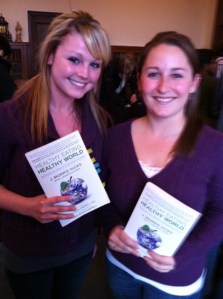
Both dressed in Holy Cross purple, Mackenzie and Brianna show their books that I joyfully signed for them. Loved seeing all the tabs on Mackenzie's copy.

Great questions indeed from a very bright, attentive and refreshing group of young people. And this is exactly why I want to spend as much time as I can on college campuses everywhere in the years ahead. These bright young people “get it.” and they get it quickly. They also have strong convictions and take their responsibilities seriously. They know that with knowledge, comes responsibility. And they welcome the challenge.

In my final slide of the presentation I asked who was needed to spread the word about plant-based eating? Government? Medicine? Scientists? I don’t think so. They seemed pleased when I told them that what we need are lots of…

“CRUSADERS”

On that note, yesterday one of my blog-readers posted the following comment on my pork blog:

In viewing these film clips, it amazes me that you can remain so optimistic about the destiny of mankind. Humans are ugly. Best, Sal Liggieri.

My response. Hi Sal, Regarding your comment about my optimism—two words—college students. They “get it” and they will make things happen.

Want to receive some occasional special news from us? You may wish to join our periodic mailing list. Also, for help in your own quest to take charge of your health, you might find some useful information at our 4Leaf page.

If you’d like to order our book on Amazon,  visit our BookStore now.

J. Morris Hicks, working daily to promote health, hope and harmony on planet Earth.

And if you like what 4Leaf eating is doing for you and your family, you might enjoy visiting our new “4Leaf Gear” store. From the seaside village of Stonington, Connecticut – Be well and have a great day.

—J. Morris Hicks…blogging daily at HealthyEatingHealthyWorld.com

SHARE and rate this post below…One more thing, occasionally an unauthorized ad may appear beneath a blog post. It is controlled by WordPress (a totally free hosting service). I do not approve or personally benefit whatsoever from any ad that might ever appear on this site. I apologize and urge you to please disregard.

J. Morris Hicks -- Member of the Board of Directors -- Click image to visit the foundation website.

Posted in Activism & Leadership, Big Picture | 1 Comment

Pork tales continue; when does the madness end?

Apparently not anytime soon

I don’t know which is worse—the horrors inflicted on our environment, on our health or on the poor animals that suffer their entire lives so we can enjoy our Egg McMuffin. But today, I want to talk about the latter.

How would you like to spend four months in a place like this? Laying hens spend their entire lives in similar quarters.

On Monday, there was an article in the New York Times (See link below) about the practice of using “gestation crates” for pregnant sows in the pork industry. Did you know that there are five million breeding sows in the United States and that over three million of them spend their entire 4-month pregnancy in a 2 by 7-foot crate which does not give them enough room to turn around? From the article:

At a little more than 2 feet by 7 feet, sow stalls are too small for a pregnant pig to turn around. Being confined in a stationary position for the four months of an average pregnancy leads to a variety of health problems, including urinary tract infections, weakened bone structures, overgrown hooves and mental stress, according to animal rights advocates.

This is just the latest story to hit our mainstream newspapers reminding us of the absolute madness associated with our marriage to the deadly habit of eating some form of meat and dairy three meals a day. As the article points out, McDonalds is now involved in this saga, one that has been around for a long time. And it will probably be around for much longer.

In 2007, Smithfield Foods, the world’s largest pork producer, pledged to end the use of gestation crates in the facilities it owns by 2017, a date it postponed during the economic downturn. The Humane Society then conducted an undercover investigation, releasing video of pigs in Smithfield’s stalls, and the company once again pledged to stop using the crates by 2017.

Our children think that pigs have a pretty nice life---the 3 little pigs of our youth.

When will all of this “madness” end? The answer is simple—when we stop buying the products. You’ve no doubt heard the children’s story about the three little pigs. Well, today we’re featuring “three little pig stories.” Here are the other two—from earlier blogs.

  • COMPLICITY — Billions of animals suffering in factory farms Warning, there is a video in this blog that features vivid images (and sounds) of things that take place in today’s pig factories. I couldn’t make it past the first 30 seconds.
  • Burning trees in the Amazon — to feed pigs in China As Mark Bittman (New York Times) has noted over the years, our meat and dairy food model is the most wasteful, damaging and unsustainable system imaginable. I frequently mention this example of just how ridiculous our meat-eating habits have become. We’re now burning trees in the Amazon—to make room for growing soybeans—that we then ship 10,000 miles to feed pigs in China. That’s because the Chinese don’t want to depend on the United States for their all-important pork eating needs.

All of the above reinforces just how far humankind has strayed from living in harmony with Nature on this planet. Sadly, we are the only species (out of millions) that have taken this route. This week, I am delivering lectures on college campuses. Following the theme of our book, my topic is:

The “big picture” about the food we eat and how it relates to the promotion of health, hope and harmony on planet Earth

Promoting health, hope and harmony on planet EarthOf course, the simple answer to ending the madness is for all of us to start choosing the kind of food promotes health, hope and harmony. When we choose a whole foods plant-based diet for ourselves, we not only promote our own health—we can also save our nation $2 trillion in health care, conserve fossil fuels, remove the #1 driver of global warming, feed all of the world’s hungry on far less land, and facilitate the restoration of our degraded arable land, forests, lakes, rivers and oceans. We can also end the suffering of sixty billion “food animals” per year—those who are grown to feed the wealthiest 2 billion people in the world—a very unhealthy diet.

Finally, one more article on “ending the madness” along with a link to the New York Times article about the sows in the crates.

Ending the madness. For the environment

McDonald’s Vows to Help End Use of Sow Crates – NYTimes.com.

Want to receive some occasional special news from us? You may wish to join our periodic mailing list. Also, for help in your own quest to take charge of your health, you might find some useful information at our 4Leaf page.

If you’d like to order our book on Amazon,  visit our BookStore now.

J. Morris Hicks, working daily to promote health, hope and harmony on planet Earth.

And if you like what 4Leaf eating is doing for you and your family, you might enjoy visiting our new “4Leaf Gear” store. From the seaside village of Stonington, Connecticut – Be well and have a great day.

—J. Morris Hicks…blogging daily at HealthyEatingHealthyWorld.com

SHARE and rate this post below…One more thing, occasionally an unauthorized ad may appear beneath a blog post. It is controlled by WordPress (a totally free hosting service). I do not approve or personally benefit whatsoever from any ad that might ever appear on this site. I apologize and urge you to please disregard.

J. Morris Hicks -- Member of the Board of Directors -- Click image to visit the foundation website.

Posted in Suffering of Animals | 3 Comments

Dairy; “Beware the Sacred Cow,” by Nigel Richardson

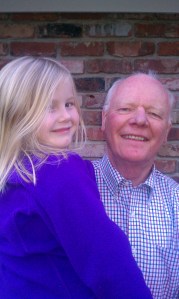
Nigel with Kate, his adorable six year old granddaughter---who is quoted in the dairy piece below.

Meet my good friend Nigel Richardson—born British, now an American citizen living in Atlanta. Having met as colleagues in the same consulting firm, I have known Nigel for forty years. In 2004, we realized that we had both started down a similar path of plant-based nutrition and had been learning from the same experts: Fuhrman, McDougall, Campbell and others. Since then we have collaborated often.

Nigel recently accompanied me on a visit with Dr. Campbell in Ithaca and is now enrolled in Colin’s Plant-Based Nutrition Course at Cornell. With a large family of siblings, children and grand-children, he occasionally prepares newsletters to help them all learn the truth about what they should be eating. For more about Nigel, you can read about him on page 45 of our book. Here is his latest work, prepared last week, with bibliography included at the end. Also included on this page is a special 80-minute video by Dr. Walter J. Veith—“Udderly Ridiculous.” Scroll to just below Nigel’s bibliography.

If you’d like to send Nigel a note, his email address is provided below his comprehensive 14-point piece (See Deming link below) about the mighty dairy industry.

Nigel’s Nutritional Newsletter

Beware the Sacred Cow

1. Dairy Products: All dairy products – which include milk, cheese, butter, yogurt, cream, ice cream, sour cream, whey, etc. – are dangerous and should be avoided. Even skim milk (5% of calories from fat) comes loaded with cholesterol and a variety of toxins. Other than taste, there is no reason to consume milk and many reasons not to.

2. Some get it right: others don’t: “There is no finer investment for any community than putting milk into babies.” Churchill; “A land flowing with milk and honey” The Bible; “Milk, it does a body good” Dairy Industry ad; “Milk is bad for you and has carcinogens in it.” Kate, our six year old granddaughter while on a trip to a dairy farm. It is the only quote that is accurate and useful.

3. The Opposition: Second only to meat, the most commonly held dietary belief is that dairy is essential for good health. The view is supported by the US dietary guidelines that recommend the consumption of dairy products and a federal mandate that requires that school children are given milk daily.  With such apparent respect, how could dairy products be other than beneficial? Simply put, organizations that have a commercial interest in dairy foods have been able, through their funds, marketing capabilities,  strong lobbying  clout and  ability to insinuate themselves onto key committees, to divert the truth  to the disadvantage of consumers. Is their case scientifically valid? A few facts:

4. Top of the class: some class: Because milk is essentially liquid meat, it has all the negatives associated with eating animal products, such as increased fat, protein and cholesterol with the attendant heart disease, cancer and stroke risks. Dairy contributes more to heart disease, stroke and cancer than any other food.  As these three, plus medical problems stemming from medical procedures, drugs, etc., are the top four causes of death in the US, it is amazing that more is not done to curb consumption.

5. Cheese and cousin butter: Cheese consumption in the US has doubled in the past thirty years. Cheese has more saturated fats and more substances that contain hormones than any other food and the incidence of hormonally generated cancers, such as breast and prostate, has increased accordingly. Cheese and cousin butter are more dangerous to the health of the US than smoking and any other food.

6. Calamitous calcium: Calcium from an animal source is the sine qua non of the Dairy Industry; without it and its effective absorption to support bone health, it has little reason for being. In the US we consume about twice the daily intake recommended by the WHO.  If this were benign, we could dismiss it as inconsequential.  But it isn’t.  Studies testify to its destructive qualities when the source is animal based; increased calcium in the blood may cause anything from joint and muscle pain to irregular heart beat and coma; consumption of animal based dairy products, particularly at a younger age, is associated with an increased risk of hip fracture and breast cancer later, and on and on.

7. Osteoporosis is lower elsewhere: The countries – US, UK, Sweden et al – with the highest milk consumption are also those with the most osteoporosis and bone fracture in later life, while those with low milk consumption – Hong Kong, Singapore, Japan et al – have lower rates; this is the complete antithesis of the popularly held belief that we need milk to build strong teeth and bones. As our diet, of which milk is a part, is animal based, we put ourselves at risk for osteoporosis.  Animal protein is acidic, and the process of digestion and absorption thrives in a neutral environment; to buffer the acid, the system leaches alkali from the bones, thus weakening them. As if that weren’t enough, about 80 % of the protein in milk, casein, is a carcinogen.

8. Dairy makes us fat: Contrary to Industry claims that dairy makes us trim, it actually makes us fat. It is high in calories because its principal purpose is to turn a sixty pound calf into a six hundred pound cow in a couple of years, which it does well.  Hence the adage that milk is good for cows, but not for humans.

9. Lactose intolerance is no fun: Many people are lactose intolerant and unable to digest this milk sugar, causing gastrointestinal upsets.  In addition, dairy protein may cause food allergies in some people, producing asthma, colds, runny noses and ear infections.

10. A weak fortification: Vitamin D is added to milk, but in inadequate amounts for people to reach the required levels. The requirement can easily be met in southern climates by 15 minutes per day of exposure to the sun three or four times per week.

11. Autoimmune disasters: With autoimmune diseases – multiple sclerosis, lupus, rheumatoid arthritis and about forty others – the immune system attacks itself.  There appear to be four possible causes- the immune system, environment, infectious diseases and genes, but nothing has been proven. One theory points to the presence of a virus in milk, but, again, there is no certainty.

12 Your daily dose of toxins: In this dismal diatribe against dairy deficiencies are the toxins and infectious agents, which point to a virus that causes leukemia (Bovine Leukemia Virus) and lymphoma in humans.

13. Partial protection: Pasteurization, unlike sterilization, does not protect us, but it does reduce the risk of disease.

14. Let’s get high: And something that is probably as new to you as it was to me. Digesting casein produces casmorphins, which, particularly for cheese, activate the same receptors as morphine.  So we crave dairy, especially in cheese, because we are addicted to it. No wonder we are reluctant to give it up!

—–Nigel Richardson, nigelr@mindspring.com

Bibliography:

  1. Neal Barnard, MD: Program for Reversing Diabetes. Associate professor of medicine, G. Washington U.
  2. T. Colin Campbell, PhD: The China Study. Emeritus professor of nutritional biochemistry, Cornell
  3. Caldwell Esselstyn, MD: Prevent and Reverse Heart Disease. Wellness Institute of the Cleveland Clinic
  4. Joel Fuhrman MD: Eat to Live and Disease Proof Your Child. Family physician, New Jersey
  5. J. Morris Hicks: Healthy Eating, Healthy World. Writer, blogger, speaker & consultant, Connecticut.
  6. Alona Pulde MD and Matthew Lederman MD: Keep It Simple, Keep It Whole. Physicians, L.A.

Speaking of 14 points, the great Dr. W. Edwards Deming produced a list of 14 points on the transformation of industry that changed the world. Take a look.

On 2-19-11, I added another feature to this page, an 80-minute video by Dr. Walter J. Veith, entitled Udderly Amazing. This video supports everything that Nigel has stated above.

Want to receive some occasional special news from us? You may wish to join our periodic mailing list. Also, for help in your own quest to take charge of your health, you might find some useful information at our 4Leaf page.

If you’d like to order our book on Amazon,  visit our BookStore now.

J. Morris Hicks, working daily to promote health, hope and harmony on planet Earth.

And if you like what 4Leaf eating is doing for you and your family, you might enjoy visiting our new “4Leaf Gear” store. From the seaside village of Stonington, Connecticut – Be well and have a great day.

—J. Morris Hicks…blogging daily at HealthyEatingHealthyWorld.com

SHARE and rate this post below…One more thing, occasionally an unauthorized ad may appear beneath a blog post. It is controlled by WordPress (a totally free hosting service). I do not approve or personally benefit whatsoever from any ad that might ever appear on this site. I apologize and urge you to please disregard.

J. Morris Hicks -- Member of the Board of Directors -- Click image to visit the foundation website.

Posted in Dairy, cow's milk | 2 Comments