Geneticist’s Research Finds His Own Diabetes

And turns the story into a sales pitch for high-tech medicine

Many of the world’s brightest medical minds are pinning their hopes for the future on the miracles that will ensue from human genome sequencing. On 6-2-12, the New York Times  published which amounts to a sales pitch for the future of medicine (See link below). It involved a geneticist, Dr. Michael Snyder, who claims that his human genome enabled him to catch his type 2 diabetes before it did any damage.

Because his genome showed that he was at high risk for the disease, the research team began going extensive blood tests every two months—and after 14 months, those tests revealed that he had indeed developed type 2 diabetes. But all of those blood tests came with a pretty hefty price tag:

Dr. Snyder said the cost to collect molecular data from each blood sample was about $2,500 — which did not include the cost of analysis. But the price for tests similar to Dr. Snyder’s will also decline in the future, Dr. Church said.

Total Cost. Let’s run the numbers; if he paid $2500 every two months, and it took 14 months, that works out to seven rounds of blood tests for a total of $17,500 just for the blood tests. Then, after spending all that money, guess how he treated his newfound disease?

Dr. Snyder treated his diabetes through a change in diet — he eliminated desserts — and a doubling of his typical bike-riding regimen. He also returned to running. “It took about six months,” he said, “but my glucose levels came back to normal, allowing me to avoid medication.”

So all he did was eliminate desserts and increase his exercise. But what about the rest of his diet? Odds are at least 20 to 1 that he consumes some variation of the typical western diet—with meat, dairy or eggs at least three times a day.

J. Morris Hicks, “the big picture guy” promoting health, hope and harmony on planet Earth — simply by returning to the natural diet for our species.

My question is this. What if he had learned the truth about nutrition ten years ago and had adopted a whole foods, plant-based diet. Odds are very good that he would’ve never developed type 2 diabetes—regardless of what his human genome predicted. Not only would he have saved a lot of money, but he would probably still be able to enjoy that occasional dessert without any problems.

Landmark? Our medical system sees this example much differently than I do. They see it as the future of medicine—and as the primary vehicle to continue the steady rise of our cost of health care. It now stands at $2.7 trillion and nearly 18% of our GDP; no doubt it is this unnecessary high-tech medicine that will continue to drive us to the 31% of GDP that U.S. officials have predicted by 2035.

“This study is a landmark for personalized medicine,” said Dr. Eric J. Topol, a professor of genomics at the Scripps Research Institute in La Jolla, Calif., and author of “The Creative Destruction of Medicine.”

The study “is an unprecedented look at one person’s biology, showing what can be accomplished in the future,” he said. “This kind of granular information will one day allow doctors to manage illness in an altogether different and precise way.”
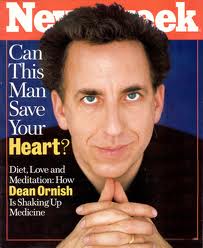
Dr. Dean Ornish, one of the most famous “real doctors” in the world, says just “Get rid of your type 2 diabetes.”

Manage illness? I say get rid of it! And the five medical doctors featured in our book say the same thing. See what they all have to say about type 2 diabetes in this earlier post that includes several compelling videos. You may want to send this to everyone you know with type 2 diabetes or those who may be “at risk.” Chances are about one in three of everyone you know falls in one of those categories:

Got Type 2 Diabetes? “Get rid of it,” says Dr. Ornish

The Bottom Line. Most of the people suffering from type 2 diabetes today could easily get  rid of it—without spending any money. In fact, they’ll actually save money by shifting to a whole foods, plant-based diet. And in the long run, they’ll save a fortune on medical bills for the human genome driven high-tech disease-management medicine of the future.

For your convenience, I have provided a link to the New York Times article along with a few links to some of my other blogs on the topic of diabetes:

Handy 3-piece take-charge-of-your-health kit—from Amazon.com

Want to find out how healthy your family is eating? Take our free 4Leaf Diagnostic Survey. It takes less than five minutes and you can score it yourself. After taking the survey, please give me your feedback as it will be helpful in the development of our future 4Leaf app for smartphones. Send feedback to jmorrishicks@me.com

International. We’re now reaching people in over 100 countries. Follow us on Facebook and Twitter or get daily blog notices by “following” us in the top of the right-hand column. For occasional updates, join our periodic mailing list.

To order more of my favorite books—visit our online BookStore now

J. Morris Hicks, working daily to promote health, hope and harmony on planet Earth.

For help in your own quest to take charge of your health, you might find some useful information at our 4Leaf page or some great recipes at Lisa’s 4Leaf Kitchen.

Got a question? Let me hear from you at jmorrishicks@me.com. Or give me a call on my cell at 917-399-9700.

SHARE and rate this post below.

Blogging daily at hpjmh.com…from the seaside village of Stonington, Connecticut – Be well and have a great day.

—J. Morris Hicks, board member, T. Colin Campbell Foundation
Posted in Diabetes, Human Genome | 2 Comments

Medical Doctor avoids “physicals” for 23 years

And she wrote about her reasons in the New York Times

After rupturing my Achilles tendon at America’s oldest lawn tennis club on Labor Day of 2010—I went directly to the doctor.

Sounds like a good idea to me. Since learning to take charge of my health in 2003, I too, have not had a single routine physical exam. Oh, I’ve been to the doctor—like back in late 2010 when I completely severed my Achilles tendon while playing tennis on a grass court for the first time in my life.

Fortunately for me, I learned how to take charge of my own health right about the time I discovered that the third leading cause of death in this country was “going to the doctor.” Yep, it’s right up there with cancer and heart disease.

On June 2, Elizabeth Rosenthal, M.D., published an article (See link below) entitled, Let’s (Not) Get Physicals, leading off:

FOR decades, scientific research has shown that annual physical exams — and many of the screening tests that routinely accompany them — are in many ways pointless or (worse) dangerous, because they can lead to unneeded procedures. The last few years have produced a steady stream of new evidence against the utility of popular tests.

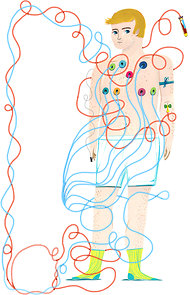
Here’s the photo that Dr. Rosenthal used for her article in the Times.

After admitting that she had not had a routine physical herself since 1989, she went on to describe why doctors everywhere continue to conduct them:

“If you ask gynecologists why they still do yearly Pap smears they’ll say things like: Patients expect it; It keeps patients coming back; It’s what we do in an OB-GYN visit.”

In the United States, most doctors and hospitals profit more by doing more, and prices are particularly high for tests and scans.

The Big Picture Cost: Quoting directly from the article; “The United States spends about twice as much per person as other developed countries on health care, generally without better results. A 2009 study of waste in the United States health care system pointed to “unwarranted use of medical care” — unneeded, unproven or redundant diagnosis or treatment — as the biggest single component, accounting for $250 billion to $325 billion a year.”

Readers weigh in. At the end of the article, as of 6-4-12, there were 272 comments and, as you might expect, many were anecdotes that reinforced the need for the annual physical. An example:

During my annual physical, my physician discovered a flutter and problem in my heart. Had I not taken the annual physical, I would not have known and been at risk of a stroke similar to the one that killed my father, grandfather and two uncles.

I’ll play it safe and continue my annual physicals.

J. Morris Hicks, not going to the doctor very often—only when I have a problem.

The Bottom Line. As long as people continue to eat our disease-promoting toxic western diet, it’s probably a good idea to continue getting a routine examination every few years. But once an individual learns how to REALLY take charge of their health with superior nutrition, there are more reasons NOT to get that examination.

Remember the third leading cause of death—going to the doctor—whether for “physicals” or for routine screenings such as colonoscopies, P.S.A. tests or mammograms.

For your convenience, I have included a few of my recent blog posts that are related to this topic—along with a link to the NY Times article:

Handy 3-piece take-charge-of-your-health kit—from Amazon.com

Want to find out how healthy your family is eating? Take our free 4Leaf Diagnostic Survey. It takes less than five minutes and you can score it yourself. After taking the survey, please give me your feedback as it will be helpful in the development of our future 4Leaf app for smartphones. Send feedback to jmorrishicks@me.com

International. We’re now reaching people in over 100 countries. Follow us on Facebook and Twitter or get daily blog notices by “following” us in the top of the right-hand column. For occasional updates, join our periodic mailing list.

To order more of my favorite books—visit our online BookStore now

J. Morris Hicks, working daily to promote health, hope and harmony on planet Earth.

For help in your own quest to take charge of your health, you might find some useful information at our 4Leaf page or some great recipes at Lisa’s 4Leaf Kitchen.

Got a question? Let me hear from you at jmorrishicks@me.com. Or give me a call on my cell at 917-399-9700.

SHARE and rate this post below.

Blogging daily at hpjmh.com…from the seaside village of Stonington, Connecticut – Be well and have a great day.

—J. Morris Hicks, board member, T. Colin Campbell Foundation

Posted in Activism & Leadership | 2 Comments

Is salt a serious problem? Or merely a scapegoat?

Maybe a little of both — along with a bit of controversy

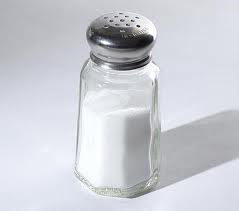
Most of our salt intake doesn’t come from this little guy — but from the highly processed foods and restaurant foods.

Just in the past week, I have heard two bits of good news about salt—in both the New York Times (see link below) and in Dr. McDougall’s new book. The Times ran an article by Gary Taubes, the author of Why We Get Fat and an independent investigator for the Robert Wood Johnson Foundation.

Taubes points out that while almost all the experts have agreed in recent decades that we should eat less salt, the evidence supporting that mass agreement has been somewhat flimsy. From his article:

Although researchers quietly acknowledged that the data were “inconclusive and contradictory” or “inconsistent and contradictory” — two quotes from the cardiologist Jeremiah Stamler, a leading proponent of the eat-less-salt campaign, in 1967 and 1981 — publicly, the link between salt and blood pressure was upgraded from hypothesis to fact.

In the years since, the N.I.H. has spent enormous sums of money on studies to test the hypothesis, and those studies have singularly failed to make the evidence any more conclusive. Instead, the organizations advocating salt restriction today — the U.S.D.A., the Institute of Medicine, the C.D.C. and the N.I.H. — all essentially rely on the results from a 30-day trial of salt, the 2001 DASH-Sodium study. It suggested that eating significantly less salt would modestly lower blood pressure; it said nothing about whether this would reduce hypertension, prevent heart disease or lengthen life.

Chapter 12 cuts us a little slack when it comes to both salt and sugar.

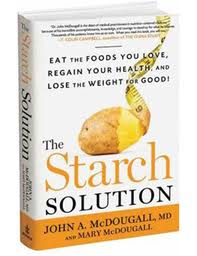
Enter Dr. John McDougall. In his new book, The Starch Solution, Chapter 12 is entitled “Salt and Sugar: The Scapegoats of the Western Diet.” He basically makes the case that if salt and sugar improves your chances of sticking with his improved starch-based (mostly whole plants) diet, then you should not be afraid to use them. As he says:

Scapegoating salt and sugar deflects attention from the real problems: meat, dairy, fats, oils and processed foods.

While researching for our book, I learned that we only need 50 mg./day, and that the maximum intake of sodium in our diet should not exceed 2,000 mg/day. But our love affair with the “problem foods” mentioned above has resulted in an average daily consumption closer to 4,000 mg. And most of that pile of salt is from the problem foods, not from  the salt we might sprinkle on our cooked foods. The same logic applies to the small amounts of sweeteners we might add to our coffee or food.

J. Morris Hicks

In my case, I do not keep salt or sweeteners in my house and I have not missed them at all. I’m sure I get all the sodium I need from my low-sodium popcorn or occasional V8 Juice and from the many whole plants that contain it. But as Dr. Mcdougall says, the inclusion of a little salt and sugar just might be the “tipping point” that enables many to actually stick with the health-promoting plant-based diet.

The Bottom Line. If we’re eating the right food (mostly whole plants), we’re getting very little salt from the problem foods mentioned earlier and a little bit of salt or sugar on food we cook at home is not going to hurt that much. We frequently see the phrase, “salt to taste” in many recipes. Maybe it should say, “try it first without the salt, then add salt if you prefer.” For me, I no longer need it—or want it.

One reason I no longer need it or want it is because of my Kirkland “No-salt organic seasoning” that I have been using for the last few months. Need more information; here are a few relevant posts on this subject.

Handy 3-piece take-charge-of-your-health kit—from Amazon.com

Want to find out how healthy your family is eating? Take our free 4Leaf Diagnostic Survey. It takes less than five minutes and you can score it yourself. After taking the survey, please give me your feedback as it will be helpful in the development of our future 4Leaf app for smartphones. Send feedback to jmorrishicks@me.com

International. We’re now reaching people in over 100 countries. Follow us on Facebook and Twitter or get daily blog notices by “following” us in the top of the right-hand column. For occasional updates, join our periodic mailing list.

To order more of my favorite books—visit our online BookStore now

J. Morris Hicks, working daily to promote health, hope and harmony on planet Earth.

For help in your own quest to take charge of your health, you might find some useful information at our 4Leaf page or some great recipes at Lisa’s 4Leaf Kitchen.

Got a question? Let me hear from you at jmorrishicks@me.com. Or give me a call on my cell at 917-399-9700.

SHARE and rate this post below.

Blogging daily at hpjmh.com…from the seaside village of Stonington, Connecticut – Be well and have a great day.

—J. Morris Hicks, board member, T. Colin Campbell Foundation
Posted in Healthy Eating 101, Medical Experts | 7 Comments