“World Hunger, the Problem Left Behind”

That was the headline of a 9-15-12 article in the New York Times.

In Chapter 6 of our book, we summarized the sad dilemma of world hunger. It boils down to three things: a finite amount of land, a growing population and a steadily increasing preference for the highly inefficient western diet by entire cultures of people coming out of poverty for the first time.
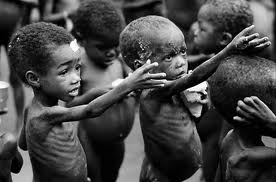
As for the finite amount of farmland; actually it’s not finite—it’s shrinking. Each year the world loses (to degradation and erosion) a chunk of land about the size of South Carolina. And as for the growing population, the net daily gain is 197,000 people. It’s like adding a new Grand Rapids, Michigan every single day. From the 9-15-12 New York Times article (see link below), Tyler Cohen writes:

THE drought-induced run-up in corn prices is a reminder that we’re nowhere near solving the problem of feeding the world. The price surge, the third major international food price spike in the last five years, casts more doubt on the assumption that widespread economic development leads to corresponding gains in agriculture.

In the United States, there is no general consciousness of the precarious state of global agriculture. Even in the economics profession, the field of agricultural economics is often viewed as secondary in status.

Neither candidate is talking about the most important issues in the world.

On this blog, I frequently write about why our elected officials and world leaders never seem to address crucial problems like global warming, water shortage, loss of species and  world hunger.

Cohen writes: “Today, we have two presidential candidates who both look a bit short on grand vision and transformational change. Perhaps they could look to helping solve the food problem — and making a big dent in global hunger — as America’s next beneficial legacy.”

The United Nations has made their position public on these kinds of global issues. But without serious leadership from officials from the most powerful nations, nothing is going to happen.

United Nations. “A global shift towards a vegan diet is vital to save the world from hunger, fuel poverty and the worst impacts of climate change,” according to a UN report, June 2, 2010. “As the global population surges towards a predicted 9.1 billion people by 2050, western tastes for diets rich in meat and dairy products are unsustainable,” says the report from United Nations Environment Program’s (UNEP) international panel of sustainable resource management.

As for the United States, addressing the obvious solution (as described by the U.N. above) to world hunger would be political suicide for any presidential hopeful. By the same token, members of Congress would not be re-elected in most states if they started talking about the need for eliminating meat, dairy, and eggs from our diet.

The Bottom Line. We cannot depend on our world leaders to tackle some of the most urgent global issues. As Gandhi said, “We must be the change that we wish to see in this world.” Since our current diet-style is simply unsustainable, it is inevitable that change will eventually come.

Consecutive Daily Blogs

And by making the right choices sooner rather than later, we will help to ease the transition for all concerned. And, in the meantime, our efforts will be rewarded with vibrant health. Please take a look at the source article as well as a few of my earlier blogs on this topic.

Handy 4-piece take-charge-of-your-health kit—from Amazon.com

Want to find out how healthy your family is eating? Take our free 4Leaf Diagnostic Survey. It takes less than five minutes and you can score it yourself. After taking the survey, please give me your feedback as it will be helpful in the development of our future 4Leaf app for smartphones. Send feedback to jmorrishicks@me.com

International. We’re now reaching people in over 100 countries. Follow us on Facebook and Twitter or get daily blog notices by “following” us in the top of the right-hand column. For occasional updates, join our periodic mailing list.

To order more of my favorite books—visit our online BookStore now

J. Morris Hicks, working daily to promote health, hope and harmony on planet Earth.

For help in your own quest to take charge of your health, you might find some useful information at our 4Leaf page or some great recipes at Lisa’s 4Leaf Kitchen.

Got a question? Let me hear from you at jmorrishicks@me.com. Or give me a call on my cell at 917-399-9700.

SHARE and rate this post below.

Blogging daily at hpjmh.com…from the seaside village of Stonington, Connecticut – Be well and have a great day.

—J. Morris Hicks, board member, T. Colin Campbell Foundation
Posted in Activism & Leadership, World Hunger | Tagged | 2 Comments

4 REASONS why plant-based eating is best for the planet…

And her ability to sustain human life indefinitely

Let’s face it, the planet is going to be just fine no matter what we humans do. That’s because Mother Earth has been around for about 4 billion years and has survived a number of mass extinctions of various creatures who have resided here. But what about us humans? How much longer can we survive without some serious changes?

There’s simply not enough land for humans to continue eating the meat, dairy and eggs for very much longer.

We know that the way we’re currently eating in the United States and the rest of the western world is simply unsustainable for very much longer. As a matter of fact, if everyone in the world started eating the same way that we’re eating now, we’d need almost three planet Earths to feed us all—and we’ve only got one.

1. Let’s begin with the land. As we explained in Chapter 6 of our book, there are only 8 billion arable acres of land on the planet. If all seven billion humans ate the typical western diet, we’d need over 21 billion arable acres. So, we’re about 13 billion acres short and, to make matters worse, due to our irresponsible farming methods, the world loses an area of arable land the size of South Carolina every year.

Water, our most precious natural resource, is being wasted by the highly inefficient process of producing meat and dairy calories for human consumption.

2. Then there’s our finite water supply. We’ve had the exact same amount of water on planet Earth for billions of years, and until just recently, it looked like we’d never run out. Well we’re running out now and it’s causing some serious problems. The main reason we’re running out is driven by what we’re eating. On a per calorie basis, the rich western diet requires between 10 and 20 times more water than a diet of whole, plant-based foods.

3. Biodiversity, much scarier than we know. We know that millions of species of creatures have lived on this planet and that over a million named species are alive today. We also know that we humans are the only species that has not lived in harmony with nature. And it’s that reckless human lifestyle that’s driving that surging loss of species. Scientists estimate that the rate for loss of species is now running at some 1,000 times the natural rate.

To support our wasteful diet-style, we’ve been destroying our precious forests—without fully understanding the consequences we face relative to climate change and biodiversity.

4. Climate change is for real. And it’s primarily being driven by the food choices of humans. In the 2006 U.N. Report, Livestock’s Long Shadow, the international scientists argued that livestock is by far the single biggest human-driven cause of greenhouse gases. Many think that we’ve already passed the tipping point, and that many of our major cities will be underwater by before the beginning of the 22nd century.

The Bottom Line. All of the above spell big trouble for the human race if we don’t start making some rapid, well-planned changes in the way we feed ourselves.

Like I said, we don’t need to worry about saving the planet. But we do need to think about doing our part to preserve her ability to sustain human life. And, by far, the single most powerful move that we can make is the widespread adoption of a whole foods, plant-based diet.

Promoting health, hope and harmony on planet Earth

Promoting health, hope and harmony on planet Earth—and the longterm sustainability of the human race.

Our great-great grandchildren will be very glad that we did—and in the short term, we’ll all get to enjoy vibrant health, a trimmer body and a much less likelihood of spending our final years in the old nursing home.

When people talk about sustainable living, they usually thinking of the dictionary definition of sustainable: conserving an ecological balance by avoiding depletion of natural resources. But we’re also talking about a bigger picture regarding the sustainability topic—the longterm ability of our planet to sustain human life.

Consecutive Daily Blogs

Want to read more about this fascinating topic? For your convenience, I have provided links to six of my earlier blogs on this topic.

Handy 4-piece take-charge-of-your-health kit—from Amazon.com

Want to find out how healthy your family is eating? Take our free 4Leaf Diagnostic Survey. It takes less than five minutes and you can score it yourself. After taking the survey, please give me your feedback as it will be helpful in the development of our future 4Leaf app for smartphones. Send feedback to jmorrishicks@me.com

International. We’re now reaching people in over 100 countries. Follow us on Facebook and Twitter or get daily blog notices by “following” us in the top of the right-hand column. For occasional updates, join our periodic mailing list.

To order more of my favorite books—visit our online BookStore now

J. Morris Hicks, working daily to promote health, hope and harmony on planet Earth.

For help in your own quest to take charge of your health, you might find some useful information at our 4Leaf page or some great recipes at Lisa’s 4Leaf Kitchen.

Got a question? Let me hear from you at jmorrishicks@me.com. Or give me a call on my cell at 917-399-9700.

SHARE and rate this post below.

Blogging daily at hpjmh.com…from the seaside village of Stonington, Connecticut – Be well and have a great day.

—J. Morris Hicks, board member, T. Colin Campbell Foundation

Posted in Activism & Leadership | Leave a comment

A case for fitness—to ward off “lengthening morbidity”

In God We Trust—All Others Must Bring Data

There has been a sign in my office with that phrase for the past thirty years. Having been trained as an industrial engineer, I have always had an appreciation for numbers. If something is worth doing, it’s worth measuring it—and reporting the numbers.

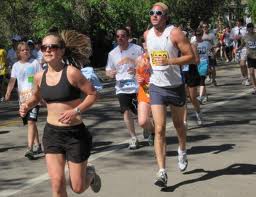
One of the many forms of aerobic exercise

A recent article in the New York Times health section caught my attention last week. It was all about how just being fit at middle age bodes well for a better life in the golden years. From the article (See link below):

Americans are living longer, with our average life expectancy now surpassing 78 years, up from less than 74 years in 1980. But we are not necessarily living better. The incidence of a variety of chronic diseases, like diabetes and heart disease, has also been growing dramatically, particularly among people who are not yet elderly.

The convergence of those two developments has led to what some researchers have identified as a “lengthening of morbidity.” That means we are spending more years living with chronic disease and ill health — not the outcome that most of us would hope for from a prolonged life span.

The data from a new study published last week in Archives of Internal Medicine was interesting. They pulled the records of almost 19,000 middle-aged men and women who’d visited the Cooper Institute Clinic in Dallas for a check-up beginning in 1970.

For the study, researchers at the University of Texas Southwestern Medical Center and the Cooper Institute in Dallas gathered medical records for 18,670 middle-aged men and women who’d visited the Cooper Clinic (the medical arm of the Cooper Institute) for a checkup beginning in 1970 (average age was 49).

Then they compared the results of that checkup (using their aerobic test scores to establish five categories of fitness) with their Medicare records from 1990 to 1999, a decade when most of the participants were in their 70s or 80s. And guess what? The people in the “least fit” category were the most likely to have developed any of eight serious or chronic conditions early in the aging process.

On the other hand, people who scored in the “most fit” category in their middle age also developed many of the same chronic conditions but developed them later in life. As they summarized in the article:

Typically, the most aerobically fit people lived with chronic illnesses in the final five years of their lives, instead of the final 10, 15 or even 20 years.

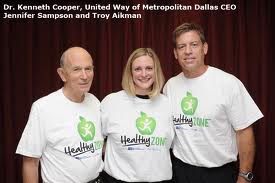
Dr. Kenneth Cooper on the left and Troy Aikman on the right. Dr. Cooper is known as the “father or aerobics.”

I know what you’re thinking. What if they had data on 5,000 of those 19,000 people who’d adopted a whole foods, plant-based diet at age 59? I wonder what their frequency of developing any of those eight chronic diseases would have been. Diseases such as heart disease, diabetes, Alzheimer’s, and colon or lung cancer.

Given what we know about the combined disease reversal records of Esselstyn, Fuhrman, Barnard, McDougall and Ornish—I am betting that those aerobically fit “healthy eaters” would have knocked the ball out of the park when it comes to avoiding 80% of those diseases and completely eliminating most of the “morbidity” associated with old age. Someday there will be such a study. But in the meantime…

It only stands to reason, if heart disease and diabetes can be reversed with a whole foods, plant-based diet, then beginning that same healthy eating regimen earlier in life would certainly be expected to prevent those diseases (and some cancers) in the first place. This is a concise summary of the primary finding of the study:

Being or becoming fit in middle age, the study found, even if you haven’t previously bothered with exercise, appears to reshape the landscape of aging.

So why not do both? Get fit, eat right, and while you’re at it—work on eliminating depression, following your passion and being as happy you can be. That kind of winning combination just makes sense. Enjoy vibrant health now and a relative absence of morbidity during your golden years.

Consecutive Daily Blogs

In addition to the source article, I have also provided links to a few earlier blogs that focus on the “big picture” of vibrant health—with emphasis on exercise, sleep & mental attitude in addition to a near-optimal diet.

Handy 4-piece take-charge-of-your-health kit—from Amazon.com

Want to find out how healthy your family is eating? Take our free 4Leaf Diagnostic Survey. It takes less than five minutes and you can score it yourself. After taking the survey, please give me your feedback as it will be helpful in the development of our future 4Leaf app for smartphones. Send feedback to jmorrishicks@me.com

International. We’re now reaching people in over 100 countries. Follow us on Facebook and Twitter or get daily blog notices by “following” us in the top of the right-hand column. For occasional updates, join our periodic mailing list.

To order more of my favorite books—visit our online BookStore now

J. Morris Hicks, working daily to promote health, hope and harmony on planet Earth.

For help in your own quest to take charge of your health, you might find some useful information at our 4Leaf page or some great recipes at Lisa’s 4Leaf Kitchen.

Got a question? Let me hear from you at jmorrishicks@me.com. Or give me a call on my cell at 917-399-9700.

SHARE and rate this post below.

Blogging daily at hpjmh.com…from the seaside village of Stonington, Connecticut – Be well and have a great day.

—J. Morris Hicks, board member, T. Colin Campbell Foundation

Posted in Athletic performance, Vibrant health | Tagged , | 1 Comment