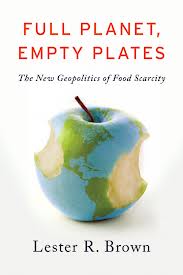
Like ours, Mr. Brown’s book features a single apple on the cover. And like our apple, his tells a story.
In October of 2012, I purchased a Kindle copy of Lester Brown’s new book, Full Planet, Empty Plates. After reading it, I believe it is the greatest summary of our grossly unsustainable way of life that I have seen. In my opinion, he knows more about this topic than any other person—and if you care about our planet and her ability to sustain human life, you should buy a copy.
What’s the difference between his book and our book? They both have an “apple” image of planet Earth on the cover and they both devote a lot of attention to the way we humans feed ourselves—and the resulting environmental disasters that are occurring. But the big difference is that he focuses primarily on the PROBLEM, whereas we focus primarily on the blinding flash of the obvious SOLUTION.
In particular, I want to address our two most precious natural resources—fertile land and fresh water. As Mr. Brown points out, humans lived for 200,000 years without oil, but we wouldn’t survive more than a few days without food and water. And, at the rate we’re going, we are leaving a gigantic mess to future generations.
Land. Brown’s Chapter 5, which focuses on the fertile land, is entitled: Eroding Soils Darkening Our Future. In our book, Chapter 4 is entitled Running Roughshod and covers all forms of environmental disasters that we’re causing. For example, on a global basis, we’re losing arable land at an alarming rate—an area about the size of South Carolina every year. Meanwhile, our population is increasing at the rate of 200,000 people—every single DAY.
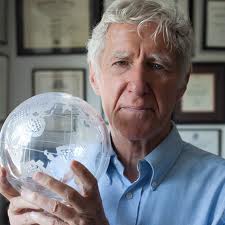
Lester Brown has been trying to warn all of us for most of his career. We had better start listening soon.
In the movie HOME, scientists reported that the human race has inflicted more damage on the fragile harmony of nature in just the past fifty years than all previous generations of humans combined for 200,000 years. And Mr. Brown goes into great detail in ALL the categories of that destruction. From Chapter 5, one of many examples:
When it comes to sheep and goats, the United States has a combined population of only 9 million, whereas China has 285 million. Concentrated in China’s western and northern provinces, these animals are stripping the land of its protective vegetation. The wind then does the rest, removing the soil and converting rangeland into desert.
Wang Tao, one of the world’s leading desert scholars, reports that from 1950 to 1975 (in China) an average of 600 square miles of land turned to desert each year. Between 1975 and 1987, this climbed to 810 square miles a year. From then until the century’s end, it jumped to 1,390 square miles of land going to desert annually.
The accelerating loss of topsoil is slowly but surely reducing the earth’s inherent biological productivity. The shrinking area of productive land and the earth’s steadily expanding human population are on a collision course. Soil erosion and land degradation issues are local, but their effect on food security is global.
Water. Just as with land, water is a finite resource—and there is no way we can make more of it. As the movie HOME reported, we’ve had the exact same amount of water on this planet for billions of years—ALL generations have used the same water. From Brown’s book in Chapter 6: Peak Water and Food Scarcity:
Although many analysts are concerned about the depletion of oil resources, the depletion of underground water resources poses a far greater threat to our future. While there are substitutes for oil, there are none for water. Indeed, modern humans lived a long time without oil, but we would live for only a matter of days without water.
Not only are there no substitutes for water, but the world needs vast amounts of it to produce food. As adults, each of us drinks nearly 4 liters of water a day in one form or another. But it takes 2,000 liters of water— 500 times as much— to produce the food we consume each day.
The Solution. Two simple facts. The variation in both depends on the specific products being eaten—some require more land and water than others.
- It takes between 10 to 20 times more land to feed a meat/dairy-eater than it does to feed a plant-eater.
- Compared to plant based calories, it takes between 10 to 20 times more water to produce the same number of meat/dairy-based calories.
With most of our planet’s land and our water being devoted to feeding humans, the implications of a global shift to a plant-based diet are staggering. How difficult will that be? Well, over half of our 7 billion humans are already eating plant-based. But more of them are adopting our grossly harmful, wasteful and unsustainable western diet-style every day.

Consecutive daily blogs
The world needs credible leaders to step forward and start publicizing these simple facts—and what they mean to the longterm sustainability of the human race. It’s that simple. Click here to purchase Mr. Brown’s new book on Amazon For your convenience, another half-dozen of my blogs devoted to this most-crucial topic.
- Too many people, wasting resources, eating the wrong food
- Walking for hunger—helping victims – J. Morris Hicks, author
- Forget “saving the planet.” Think great grandchildren.
- Why are the “world’s greatest thinkers” missing the boat?
- Drought, famine and the sustainability of the human race
- “Dust Bowl” debate. Experts are missing the main point.
Happy Holidays! Everyday is a shopping day on Amazon. Want to give the gift of health this year? This may be the answer to your shopping dilemma:
Handy 4-piece take-charge-of-your-health kit—from Amazon.com
- The movie that’s changing the lives of millions: Forks Over Knives DVD
- Healthy Eating, Healthy World, The “big picture” about food (our book)
- An essential scientific resource: The China Study by Dr. T. Colin Campbell
- Dr. McDougall’s new book, The Starch Solution, with lots of great recipes.
Want to find out how healthy your family is eating? Take our free 4Leaf Diagnostic Survey. It takes less than five minutes and you can score it yourself. After taking the survey, please give me your feedback as it will be helpful in the development of our future 4Leaf app for smartphones. Send feedback to jmorrishicks@me.com

 International. We’re now reaching people in over 100 countries. Follow us on Facebook and Twitter or get daily blog notices by “following” us in the top of the right-hand column. For occasional updates, join our periodic mailing list.
To order more of my favorite books—visit our online BookStore now

J. Morris Hicks, working daily to promote health, hope and harmony on planet Earth.
For help in your own quest to take charge of your health, you might find some useful information at our 4Leaf page or some great recipes at Lisa’s 4Leaf Kitchen.
Got a question? Let me hear from you at jmorrishicks@me.com. Or give me a call on my cell at 917-399-9700.
SHARE and rate this post below.
Blogging daily at hpjmh.com…from the seaside village of Stonington, Connecticut – Be well and have a great day.
—J. Morris Hicks, board member, T. Colin Campbell Foundation
 Leading off with a milk mustache video by Whoopi Goldberg, that was the title of an online Wall Street Journal article on 12-11-12 (see link below). No matter how much Dairy Management, Inc. spends on celebrity ads aimed at selling poison to our children, Americans are finally beginning to Just Say No to this deadly product.
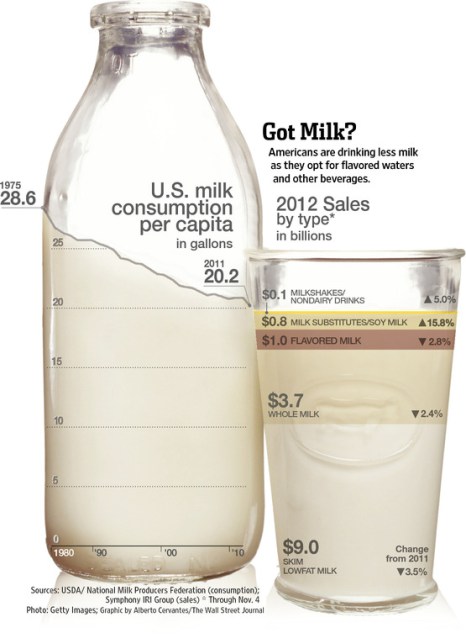 So the milk people are scrambling to come up with creative ways to sell more milk—fighting the rising tide of better-educated consumers who know that milk and all of its derivative products is simply not fit for human consumption. Want to find out why, check out the “truth about dairy” links at the end of this blog. Meanwhile the scrambling for recovering that lost milk volume continues:





 J. Morris Hicks, engineer. writer. big picture guy.