Bill Gates is way off base on MEAT!

As he casually hastens the end of our civilization

bill-gatesToward the end of his 4-21-15 blogpost, Bill Gates sums up the meat situation as follows:

How can we make enough meat without destroying the planet?—one solution would be to ask the biggest carnivores (Americans and others) to cut back, by as much as half. Although it might be possible to get people in richer countries to eat less or shift toward less-intensive meats like chicken, I don’t think it’s realistic to expect large numbers of people to make drastic reductions. Evolution turned us into omnivores.

But there are reasons to be optimistic. For one thing, the world’s appetite for meat may eventually level off. Consumption has plateaued and even declined a bit in many rich countries, including France, Germany, and the United States. I also believe that innovation will improve our ability to produce meat. Cheaper energy and better crop varieties will drive up agricultural productivity, especially in Africa, so we won’t have to choose as often between feeding animals and feeding people.

I’m also hopeful about the future of meat substitutes. I have invested in some companies working on this and am impressed with the results so far. Smil is skeptical that it will have a big impact—and it is true that today the best products are sold mostly in fancy grocery stores—but I think it has potential. 

With a little moderation and more innovation, I do believe the world can meet its need for meat.

My response to this disturbing conclusion by one of the most influential people in the world was posted on his blog-site this morning:
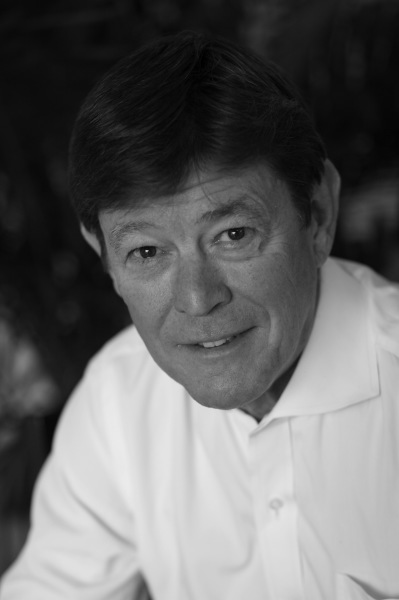
J. Morris Hicks, always trying to focus on the big picture.

J. Morris Hicks, always trying to focus on the big picture.

Dear Mr. Gates,

It’s a real tragedy when one of the most influential people in the world is so terribly misguided on such a crucial topic. To conclude that “with a little moderation and more innovation, I do believe the world can meet its need for meat” is shockingly irresponsible. First of all, the world has no “need” for meat, it only has “demand” because that’s what people want. And unless we drastically reduce that “demand” during the next few years, we’re going to soon render our fragile ecosystem incapable of sustaining us as a species.

I suggest that you seek the counsel of one of Microsoft’s employees on this most crucial of all topics. His name is Dr. Stephen Emmott and he runs “computational science” in the UK. I met with him there in 2013, shortly after his book, TEN BILLION, was published. In that book, he described a terrifying chain of events that is happening right now. And, as he says, unless we make some radical changes in the way we live, our civilization will most definitely collapse well before 2100. He also agreed with me that changing what we eat (specifically animal-based foods) is a HUGE part of the “radical” change that is needed.

You may disagree with Dr. Emmott, but you should at least seek his counsel before posting something that could have such a devastating effect on the future of our species. You must remember that, while you are no expert on this topic, you have the ability to influence the behavior of billions of people–because of your fame, reputation and your own billions of dollars.
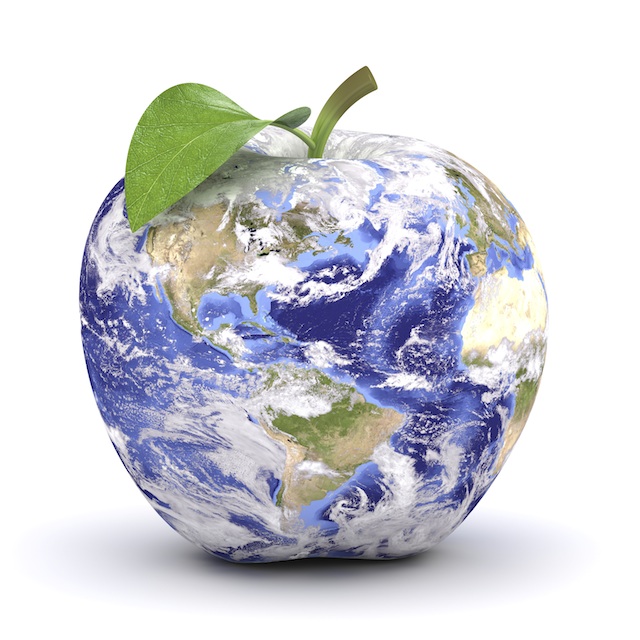
Promoting health, hope and harmony on planet Earth

Promoting health, hope & harmony on planet Earth

Finally, I have been researching this topic since 2002 and have concluded that, without a doubt, the most important issue in the history of humanity is our food choices in the 21st century. It’s the only part of the way we live that we can change quickly.

We don’t have time to curb overpopulation, change the way our economy works or ease our dependence on fossil fuels. But we do have time to change what we eat–almost anyone in the developed world can do that overnight AND be a lot healthier for it. And by simply changing what we eat, we can buy the time we need to fix those other unsustainable aspects of the way we humans are living.

Best regards, J. Morris Hicks, author, “Healthy Eating, Healthy World.”

The following five books and one DVD can be purchased on Amazon for a grand total of less than $60—and will enable you to understand the overwhelming challenges we face—along with the single most-powerful solution of all.

Six-Pack from Hicks—for health, hope & harmony on planet Earth

  1. Healthy Eating, Healthy WorldThe “big picture” about food (our book)
  2. A life changer for millions, including James Cameron. Forks Over Knives DVD 
  3. An essential scientific resource: The China Study by Dr. T. Colin Campbell; the primary book that influenced Bill Clinton to adopt a whole food, plant-based diet.
  4. What have we done to our planet? Full Planet, Empty Plates by Lester Brown
  5. A horrifying wake-up call for leaders. TEN BILLION by Dr. Stephen Emmott
  6. Food choices are the primary cause of our environmental problems, yet our world leaders, scientists & experts are Comfortably Unawareby Richard Oppenlander.

Why should we be eating mostly plants? The “big picture” in 4 minutes.

Want to find out how healthy your family is eating? Take our free 4Leaf Survey. It takes 2 or 3 minutes. eCornell is now using our survey in their plant-based nutrition course. Check it out on your smartphone at eCornell.com/4Leaf-Survey.

International. We’re now reaching people in over 100 countries. Follow us on Facebook and Twitter or get daily blog notices by “following” us in the top of the right-hand column. For occasional updates, join our periodic mailing list.

J. Morris Hicks, working daily to promote health, hope and harmony on planet Earth.

To order more of my favorite books—visit our online BookStore now For help in your own quest to take charge of your health, visit our 4Leaf Program and also enjoy some great recipes from Lisa’s 4Leaf Kitchen.

Got a question? Let me hear from you at jmorrishicks@me.com. Or give me a call on my cell at 917-399-9700.

—J. Morris Hicks, board member since 2012; click banner for more info:
Nutrition Certificate

Posted in Activism & Leadership, Sustainability | Tagged | 4 Comments

My letter to a U. S. Senator. Subject: Food Choices

Searching for powerful leadership to address the all-important FOOD issue.

Senate SealThis past weekend, I saw a news item about a friend and former business colleague that I have known for over forty years. I had followed the campaign that led to his election and,  now that he’s completed his first 100 days as a member of one of the most exclusive groups in the world, I decided to send him a note.

I am providing this letter as a template for anyone who might want to send a similar letter to one of their own elected officials at any level. If you are successful in gaining an audience with some of those people, let me know if you’d like for me to join you for that all-important first meeting.

I am not mentioning the addressee by name, simply because he is a personal friend and his name is not relevant to the purpose of this letter–to help you reach out to your own elected officials.

May 16, 2015

Hi Dave,

First of all, congratulations on being elected to the U. S. Senate—and successfully completing your first 100 days in office. I am proud to call you my friend. Although I am not one of your constituents (reside in CT), I do have family and many friends in Georgia and I enjoy following your progress there in the Senate.

Just read your note about lack of urgency. That’s something that I write and/or speak about every day. The fact is that NONE of our world leaders are urgently addressing our most critical issues. On that topic, please take a minute to read this one pager regarding the most important issue in the history of humanity. As a Georgia Tech engineer and seasoned business executive, I am sure that you’ll quickly grasp the “big picture” disaster that we humans have on our hands.

One-page Recipe for Saving Our Ecosystem — an industrial engineer’s guide to saving our species; it describes the most important executive search assignment of my career.

To better understand our “big picture” global dilemma, I recommend that you take just one hour to read Dr. Stephen Emmott’s TEN BILLION. He runs computational science for Microsoft (based in the UK) and I met with him in late 2013. He doesn’t describe the solution in his book, but he does a superb job of describing the problem. And he agrees that what I am proposing would have “an incredibly huge positive impact on our ecosystem.”

Finally, I know that you’ve been elected to look after the needs of the people of Georgia, but I ask you, “What could be more important to them than the survival of our civilization?” Since you say you’re not going to become a Washington “insider,” perhaps you could lead a global coalition to start making a lot of noise about all of the above. I continue to reach out to powerful leaders everywhere on this URGENT topic–including Pope Francis. So far, no one has risen to the challenge.

I would be happy to come down to Washington or Georgia to discuss all of this with you in more detail at your convenience. Just let me know. 

Best regards, Jim

Do you know any prominent leaders? I am serious about attending a meeting with you if you think that it would help. Let me know if you have someone in mind.

Senate

The following five books and one DVD can be purchased on Amazon for a grand total of less than $60—and will enable you to understand the overwhelming challenges we face—along with the single most-powerful solution of all.

Six-Pack from Hicks—for health, hope & harmony on planet Earth

  1. Healthy Eating, Healthy WorldThe “big picture” about food (our book)
  2. A life changer for millions, including James Cameron. Forks Over Knives DVD 
  3. An essential scientific resource: The China Study by Dr. T. Colin Campbell; the primary book that influenced Bill Clinton to adopt a whole food, plant-based diet.
  4. What have we done to our planet? Full Planet, Empty Plates by Lester Brown
  5. A horrifying wake-up call for leaders. TEN BILLION by Dr. Stephen Emmott
  6. Food choices are the primary cause of our environmental problems, yet our world leaders, scientists & experts are Comfortably Unawareby Richard Oppenlander.

Why should we be eating mostly plants? The “big picture” in 4 minutes.

Want to find out how healthy your family is eating? Take our free 4Leaf Survey. It takes 2 or 3 minutes. eCornell is now using our survey in their plant-based nutrition course. Check it out on your smartphone at eCornell.com/4Leaf-Survey.

International. We’re now reaching people in over 100 countries. Follow us on Facebook and Twitter or get daily blog notices by “following” us in the top of the right-hand column. For occasional updates, join our periodic mailing list.

J. Morris Hicks, working daily to promote health, hope and harmony on planet Earth.

To order more of my favorite books—visit our online BookStore now For help in your own quest to take charge of your health, visit our 4Leaf Program and also enjoy some great recipes from Lisa’s 4Leaf Kitchen.

Got a question? Let me hear from you at jmorrishicks@me.com. Or give me a call on my cell at 917-399-9700.

—J. Morris Hicks, board member since 2012; click banner for more info:

Nutrition Certificate

Posted in Activism & Leadership, Sustainability | Tagged | 3 Comments

My relentless drum-beat continues.

Beginning today with the fact that our solar system is just one of 100 billion.

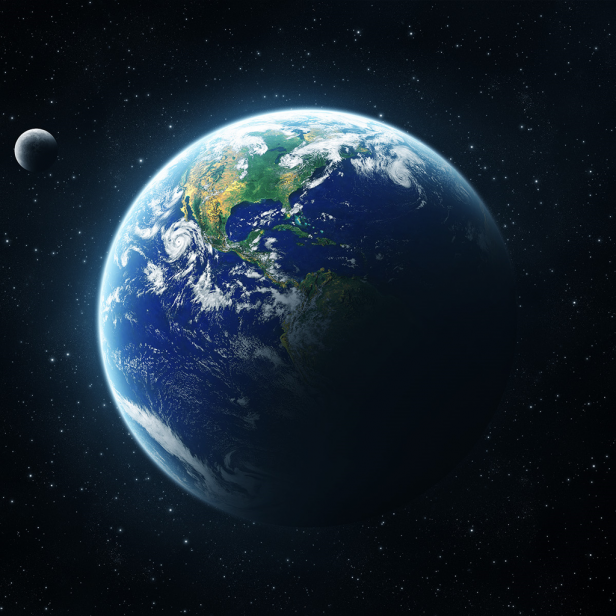
Planet Earth with moon

And scientists estimate that many of them could possibly support life. So, does that mean that, like in the movie Avatar, we can take over one of those planets after we’ve run out of natural resources here on planet Earth? No, it definitely does not.

While reading E.O. Wilson’s “The Meaning of Human Existence,” I learned that there are an estimated 100 billion star systems out there, with each of them having at least one planet in orbit around it. I also learned that, in order to support life, the planet must be in what scientists call the “Goldilocks” zone–meaning that its orbit is not to far away from its sun and not too close, but rather, “just right.”

So I got to wondering how many of those other 100 billion planets are in the Goldilocks Zone? According to Wikipedia data (see link below), there are a lot more of them than you might think–maybe as many as 40 billion. Surely, a few of them have intelligent life. E.O. Wilson estimates that maybe 4 or 5 of them do. If so, that brings up the prospect of building trading relationships with them or conquering them, right? Not very likely.

The nearest one is twelve light years away. So how long would it take us to travel there? If we could travel at the speed of light, a round-trip would take 24 years. Light travels at 186,000 miles per second, or about 670 million miles per hour. By contrast, the satellites in orbit around the Earth travel at just 17,000 miles an hour.  Even if we could travel at just 1/10 the speed of light (67 million miles per hour), a round trip to that nearest Goldilocks planet would take 240 years.

As for traveling months (or years) in a spacecraft, this NY Times article (published a few months after this blog) gives you a pretty good idea what it would be like. My reaction is an emphatic, “NO THANK YOU!” Let’s Not Move to Mars

How feasible is travel to other planets that can support life? Almost nil with today’s travel technology. And even if we could get there and back in 24 years, the likelihood of finding a complete biosphere there that could support us is also close to nil.

My conclusion that I will never quit talking about:

Our Biosphere

Our Biosphere

We only have one planet and we must learn to live in harmony with the overall ecosystem of that planet. That system of nature has four components and our future as a species depends on the harmonious interaction of all four:

  1. Atmosphere (the air we breathe)
  2. Hydrosphere (the water)
  3. Cryosphere (ice and glaciers)
  4. Biosphere (plants and animals)

Under the banner of more people leading a better quality of life, human activity has thrown this entire interconnected system seriously out of balance and it continues to get worse. Much worse. We’re heating and polluting the atmosphere, hydrosphere and cryosphere. And we continue to destroy many of the millions of species of plants and animals (our biosphere) with reckless abandon–leading to an unprecedented rate of species extinction, now running at over 1,000 times the normal rate.

We seem to have forgotten that all things are connected in nature as we seem hellbent on destroying our precious ecosystem that gives us life. What’s it going to take for us to return to living in harmony with nature? A lot more than recycling newspapers, taking shorter showers and driving electric cars.

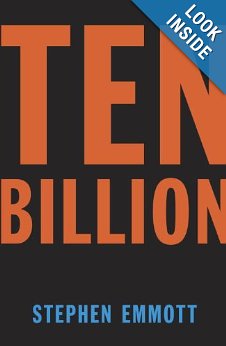
Ten BillionAs Stephen Emmott points out in TEN BILLION, what is needed is a RADICAL change in human behavior. Yet, there are exactly ZERO world leaders who have even begun to talk about radical change. What we have is an overall “system” that is selfishly grabbing what’s left of our natural resources to support a grossly unsustainable way of life.

The Bottom Line.  I have concluded that the ONLY pragmatic way to get us moving in the right direction is to begin an URGENT effort to move rapidly in the direction of a plant-based diet for all humans. You see, our food choices determine how most of the world is being used and we ran out of available farmland many years ago.

It took 200,000 years for humans to get to reach a population of one billion. Since then, with the help of the agricultural and scientific revolutions, in just over 200 years, we’ve added 6.3 billion people and taken over the entire globe to produce our food and other “stuff” that we consume.

Since animal-based foods (on a per calorie basis) require over ten times as much land, water and energy as do plant-based foods, any move in the direction toward more plants and fewer animals will result in HUGE improvements to our ecosystem. And, it just might buy us enough time to work on other issues that continue to drive us away from living in harmony with nature: overpopulation, overconsumption and dependence on fossil fuels.

The cost of global depletion is a tough lesson to learn.

The cost of global depletion is a tough lesson to learn.

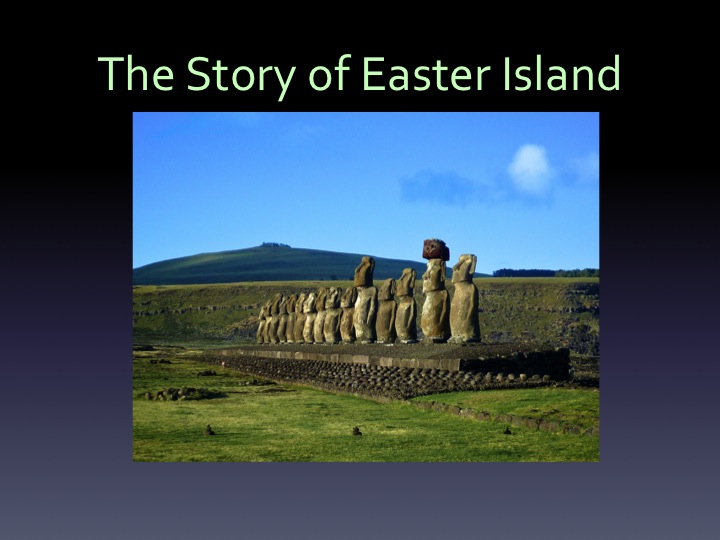
The people of Easter Island had a similar situation about one thousand years ago. After they squandered their natural resources, their ecosystem collapsed–followed closely by their civilization. The humans themselves were nearing extinction when the Dutch explorers discovered their island on Easter Sunday in 1722.

We can learn from those unfortunate souls. Like them, we only have one home. (For more on Easter Island, see my first blog on the list below.)

What can you do? Like I said in a recent post, you can start by getting the “animal out of the equation” in your own diet. You can also become a part of this discussion. You can ask other people to look at the simple arithmetic that any 3rd grader could understand. You can challenge the “leaders” that you know about the unsustainable nature of our lifestyle. You can ask them why no one in power ANYWHERE is talking about this most crucial of all topics. Finally, you can invite me to speak at your company, church, university or club.

Why do I continue to harp on this subject like a relentless drum beat every day? One reason is that I am preparing myself for an upcoming meeting that a colleague and I will soon be having with a very prominent and highly respected leader. We believe that this particular man has the requisite combination of integrity, conviction, courage, resources, leadership skills and popularity–to organize and lead a global coalition aimed at urgently promoting the health of our ecosystem that gives us life. If that meeting is a success, you will hear all about it. Maybe he’ll even be able to get us that meeting with the Pope.

Source Information. Here’s an excerpt from the Wikipedia page mentioned earlier. Below this information is a link to that page and a few links to some of my earlier blogs on the topic of sustainability.

Finding Earth-sized Goldilocks planets is a key part of the Kepler Mission, which uses a space telescope (launched on 7 March 2009 UTC) to survey and compile the characteristics of habitable-zone planets.[3] On 4 November 2013, astronomers reported, based on Kepler space mission data, that there could be as many as 40 billion Earth-sized planets orbiting in the habitable zones of sun-like stars and red dwarf stars within the Milky Way Galaxy.[4][5] 11 billion of these estimated planets may be orbiting sun-like stars.[6] The nearest such planet may be 12 light-years away, according to the scientists.[4][5]

The following five books and one DVD can be purchased on Amazon for a grand total of less than $60—and will enable you to understand the overwhelming challenges we face—along with the single most-powerful solution of all.

Six-Pack from Hicks—for health, hope & harmony on planet Earth

  1. Healthy Eating, Healthy WorldThe “big picture” about food (our book)
  2. A life changer for millions, including James Cameron. Forks Over Knives DVD 
  3. An essential scientific resource: The China Study by Dr. T. Colin Campbell; the primary book that influenced Bill Clinton to adopt a whole food, plant-based diet.
  4. What have we done to our planet? Full Planet, Empty Plates by Lester Brown
  5. A horrifying wake-up call for leaders. TEN BILLION by Dr. Stephen Emmott
  6. Food choices are the primary cause of our environmental problems, yet our world leaders, scientists & experts are Comfortably Unawareby Richard Oppenlander.

Why should we be eating mostly plants? The “big picture” in 4 minutes.

Want to find out how healthy your family is eating? Take our free 4Leaf Survey. It takes 2 or 3 minutes. eCornell is now using our survey in their plant-based nutrition course. Check it out on your smartphone at eCornell.com/4Leaf-Survey.

International. We’re now reaching people in over 100 countries. Follow us on Facebook and Twitter or get daily blog notices by “following” us in the top of the right-hand column. For occasional updates, join our periodic mailing list.

J. Morris Hicks, working daily to promote health, hope and harmony on planet Earth.

To order more of my favorite books—visit our online BookStore now For help in your own quest to take charge of your health, visit our 4Leaf Program and also enjoy some great recipes from Lisa’s 4Leaf Kitchen.

Got a question? Let me hear from you at jmorrishicks@me.com. Or give me a call on my cell at 917-399-9700.

—J. Morris Hicks, board member since 2012; click banner for more info:

Nutrition Certificate

Posted in Activism & Leadership, Sustainability | Tagged | 2 Comments