Top 10 “Zingers”—food choices & the presidential debates

Debate season is full of zingers, gotchas, one-liners & sound-bytes

Lots of zingers, but neither candidate is talking about the most important issues in the world.

With the election only a few weeks away, I thought it was time to share a few of my favorite zingers that I use in explaining the maddening absurdity and unsustainability of our typical western diet.

And while there are references or footnotes for all of my zingers somewhere in our book or on this blog, I choose today to invoke “debate season privilege” and just say whatever I please. (See “Fact Check” note at end)

My Top Ten Zingers — for promoting health, hope & harmony

  1. Harmony. In the past fifty years (a mere blink in the eye of history) we humans have inflicted more damage on the harmony of nature than all previous generations of humans combined for the past 200,000 years.
  2. Water. To produce one kilo of potatoes requires 100 liters of water; whereas to produce one kilo of beef requires 13,000 liters of water.
  3. Earthlings. Only 100 billion people have ever lived. 7 billion are alive today. And we torture and kill 2 billion animals every week for our dinner tables.
  4. World Hunger. For every meat-eater who goes vegan, he/she will free up enough land to feed 3 or 4 families of 4 people each.
  5. Waste. By cycling our grain through animals to produce meat, we waste 90% of the protein, 96% of the calories, 100% of the fiber and 100% of the carbs.
  6. Axis of Evil. George Bush was wrong. The Axis of Evil doesn’t run through Iraq, or Iran or North Korea. It runs through our dining tables. Weapons of Mass Destruction are our knives and forks.
  7. Starving people. 1 billion people today are hungry. 20 million people will die from malnutrition. Cutting meat by only 10% will feed 100 million people. Eliminating meat will end starvation forever.
  8. Needless disease. Meat causes a wide range of cancers, diabetes and heart disease. Can anyone name just one disease caused by a plant-based diet?
  9. Disappearing resources. We humans are squandering our natural resources by over-cutting, over-grazing, over-pumping, over-plowing and over-fishing; a startling 80 percent of oceanic fisheries are being fished at or beyond their sustainable yield.
  10. Intelligent species? There are over 50,000 vertebrate species (5500 of which are mammals) and well over one million species of insects. ALL of them are living in harmony with nature—with one exception. Human beings.

Long after our book came out in October of 2011, I heard an environmentalist make a statement that caught my attention:

“Our food choices determine how the entire planet is used.”

Promoting health, hope and harmony on planet Earth

We must all get busy promoting health, hope and harmony on planet Earth—and the longterm sustainability of the human race.

The Bottom Line. We are now using ALL of this planet as if there were no other creatures sharing it with us. Although our species has existed for only 5/1000th of one percent of the 4 billion years that there has been life on Earth, we have done some serious multiplying in the past few hundred years.

It took us about 200,000 years to reach the one billion mark in 1804. Since then, in just over 200 years (a mini-blink in the eye of history) we’ve added another six billion people.

Now, all seven billion of us are still multiplying and destroying our natural resources at a mind-boggling rate. When will the madness end? Will we have to wait for Mother Nature to have her revenge? Or can we come together and take action now?

That action should include two big steps. Stabilize global population and begin an aggressive return to the natural diet for our species—a whole foods, plant-based diet. The latter step will give us the time needed to get a handle on the former. Who is going to lead this transformation? I have concluded that it has to be the large, profit-motivated corporations of the world.

That’s because they’re the only ones with a financial incentive to reduce the out-of-control cost of healthcare. In the largest of companies, just a handful of CEOs can affect millions of people. And the resulting PR success stories will be heard and copied by hundreds of millions more.

Now, here’s the best part. By taking that step, those big corporations will be providing an integrated environmental blueprint for the rest of the world to follow. Be eating the food that is best for our health, we simultaneously do some wonderful things for the planet—and her ability to provide for the longterm sustainability of the human race.

We can work ourselves out of this mess, but we’ve got to get started in earnest now.

623 Consecutive Daily Blogs (numerals today from the Bayou State)

My #1 priority. Launching healthcare cost reduction programs with every forward-thinking CEO I can find. This week I met with two Fortune 200 firms and mailed a proposal to the Chairman of the 9th largest corporation in the United States. Let me know if you know of any forward-thinking CEOs that you think I should contact.

Fact Check. Just to clarify, all of my ten zingers are true and you can find the sources of all of them in at least one of my 623 blogs. Many of them can be found in these six links, provided here for your convenience:

Handy 4-piece take-charge-of-your-health kit—from Amazon.com

Want to find out how healthy your family is eating? Take our free 4Leaf Diagnostic Survey. It takes less than five minutes and you can score it yourself. After taking the survey, please give me your feedback as it will be helpful in the development of our future 4Leaf app for smartphones. Send feedback to jmorrishicks@me.com

International. We’re now reaching people in over 100 countries. Follow us on Facebook and Twitter or get daily blog notices by “following” us in the top of the right-hand column. For occasional updates, join our periodic mailing list.

To order more of my favorite books—visit our online BookStore now

J. Morris Hicks, working daily to promote health, hope and harmony on planet Earth.

For help in your own quest to take charge of your health, you might find some useful information at our 4Leaf page or some great recipes at Lisa’s 4Leaf Kitchen.

Got a question? Let me hear from you at jmorrishicks@me.com. Or give me a call on my cell at 917-399-9700.

SHARE and rate this post below.

Blogging daily at hpjmh.com…from the seaside village of Stonington, Connecticut – Be well and have a great day.

—J. Morris Hicks, board member, T. Colin Campbell Foundation
Posted in Activism & Leadership, Big Picture | 5 Comments

Vegetarian Broadway star goes back to eating meat.

And gets encouragement from her physician.

Sherie Rene Scott on Broadway

A Word With Sherie Rene Scott—driven by desire back to meat. That was the headline in the New York Times that caught my eye. You don’t often hear about a long-term vegetarian (in her case 26 years) return to eating meat. Her story of how it happened sounds a little bizarre:

I never wanted meat, and then I started to have a sensation, a serious, undeniable, overwhelming hunger for meat that came upon me at 44. I was in the apartment alone, and someone was cooking a brisket down the hall. I left my apartment to go find the door that the smell was coming out of, and I found myself with my nose stuck in the crack of some stranger’s door just so I could smell their brisket.

So poof, just like that. She’s no longer a vegetarian. And guess what, her medical doctor reinforced her decision by saying,

“Female vegetarians over 40 do not get enough iron. It’s eat meat or you get treated for anemia.”

Dr. Caldwell Esselstyn of the Cleveland Clinic has reversed heart disease in nearly 100% of his patients — with diet change only.

Guess her doctor doesn’t know that you can get plenty of iron from plants. Just went to nutritiondata.com when I entered in the first four plant foods that came to mind—and I have all of them every week. Kale, spinach, avocado and walnuts. All four had significant levels of iron. And that’s not all her doctor doesn’t know.

  • He doesn’t know that the strongest animals in the world eat nothing but raw plants; including the gorilla whose DNA is almost identical to humans.
  • He doesn’t know that the animal protein in meat & dairy products is one of the leading causes of cancer.
  • He doesn’t know that the cholesterol and fat in meat leads to coronary artery disease, stroke and other cardiovascular issues.
  • He doesn’t know that Dr. Esselstyn and many other medical doctors have successfully reversed advanced coronary artery disease and type 2 diabetes in thousands of cases–simply by putting them on a whole foods, plant-based diet.
  • Aside from all of the above, he almost certainly doesn’t know that the meat-laden western diet is grossly unsustainable.

The article (see link below) was primarily about her new show, Piece of Meat, that opened on October 16 at 54 Below. Aside from her story about having a sudden craving and then talking with her doctor, the article was primarily about the show itself.

A formula for enrichment in your life

But it got me thinking of more questions about her suddenly reverting back to eating meat after 26 years. It makes me wonder about what kind of vegetarian diet she was really eating. As we know, just being a “vegetarian” doesn’t necessarily mean that you are eating a healthy diet.

In fact, my observation has been just the opposite. Since most vegetarians still drink milk, use cream in their coffee and eat cheese, yogurt, eggs & ice-cream; how could we expect that many of them would be eating a truly health-promoting 4Leaf kind of diet? Most are probably getting nowhere near 80% of their calories from whole plants.

The article did say that she hangs around with the likes of Paul McCartney, so maybe he will influence her to return to the convictions that led her to avoid eating meat for 26 years—all of her adult life. Maybe next time, she’ll learn to eat 4Leaf and will have a much more satisfying and vibrantly healthy experience.

Consecutive Daily Blogs (numerals from the Garden State)

One final question for Sherie Rene and her physician, “How many diseases have ever been reversed by putting someone on a typical western diet with meat and dairy at almost every meal?”

Handy 4-piece take-charge-of-your-health kit—from Amazon.com

Want to find out how healthy your family is eating? Take our free 4Leaf Diagnostic Survey. It takes less than five minutes and you can score it yourself. After taking the survey, please give me your feedback as it will be helpful in the development of our future 4Leaf app for smartphones. Send feedback to jmorrishicks@me.com

International. We’re now reaching people in over 100 countries. Follow us on Facebook and Twitter or get daily blog notices by “following” us in the top of the right-hand column. For occasional updates, join our periodic mailing list.

To order more of my favorite books—visit our online BookStore now

J. Morris Hicks, working daily to promote health, hope and harmony on planet Earth.

For help in your own quest to take charge of your health, you might find some useful information at our 4Leaf page or some great recipes at Lisa’s 4Leaf Kitchen.

Got a question? Let me hear from you at jmorrishicks@me.com. Or give me a call on my cell at 917-399-9700.

SHARE and rate this post below.

Blogging daily at hpjmh.com…from the seaside village of Stonington, Connecticut – Be well and have a great day.

—J. Morris Hicks, board member, T. Colin Campbell Foundation

Posted in Vegan or vegetarian? | 1 Comment

Food in your shopping cart—ends up in your stomach.

Duh. Healthy Cart = Healthy Eating

You can tell a lot about how healthy a person is eating by taking a look at their grocery cart. I find it amusing to check out shopping carts at the supermarket—and observe how it squares with the physical condition of those who push them.

Last Sunday, I had two people comment on my healthy shopping cart before leaving the Big Y Market in Mystic, CT. The first was a local Stonington friend, and the other was the veteran cashier—one of the few to survive the cut when Big Y took over the former A&P.

So, what did I buy? How much was my bill? What was my cost per 100 calories? And what percent of my purchased “calories” were whole plant-based foods?

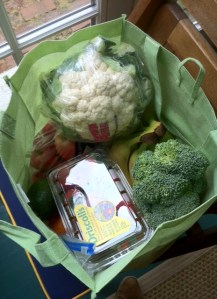
My actual shopping bag (re-usable, of course)

  • $4.99 for 3-lb. bag of 12 Gala Apples (12 x 77 = 924 calories; 24 fat, 12 gr. protein, 48 gr. fiber)
  • $4.00 for two Hess avocados (4 x 227 = 908 calories, 700 fat, 6 gr. protein, 18 gr. fiber)
  • $3.99 for one head of Cauliflower (210 calories; 24 fat, 17 gr. protein, fiber 21 gr.)
  • $1.09 for one broccoli crown (20 calories; 2 fat, 2 gr. protein, fiber 1 gr.)
  • $4.99 for 4-lb. bag of 9 navel oranges (621 calories; 18 fat, 9 gr. protein, 27 gr. fiber)
  • $2.49 for 1.25 pounds of 3 Bosc pears (258 calories; 3 fat, 3 gr. protein, 15 gr. fiber)
  • $3.99 for one pound of strawberries (114 calories; 9 fat, 2 gr. protein, 7 gr. fiber)
  • $1.66 for seven medium bananas (735 calories; 21 fat, 7 gr. protein, 21 gr. fiber)
  • $27.55 Grand total with tax

4Leaf Food Analysis for the entire shopping bag

  • Total calories = 3790
  • Total $$ spent = $27.55
  • Cost per 100 calories = $ .73
  • Total fat calories = 787
  • Percent of calories from fat = 20.7% (89% of my fat calories were from the avocados)
  • Total grams of protein = 58 grams
  • Total grams of fiber = 158 grams (more fiber than most Americans get from whole plants in a month)
  • Total cholesterol, trans fat, etc = ZERO
  • 4Leaf Score = 5Leaf (100% of calories from whole plants)

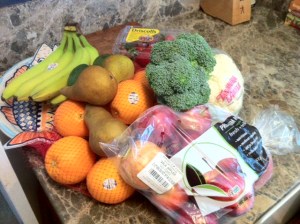
The contents of my entire shopping bag—on the kitchen counter at home

Commentary. This shopping bag represented an average of about a six day supply of the kinds of food purchased. Except for the broccoli, I eat this much every day (see pic).

Since a large portion of my calories come from oatmeal, beans, and legumes which were not purchased on Sunday, my real score (of what I consume daily) is closer to 12% fat, and a great deal more protein and fiber. For fiber, my daily average is over 75 grams.

My actual total consumption also costs much less per calorie. In an earlier blog shown below, I summarized the cost like this:

Let’s assume a hypothetical family of four that requires a combined total of 8,000 calories a day. If all meals were eaten at home, I am confident that we could feed everyone a VERY healthy diet of whole, plant-based foods for an average of forty cents per/100 calories. Food budget = $32/day or around $1,000 per month.

The Bottom Line. It does NOT cost more to eat healthy—for a ton of reasons. See two links below:

Consecutive Daily Blogs (numerals from Lansing, MI)

As for the friend in the store; she said, “I should just follow you around and buy what you buy.” Then, while checking out, the cashier said, “you always buy nothing but healthy food; you can’t imagine what we see working here.”

Finally, I must confess that I am not a 5Leaf eater. After factoring in my beverages, pasta, bread, popcorn and few other items, I routinely score safely in the 4Leaf range with over 80% of my total caloric intake from whole, plant-based foods. And only rarely does an animal product pass my lips…never planned in advance.

Handy 4-piece take-charge-of-your-health kit—from Amazon.com

Want to find out how healthy your family is eating? Take our free 4Leaf Diagnostic Survey. It takes less than five minutes and you can score it yourself. After taking the survey, please give me your feedback as it will be helpful in the development of our future 4Leaf app for smartphones. Send feedback to jmorrishicks@me.com

International. We’re now reaching people in over 100 countries. Follow us on Facebook and Twitter or get daily blog notices by “following” us in the top of the right-hand column. For occasional updates, join our periodic mailing list.

To order more of my favorite books—visit our online BookStore now

J. Morris Hicks, working daily to promote health, hope and harmony on planet Earth.

For help in your own quest to take charge of your health, you might find some useful information at our 4Leaf page or some great recipes at Lisa’s 4Leaf Kitchen.

Got a question? Let me hear from you at jmorrishicks@me.com. Or give me a call on my cell at 917-399-9700.

SHARE and rate this post below.

Blogging daily at hpjmh.com…from the seaside village of Stonington, Connecticut – Be well and have a great day.

—J. Morris Hicks, board member, T. Colin Campbell Foundation

Posted in Cost of Food | 2 Comments